Why Manuscripts From the Islamic Golden Age Are Vital to World History

You've got to appreciate how manuscripts from the Islamic Golden Period have profoundly shaped almost every facet of our modern world. These manuscripts captured groundbreaking advancements in astronomy, chemistry, and medicine, laying the foundation for future scientific exploration. They preserved ancient knowledge, ensuring accessibility for generations and fostering cross-cultural exchanges that enriched global understanding. Innovations in mathematics and philosophy from this epoch continue to influence today's educational and scientific practices. By exploring these manuscripts, you're connecting to a dynamic legacy that still impacts global thought, and there's much more to uncover as you continue your exploration.
Influential Scientific Contributions
When you explore the scientific achievements of the Islamic Golden Period, you'll find that its scholars made groundbreaking contributions across diverse fields. During this time, they excelled in making precise astronomical observations, which laid the foundation for modern astronomy. The renowned astronomer Al-Battani refined the calculation of the solar year and improved upon Ptolemaic models, influencing later European astronomers. You'll also uncover their advancements in chemical practices, as they transformed alchemy into a more systematic science.
Figures like Jabir ibn Hayyan, often dubbed the "father of chemistry," developed experimental techniques and equipment still in use today. His work in distillation, crystallization, and the classification of substances paved the way for modern chemistry. These scholars didn't just observe; they experimented and recorded their findings in manuscripts that became vital references for generations.
Preservation of Ancient Knowledge
Preserving the ancient knowledge of the Islamic Golden Period is fundamental for understanding the progression of science and culture. You might not realize it, but the manuscripts from this time hold invaluable insights into the past, revealing how scholars of the era contributed to fields like mathematics, astronomy, and medicine. These ancient texts aren't just relics; they're living documents that connect us to a time when intellectual curiosity flourished and laid the groundwork for many modern advancements.
Manuscript preservation is a significant task that guarantees these texts remain accessible for future generations. By taking steps to protect and restore these documents, you help maintain an important link to our shared human heritage. This process often involves digitizing manuscripts, repairing physical damage, and creating controlled environments to prevent further deterioration.
The work of preserving these ancient texts is not just about maintaining historical records; it's about keeping alive the spirit of inquiry and innovation that defined the Islamic Golden Period. By safeguarding these manuscripts, you enable ongoing research and exploration, allowing today's scholars to learn from the past and inspire future generations to contribute to the constantly changing tapestry of human knowledge.
Cross-Cultural Intellectual Exchange
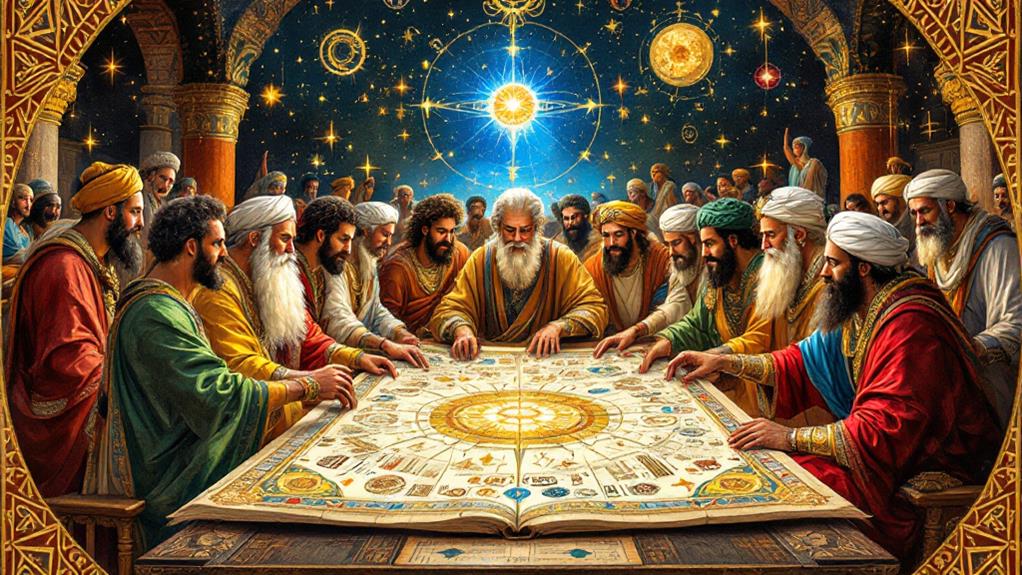
While the preservation of these ancient manuscripts secures a crucial link to the past, their significance extends beyond mere conservation. You'll find that they played a critical role in fostering cross-cultural intellectual exchange during the Islamic Golden Era. These manuscripts acted as mediums for cultural dialogues between Islamic scholars and their counterparts from varied regions, including Greece, India, Persia, and China. The dynamic intellectual environment of the time encouraged scholars to engage with ideas from multiple cultures, leading to profound knowledge transfers.
By translating and incorporating works from different traditions, Islamic scholars didn't just preserve ancient wisdom; they expanded upon it. You'd see how they integrated Greek philosophy with Islamic thought, navigated Indian mathematical concepts, and assimilated Persian literary works. This synthesis of knowledge spurred innovations in mathematics, astronomy, and philosophy.
In today's context, these manuscripts remind you of the power and value of cross-cultural collaboration. The rich tapestry of ideas that emerged from these exchanges underscores how interconnected and interdependent cultures have always been. By valuing varied perspectives, you can foster a global community that thrives on shared knowledge and mutual respect.
Advancements in Medicine
Building on the intellectual exchanges of the Islamic Golden Period, advancements in medicine flourished as scholars translated and improved medical knowledge from distinct cultures. You'd find that physicians like Al-Razi and Ibn Sina played crucial roles in shaping modern medicine. They didn't just translate Greek and Roman texts; they critically analyzed and expanded upon them. Their works, such as "The Canon of Medicine," became authoritative texts for centuries.
Medical ethics was a cornerstone of their approach. The physicians of the time emphasized compassionate care and patient welfare, principles that are still relevant today. They believed that addressing the ethical implications of medical practice was as significant as the science itself.
Herbal remedies were another area where these scholars excelled. They painstakingly documented the properties and uses of assorted plants, many of which are still used in modern pharmacology. By integrating traditional knowledge with new insights, they laid the groundwork for more thorough medical treatments.
Innovations in Mathematics
During the Islamic Golden Age, mathematicians transformed the field with groundbreaking innovations. You've likely heard of algebra, but did you know it was born from this period? The term itself comes from "al-jabr," introduced by the scholar Al-Khwarizmi. His work laid the foundation for algebraic principles that you use today, regardless of if you're solving equations in school or managing finances.
You might also be surprised by the geometric revelations made during this age. Mathematicians like Omar Khayyam tackled complex geometric problems, contributing greatly to what you now know about conic sections and cubic equations. These discoveries weren't just academic—they influenced architecture and engineering, impacting structures that still stand.
To appreciate the innovations in mathematics from this age, consider these three key contributions:
- Algebraic Principles: Pioneers like Al-Khwarizmi developed systematic solutions for linear and quadratic equations, transforming how you approach problem-solving.
- Geometric Discoveries: Contributions to geometry advanced architectural designs and engineering practices.
- Numeral System: The introduction of Arabic numerals streamlined calculations, replacing cumbersome Roman numerals.
These advancements shaped modern mathematics, and their legacy continues to influence numerous fields today.
Development of Philosophical Thought
Philosophical thought during the Islamic Golden Age underwent remarkable evolution, deeply influencing both Western and Eastern intellectual traditions. You see, Islamic Philosophy didn't just confine itself to interpreting religious thought; it expanded into a vast arena of Ethical Theory and Metaphysical Concepts. Scholars like Al-Farabi and Avicenna took Aristotle's works and integrated them with Islamic teachings, advancing rational discourse far beyond what the ancient Greeks imagined.
In this age, you'd find that philosophers grappled with questions about existence and the afterlife, blending religious thought with reason. They asked, "What is the nature of the soul?" and "How do we understand what is right or wrong?" These inquiries weren't just academic exercises; they formed a foundation for Ethical Theory that would guide personal and communal life.
Political Philosophy also saw significant contributions. Thinkers like Al-Mawardi investigated governance, justice, and the role of leadership, which later echoed in European political thought. Through rational discourse, these scholars sought to reconcile divine law with human governance, crafting ideas that still resonate today. By delving into these manuscripts, you're not just uncovering history; you're engaging with a dynamic legacy that shaped global philosophical landscapes.
Impact on Modern Education

The rich philosophical legacy of the Islamic Golden Age doesn't just rest in the past; it plays an essential role in shaping modern education. When you look at today's curriculum, you'll find traces of this age's profound influence. Manuscripts from this period, filled with groundbreaking ideas, have become indispensable educational resources. They're not just dusty old books but important tools for curriculum integration that can breathe life into learning today.
To see their impact firsthand, consider how these manuscripts contribute to education:
- Diverse Perspectives: They offer diverse viewpoints that enrich students' understanding of subjects like mathematics, science, and philosophy. This broadens young minds beyond a single narrative.
- Critical Thinking: These texts encourage a critical examination of ideas, teaching students to question and analyze rather than accept information at face value. It's a skill that's invaluable in any field.
- Cultural Appreciation: By integrating these works into the curriculum, you foster a deeper appreciation for different cultures and histories, promoting inclusivity and understanding among students.
Related posts