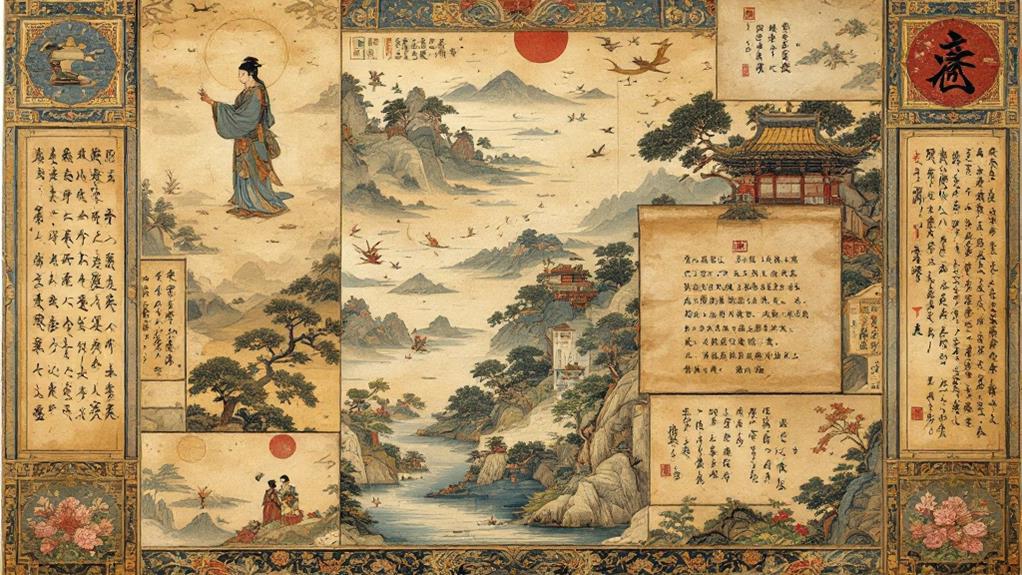
The Artistic and Literary Importance of the Diamond Sutra

You'll find the Diamond Sutra is both an artistic and literary marvel, shaping cultural and spiritual landscapes for centuries. As the oldest known printed book, its exquisite woodblock illustrations and elegant calligraphy blend art with philosophy, enhancing its teachings of impermanence and non-attachment. The Sutra's influence extends beyond Buddhism, impacting global art and literature with its themes of reality and interconnectedness. It's also a reflection of early printing techniques, bridging cultures through translations. Efforts in preservation have kept its wisdom alive, continuing to inspire modern thought and creativity. Uncover more about its enduring significance and rich legacy.
Historical Context of the Diamond Sutra
In the 9th century, the Diamond Sutra emerged as an essential text in the world of East Asian Buddhism. You can trace its origins back to Buddhist history, where it played a significant role in shaping spiritual thought and practice. Its profound ideas on impermanence and the concept of non-attachment resonated deeply with followers, elevating its status among religious texts. The Diamond Sutra's cultural significance extends beyond religious teachings; it's also a representation of the rich tapestry of ancient manuscripts that helped preserve and disseminate Buddhist ideology.
As you investigate the historical context of the Diamond Sutra, you'll find it was more than just a religious document. It was instrumental in the spread of Buddhism across Asia, influencing not only spiritual beliefs but also cultural and philosophical landscapes. This text, translated into multiple languages, became a bridge connecting diverse cultures and peoples. The sutra's preservation in ancient manuscripts highlights its enduring importance, marking a time when religious texts were cherished and carefully copied by hand.
Understanding the Diamond Sutra's historical context enriches your appreciation for its role as a cornerstone of Buddhist history, demonstrating its lasting impact on both spiritual and cultural domains.
Early Printing Techniques
Exploring early printing techniques reveals how the Diamond Sutra became a vital artifact in the history of printing. By understanding block printing, you uncover the intricate process that allowed this ancient text to be mass-produced. Block printing involves carving mirrored images of text onto wooden blocks. Once carved, these blocks are inked and pressed onto paper, creating a printed page. The Diamond Sutra is the oldest known printed book, showing the significance of this method in disseminating spiritual and philosophical ideas.
Effective ink preparation is key to successful block printing. You would need to mix soot, animal glue, and water to create ink that adheres to the wooden block yet transfers clearly to paper. The precision required in this preparation illustrates the skill and care involved in early printing techniques.
Here's how block printing works, broken down into three steps:
- Carving the blocks: You'd carve the text in reverse on a wooden block, a painstaking task demanding precision.
- Preparing the ink: You'd create a balanced ink mixture to guarantee clear impressions.
- Printing: You'd press the inked block onto paper, transferring the text and completing the printed page.
These steps highlight the dedication artisans showed in producing the Diamond Sutra.
Artistic Elements in Woodblock Illustrations

As you've seen with the careful process of block printing, the artistic elements in woodblock illustrations hold a significant role in the creation of the Diamond Sutra. These illustrations are not just decorative; they serve as a form of visual storytelling that complements the text. Each image is carefully carved to convey symbolic imagery, allowing you to engage with the Sutra's deeper meanings visually. This method of storytelling bridges the gap between visual art and the written word, drawing you into the spiritual and philosophical themes presented.
When you examine these illustrations, you'll notice how the artists use symbolism to express complex concepts. Elements like lotus flowers, bodhisattvas, and intricate patterns are more than mere decoration—they're a language of their own, speaking to the enlightenment and wisdom the Sutra aims to impart. The use of space, line work, and contrast in these woodblock prints guides your eye, leading you through the narrative.
Calligraphy and Design Aesthetics
Calligraphy, with its flowing elegance and precision, plays a crucial role in the design aesthetics of the Diamond Sutra. As you investigate the intricacies of this ancient text, you'll notice how its calligraphic techniques raise its visual appeal. The careful strokes and balanced forms aren't just about artistic expression; they embody the profound wisdom within the sutra itself. The artistry of the calligraphy invites you to appreciate the text not only as a literary masterpiece but also as a work of art.
Design symbolism further improves the Diamond Sutra's allure. Each character is crafted with intention, serving as a visual representation of deeper meanings. The interplay between form and function in the calligraphy mirrors the interconnectedness of the text's teachings. This combination of artistry and symbolism offers you a richer, more engaging experience as you investigate the sutra.
Here's why the calligraphy and design are so significant:
- Visual Harmony: The elegant script creates a sense of balance and harmony that mirrors the sutra's themes.
- Symbolic Depth: Each stroke carries symbolic weight, enriching your understanding of the text.
- Aesthetic Appeal: The beauty of the calligraphy improves your engagement with the sutra.
Philosophical Themes Explored

The Diamond Sutra investigates several profound philosophical themes that challenge your perception of reality and self. It invites you to probe into the emptiness concept, urging you to see beyond superficial appearances and understand the transient nature of the material world. In doing so, you learn that what you perceive as reality is often an illusion, prompting deeper insight into your existence.
Through non-attachment practices, the sutra encourages you to let go of clinging to thoughts, emotions, and possessions. This detachment doesn't mean indifference but rather a mindful awareness, fostering peace and clarity. Mindfulness teachings guide you to remain present, cultivating wisdom and compassion ethics in your daily life.
The text also examines duality transcendence, challenging you to transcend the binary oppositions that often dominate your thinking. By understanding the illusion and interconnectedness of all things, you move closer to wisdom cultivation. The sutra emphasizes that true insight arises not from rigid structure but from flexibility and openness.
Ultimately, the Diamond Sutra guides you toward a compassionate and wise existence, rooted in an understanding of the self's illusory nature and the interconnected reality of all beings.
Influence on Buddhist Literature
Investigating the profound philosophical themes of the Diamond Sutra naturally leads to its significant impact on Buddhist literature. As you examine Buddhist narratives, you'll notice how the Diamond Sutra serves as a cornerstone. It offers rich literary symbolism, shaping the way stories are told and understood within the Buddhist tradition. As you read, you'll see how these narratives often revolve around the core teachings of impermanence and emptiness, echoing the Sutra's influence.
Here's how the Diamond Sutra impacts Buddhist literature:
- Narrative Structure: You'll find that many Buddhist texts adopt a dialogue format similar to the Diamond Sutra. This approach engages readers, inviting them to question and investigate deeper meanings, just as the original text does.
- Literary Symbolism: The Sutra's imagery and metaphorical language infuse Buddhist stories with layers of meaning. You might recognize symbols of transient beauty and the illusion of permanence, reflecting the Sutra's teachings.
- Character Development: In Buddhist narratives, characters often undergo transformations that mirror the philosophical insights of the Sutra. As you examine these stories, you'll witness personal paths toward enlightenment, underscored by the Sutra's wisdom.
Cross-Cultural Impact

Throughout history, the Diamond Sutra has transcended its origins to influence cultures beyond Buddhism, weaving its philosophical insights into the fabric of diverse societies. As you investigate its cross-cultural impact, you'll notice how it's fueled cultural exchange and fostered global dialogue. The Sutra's core teachings on impermanence and enlightenment resonate universally, encouraging introspection and ethical living across different cultures.
When you probe into its influence, you'll find that thinkers and artists in the East and West have drawn inspiration from it. In Western literature, its themes have sparked interest in the nature of reality and the self. Meanwhile, Eastern traditions have accepted its philosophical depth, integrating it into broader spiritual practices.
In art, the Diamond Sutra's motifs and teachings have been echoed in multiple mediums, prompting artists worldwide to examine themes of emptiness and form. This cross-pollination of ideas has enriched both artistic and literary landscapes, illustrating the power of cultural exchange.
Preservation and Rediscovery
As you're reflecting on the Diamond Sutra's cross-cultural impact, it's crucial to contemplate how its preservation and reemergence have shaped its enduring relevance. The Diamond Sutra, printed in 868 AD, represents a remarkable feat of cultural preservation. Its survival over a millennium speaks volumes about the dedication to safeguarding religious and philosophical texts. You might wonder how such an ancient document managed to stay relevant and intact over the centuries.
- Cultural Preservation: The careful attention by Buddhist monks and custodians guaranteed the Sutra's survival. By storing it in secure locations like the Mogao Caves, they protected it from natural and human threats.
- Historical Rediscovery: In 1900, a hidden cache of manuscripts, including the Diamond Sutra, was uncovered in the Dunhuang caves by a Taoist monk. This historical reemergence caught the world's attention, providing invaluable insights into early printing and religious practices.
- Global Awareness: Following its reemergence, the Sutra traveled to the British Library, where it remains today. This move increased global awareness and scholarly interest, highlighting its artistic and literary importance.
Legacy in Modern Art and Literature

The Diamond Sutra's influence resonates profoundly in modern art and literature, often inspiring creators to examine themes of impermanence and enlightenment. You see this ancient text's impact in the way artists and writers investigate the fleeting nature of life and the pursuit of wisdom. Modern adaptations capture the essence of the Sutra, reimagining its teachings to fit contemporary narratives. Regardless of it being through visual art, poetry, or prose, the Diamond Sutra provides a foundation for meaningful inquiry.
In artistic reinterpretations, you encounter pieces that challenge traditional perceptions and adopt the Sutra's core teachings. Artists use mixed media, digital platforms, and groundbreaking techniques to convey the delicate balance between existence and void. Literature, too, reflects this transformation. Authors weave the Sutra's themes into their stories, offering fresh perspectives on timeless questions.
When you engage with these modern adaptations, you're invited to reflect on your own understanding of change and awareness. The Diamond Sutra's legacy persists, urging you to question what is truly permanent. By adopting this timeless wisdom, modern creators guarantee the Sutra continues to inspire and provoke thought, bridging the gap between past and present.
Related posts