The Art of Translation and Transcription in Historical Folios

You're diving into the art of translation and transcription in historical folios, where balancing language and culture is crucial. You'll need to understand historical contexts to interpret ancient scripts accurately, as regional dialects and symbols hold unique meanings. Preserving original intent requires collaboration and a keen insight into cultural nuances. Modern tools and technology, including digital archives and AI, assist in bridging linguistic gaps and preserving fragile documents. You also face challenges with damaged manuscripts and evolving language trends. As you investigate further, you'll uncover how these elements contribute to unraveling the mysteries of the past.
Understanding Historical Contexts
Investigate the past, and you'll quickly realize that understanding historical contexts is fundamental when dealing with historical folios. When you delve into these ancient documents, cultural nuances play an instrumental role in shaping your understanding. Every historical period has its own unique backdrop, influenced by social norms, political climates, and technological advancements. These elements aren't just background noise; they actively shape the meanings and interpretations of the texts you encounter.
In addition to cultural nuances, linguistic evolution is another vital aspect you need to grasp. Languages aren't static; they evolve over time, and words can shift in meaning. When you examine historical folios, you're not just translating words—you're deciphering a linguistic code. This requires a keen awareness of how language has transformed over centuries. Understanding these shifts guarantees that you don't misinterpret the original intent of the authors.
Navigating Archaic Dialects
While historical contexts provide the backdrop for understanding ancient documents, the challenge intensifies when you encounter archaic dialects. These dialects not only reflect the language of a specific period but also showcase the regional variations that have evolved over time. To navigate these linguistic mazes, you need to grasp how archaic vocabulary and dialect evolution influence the text's meaning and nuances.
First, consider recognizing archaic vocabulary. Words that seem familiar might have entirely different meanings in their original context. For example, "gay" once meant "joyful" rather than its modern connotations. Understanding these shifts is key to accurate translation.
Second, analyze dialect evolution. Language is dynamic, and dialects evolve as people migrate and cultures interact. By studying how dialects have changed, you can better interpret the phonetic and semantic shifts that occur over time.
Third, identify regional influences. Dialects often incorporate local expressions and idioms, which can be perplexing. Delving into regional histories can provide insights into these unique linguistic features, enhancing your comprehension of the text.
Deciphering Ancient Symbols

In relation to deciphering ancient symbols, a keen eye and analytical mind are essential. You've got to approach ancient scripts like a detective, piecing together clues hidden in intricate designs. Each symbol holds potential meanings, and symbolic interpretations can vary widely based on cultural and historical context. It's not just about recognizing the shapes; it's about understanding the story they tell.
To effectively decipher these symbols, you've got to engage deeply with the culture that created them. Look beyond the obvious and investigate the nuances of their symbolic interpretations. This might involve comparing symbols across different artifacts or texts to identify common themes or deviations. Ancient scripts often contain layers of meaning, so it's significant to reflect on how a symbol fits within the larger narrative of the script.
Tools such as digital databases and software can assist you in analyzing these symbols, but your intuition plays a fundamental role too. Keep questioning and reevaluating your interpretations as new information comes to light. By honing your skills and keeping an open mind, you'll reveal the secrets hidden within these ancient symbols, bringing the past to life in a way that connects today.
Preserving Original Intent
When delving into the preservation of original intent, you're tasked with the challenge of not just translating words, but also capturing the essence and nuances of the original message. It's vital to find a balance between a literal interpretation and the artistic expression that breathes life into historical texts. This process requires a keen understanding of both language and culture, in addition to the subtle interplay between them.
To effectively preserve original intent, consider the following:
- Contextual Understanding: Engage deeply in the historical and cultural context of the folio. This aids in grasping the subtleties that a literal interpretation might miss. Understanding the author's world allows you to convey their true intent.
- Balancing Literal and Artistic Expression: Literal translation can sometimes strip away the emotional depth or cultural references. Aim for a translation that maintains the message's integrity while allowing for artistic expression to capture its spirit.
- Collaborative Approach: Engage with historians, linguists, and cultural experts. Their insights can guide your interpretation, ensuring that your work remains faithful to both the text and its original context.
Challenges in Damaged Manuscripts
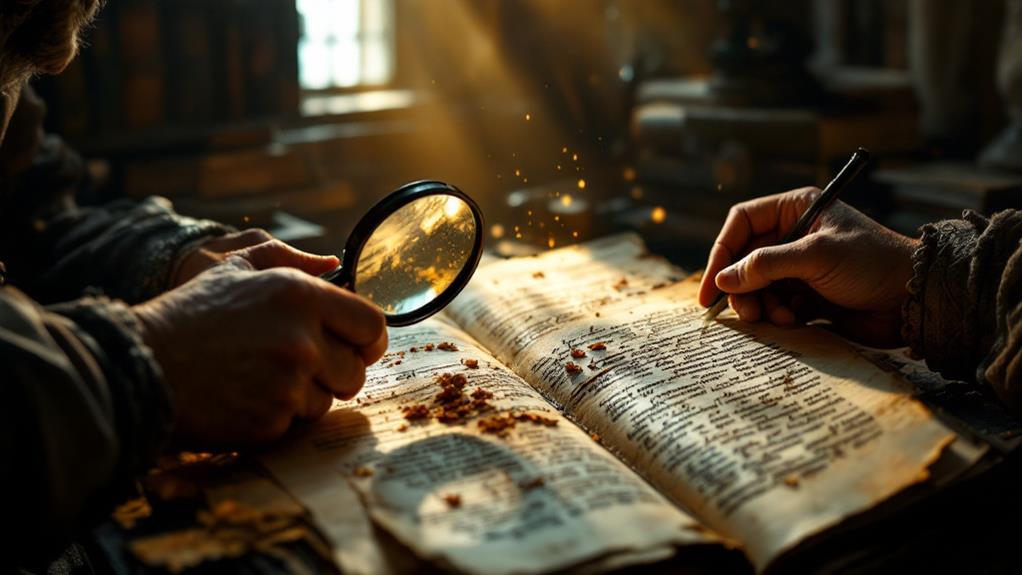
Preserving original intent often becomes even more complex when dealing with damaged manuscripts. You face challenges from manuscript deterioration caused by both material degradation and physical damage. Environmental factors like humidity and temperature fluctuations can accelerate this process, making archival preservation vital. As a conservator, you must employ precise restoration techniques to stabilize these fragile documents without compromising their authenticity.
Your initial step might be ink analysis, which helps you understand the composition and period of the writing materials. This knowledge guides you in selecting suitable conservation methods that won't further harm the manuscript. Physical damage, such as tears and missing sections, requires careful handling and possibly reconstruction, ensuring you don't erase historical context.
Conservation isn't just about fixing what's broken; it's about understanding how these manuscripts lived through time. You need to take into account all environmental factors that contributed to their current state. This insight aids in developing strategies to slow down deterioration. Archival preservation involves using controlled environments and special storage materials to extend the life of these documents.
In tackling these challenges, you're not just preserving a manuscript. You're safeguarding a piece of history, ensuring its stories endure for future generations.
Balancing Language and Culture
Amid the intricate task of translating and transcribing historical folios, you often find yourself at the intersection of language and culture. Your role involves not just converting words from one language to another, but also capturing the cultural nuances embedded in the text. Each historical document you encounter is a tapestry woven with linguistic diversity, reflecting the period's traditions, beliefs, and societal norms. Successfully balancing language and culture requires a keen understanding of both.
To effectively manage this balance, consider the following:
- Understand Context: Comprehending the historical and cultural context of the time is crucial. It helps you grasp the subtleties that may not be immediately apparent in the text.
- Embrace Linguistic Diversity: Recognize that linguistic diversity is not just a challenge but an opportunity to enrich your understanding of the source material. Each language carries unique expressions and idioms that convey deeper meanings.
- Preserve Cultural Nuances: While translating, aim to preserve the original cultural nuances as much as possible. This may involve creative solutions to guarantee the translated work connects with modern readers while staying true to its origins.
Tools for Modern Translation

As you navigate the intricate balance of language and culture in historical folios, modern translation tools become invaluable allies. They not only bridge linguistic gaps but also guarantee cultural nuances are preserved. Digital glossaries, for instance, are invaluable as they provide immediate access to specific terminologies and context-specific meanings that are vital when dealing with historical texts. You can easily cross-reference terms, guaranteeing your translation is both accurate and culturally sensitive.
Collaborative platforms further improve the translation process by allowing multiple experts to work together seamlessly. These platforms encourage real-time collaboration, where you can share insights, ask questions, and provide feedback instantly. This collaborative approach not only speeds up the translation process but also enriches the final output with diverse perspectives.
Moreover, integrating different tools into your workflow can streamline your tasks. For example, combining digital glossaries with collaborative platforms allows for a more dynamic and informed translation process. You'll find that these tools are fundamental for maintaining the integrity of the original texts while making them accessible to modern audiences. Embracing these resources guarantees you're not just translating words but also conveying the essence of historical narratives.
The Role of Technology
Technology's impact on the study and translation of historical folios is nothing short of transformative. With the advent of digital archives, you can now access a vast array of historical texts from anywhere in the world, eliminating the need to travel to specific libraries or institutions. This accessibility not only democratizes knowledge but also speeds up the research process. Machine learning algorithms further improve this experience by analyzing and translating texts more quickly and accurately than ever before.
Consider these three ways technology is reshaping your approach to historical folios:
- Digital Archives: You can browse thousands of documents online, preserving fragile originals while allowing global access. It's a game-changer for researchers and historians.
- Machine Learning: These algorithms can identify patterns and translate ancient languages, reducing human error and enhancing the accuracy of translations.
- Collaboration Tools: Platforms and software enable you to work with other scholars in real-time, sharing insights and findings instantly.
Case Studies in Transcription

Transcription often serves as the fundamental initial step in understanding historical folios, and several case studies highlight its significance. Imagine you've stumbled upon an ancient manuscript filled with manuscript variations. To make sense of it, you'd need to employ paleographic techniques to decipher the handwriting styles and dated scripts. These techniques allow you to accurately transcribe the text, preserving its original meaning and context.
Take, for instance, the transcription of medieval texts. By analyzing different script styles and variations, you can reveal significant insights into cultural and historical contexts. In one notable case, a team of researchers used paleographic techniques to transcribe a collection of letters from the Renaissance period. They unearthed variations in spelling and grammar that revealed shifts in language usage over time. This transcription work not only revealed the content of the letters but also provided a glimpse into the evolution of language itself.
Another case study focuses on the transcription of religious texts with diverse manuscript variations. By painstakingly transcribing these documents, you can identify inconsistencies or alterations made by scribes. This process helps you understand how religious teachings were interpreted and transmitted across generations. These insights are invaluable for historians and scholars alike.
Future of Historical Translations
In the future of historical translations, advances in technology promise to revolutionize the way we interpret ancient texts. You'll find that the integration of artificial intelligence and machine learning will play a crucial role. These tools can analyze languages faster than any human, identifying patterns and offering insights into linguistic evolution. This has the potential to uncover meanings lost over centuries, shedding light on the cultural significance of historical documents.
Consider these exciting developments:
- AI-Powered Translation Tools: These will not only speed up the translation process but also improve accuracy by learning from vast databases of historical languages and dialects.
- Virtual Reality Experiences: Imagine stepping into a virtual library where you can interact with ancient texts in their original form. This engaging experience will help you understand the cultural context in which these works were created.
- Collaborative Platforms: Online spaces will allow scholars from around the world to work together in real-time, ensuring diverse perspectives contribute to a more thorough understanding of historical documents.
Related posts