Scientific Knowledge in Folios: Historical Medical and Scientific Texts
You're exploring a fascinating world where historical folios, like medieval herbals and Renaissance breakthroughs, laid the groundwork for modern science and medicine. Herbalists carefully documented plant properties, forming a legacy of community wisdom. During the Renaissance, figures like Nicolaus Copernicus and Andreas Vesalius challenged traditional thought, transforming astronomy and anatomy. Illuminated manuscripts, rich in decorative detail, preserved this knowledge beautifully, linking past sciences with future innovations. As these texts traveled, cultural exchanges enriched collective insights, fostering a tapestry of shared scientific thought. There's much more to uncover about how these ancient texts continue to shape our present understanding.
Medieval Herbals and Remedies
Medieval herbals, fascinating windows into the past, were significant resources for healing and wellness. As you engage with these ancient texts, you'll uncover a world where medieval medicinal plants played essential roles. Herbalists in the medieval time period were the go-to experts for health concerns. They carefully documented the properties of diverse plants, believing each had unique healing powers. Imagine yourself as one of these herbalists, wandering through fields and forests, gathering plants like sage, chamomile, and yarrow, each chosen for its specific benefits.
In medieval herbalist practices, understanding the natural world was fundamental. You'd learn to identify plants by sight, smell, and sometimes taste, gaining insights into their potential uses. These practices were often passed down through generations and shared within communities, forming a rich tapestry of knowledge. For instance, a sprig of rosemary wasn't just for flavor; it was believed to improve memory and concentration.
As you investigate these texts, you'll appreciate how medieval herbals combined observation and tradition. They were more than mere collections of recipes; they were extensive guides that informed and influenced the health and wellness of entire communities, shaping a foundational understanding of plant-based remedies.
Renaissance Scientific Breakthroughs
The Renaissance age marked a profound shift in scientific thinking, igniting breakthroughs that transformed the understanding of the natural world. You'd find that this period introduced you to a new perspective on how the universe operates. For instance, the heliocentric theory, championed by Nicolaus Copernicus, altered astronomy by positioning the Sun, not Earth, at the center of the universe. This challenged long-held geocentric beliefs and set the stage for future astronomers like Galileo to further investigate celestial mechanics.
At the same time, anatomical revelations were reshaping medicine. Pioneers like Andreas Vesalius took human dissection to new heights, carefully documenting the human body in his groundbreaking work, "De humani corporis fabrica." You'd be amazed at how Vesalius corrected numerous misconceptions about human anatomy that had persisted since the time of Galen. His detailed illustrations provided a more accurate understanding of the body's structure, paving the way for modern medicine.
These Renaissance breakthroughs didn't just improve scientific knowledge; they changed how society viewed its place in the cosmos and the intricacies of the human form. You'd witness a world where curiosity and empirical evidence began to overthrow tradition and dogma.
Illuminated Manuscripts and Their Impact
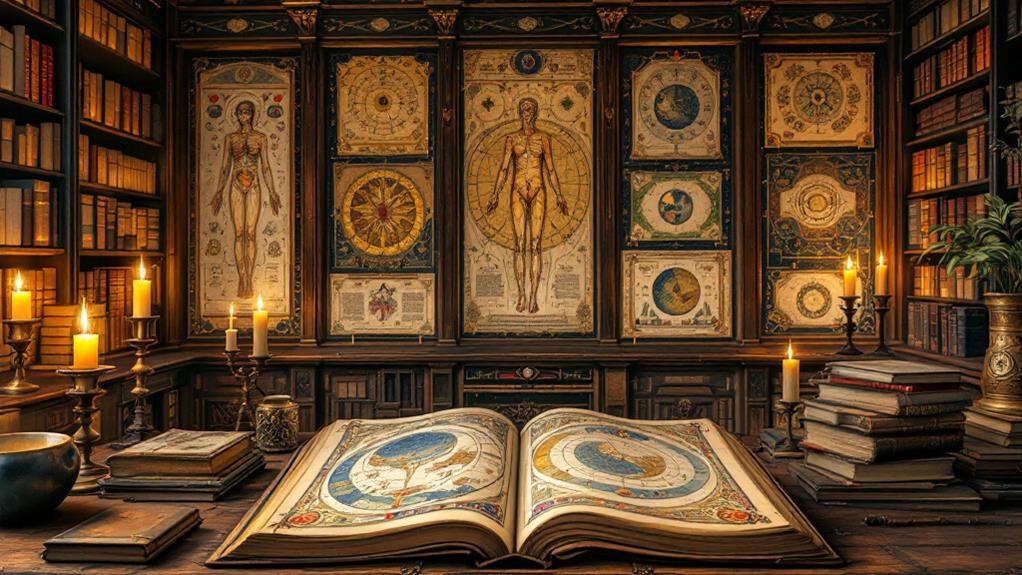
Amidst the lively tapestry of history, illuminated manuscripts stand out as masterpieces that captured the essence of a period. If you've ever wondered how knowledge was both preserved and passed down through generations, these manuscripts hold the key. Their radiant illustrations and intricate decorations aren't just for show; they employ artistic techniques that make each page a visual feast. These techniques were crucial not only for manuscript preservation but also for enhancing the understanding of the text itself.
As you turn the pages, you'll notice that the use of gold and silver leaf, alongside rich pigments, brought scenes to life, making the content more engaging and memorable. Such embellishments required skilled artisans who knew how to blend art with knowledge. The manuscripts became a hoard of scientific and medical information, ensuring that this crucial knowledge survived through the centuries. You'll find that their impact extends beyond mere decoration; they laid the groundwork for modern scientific illustration.
In a world without digital storage, illuminated manuscripts were the bridge between past and future, preserving the wisdom of their time. Their legacy remains evident in the way we visualize and record knowledge today.
Cross-Cultural Exchanges in Knowledge
Throughout history, diverse cultures have engaged in lively exchanges that enriched their collective knowledge. You see this in the way ancient texts traveled across regions, bringing new insights into medicine, astronomy, and philosophy. These cross-cultural exchanges were essential for cultural diffusion, allowing ideas to spread and evolve. Take the Silk Road, for instance—more than just a trade route, it was a conduit for exchanging scientific and medical texts. When scholars translated these works, they didn't just preserve knowledge; they adapted it, adding their own insights and innovations.
Imagine yourself in a vibrant ancient marketplace, where a merchant reveals manuscripts filled with groundbreaking ideas. As these manuscripts circulate, they bridge cultural gaps and foster understanding. You'd notice how this knowledge preservation guaranteed that even when empires fell, their wisdom didn't vanish. Instead, it got woven into the fabric of other societies.
In your exploration of historical texts, you'll find that these exchanges weren't one-way streets. Cultures absorbed what worked, discarded what didn't, and in doing so, cultivated a rich tapestry of scientific thought. Engaging with these texts today, you're participating in a tradition of shared learning that transcends time and borders.
Legacy of Ancient Texts in Modern Science
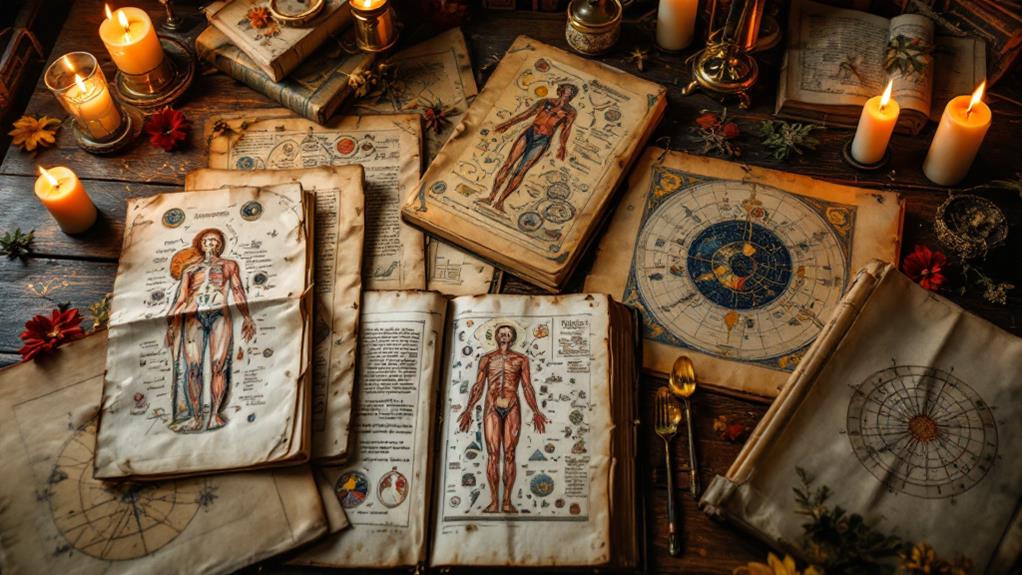
Although ancient texts may seem like relics of the past, they play a significant role in shaping modern science. You might not realize it, but many scientific principles you encounter today have roots in ancient philosophies. These early texts, once hidden in the dusty corners of history, continue to influence contemporary thought. Through text translations, ancient knowledge has traversed time and space, enriching modern understanding.
Consider how ancient Greek and Roman works contributed to foundational scientific concepts. The works of Hippocrates and Galen laid the groundwork for modern medicine. Their observations and theories, once painstakingly translated, became vital study material for generations of physicians. You see, text translations made it possible for these ancient philosophies to reach beyond their original cultures, spreading their insights globally.
Moreover, the legacy of ancient texts isn't limited to medicine. The mathematical innovations of the Egyptians and Babylonians continue to shape fields like astronomy and engineering. As you explore the modern scientific landscape, it's important to appreciate how these long-standing texts inform today's cutting-edge research and innovations. Ancient philosophies, brought to life through translations, have a timeless impact that still echoes in the scientific community.
Related posts