How Ancient Folios Preserved Early Scientific and Medical Knowledge
You'll find that ancient folios effectively preserved early scientific and medical knowledge through countless careful practices. Civilizations like the Egyptians and Chinese used materials like papyrus and parchment, valued for their durability. Scribes played a vital role in ensuring accurate transcription, while climate-controlled storage combated deterioration. Documented texts, such as Euclid's "Elements" and Aristotle's "Physics," expanded across cultures via trade routes, preserving and evolving fundamental knowledge. These folios acted as time capsules, bridging ancient wisdom with modern thought. There's much more to uncover about how these manuscripts shaped today's scientific and medical landscapes.
Origins of Ancient Manuscripts
The origins of ancient manuscripts take you on a voyage through time, revealing the beginnings of written communication and human expression. As you investigate this fascinating expedition, you'll see how cultural influences shaped the evolution of manuscripts. Early societies, like the Egyptians, Mesopotamians, and Chinese, each contributed unique elements to written forms. The Egyptians developed hieroglyphics, while Mesopotamians crafted cuneiform on clay tablets. The Chinese innovations in writing, especially with the invention of paper, were pivotal in manuscript evolution.
With each culture, you'll notice how writing styles and materials adapted to meet the specific needs and influences of their environments. For instance, the Greeks and Romans borrowed from earlier scripts, eventually refining their own alphabets. This borrowing and adaptation process was vital in the evolution of manuscripts, as knowledge and ideas traveled along trade routes, allowing cultures to influence one another.
As time progressed, the manuscript evolution reflected an increasing desire to document, preserve, and communicate complex thoughts, religious texts, and scientific observations. This progression reveals not just a timeline of technological advancement, but also a tapestry of cultural influences that shaped human thought and expression across the eras.
Materials Used in Folio Creation
Exploring the creation of ancient manuscripts naturally leads to a curiosity about the materials used in folio creation. Understanding these materials is essential to appreciating how early scientific and medical knowledge was documented and preserved. You'll find that different civilizations chose unique mediums based on availability and purpose.
- Papyrus Sheets: Originating in Egypt, papyrus was one of the earliest writing materials. Made from the papyrus plant, these sheets were lightweight and convenient for writing. Their ease of production and use made them ideal for recording daily transactions and scholarly work.
- Parchment Types: As you investigate the domain of parchment, you'll uncover it was crafted from animal skins, typically sheep, goats, or calves. Unlike papyrus, parchment offered greater durability and a smoother writing surface. Different types of parchment were employed, each chosen for specific qualities like thickness and color.
- Other Materials: Besides papyrus and parchment, other materials like bamboo, silk, and palm leaves were utilized in numerous regions. While not as commonly associated with scientific texts, these materials played a significant role in preserving knowledge across diverse cultures.
Techniques of Manuscript Preservation

Preservation methods are vital in safeguarding ancient manuscripts for future generations. You play an important role in making certain that these invaluable pieces of history endure. For ink preservation, you must control environmental factors like light and humidity. Direct sunlight can cause fading, while high humidity encourages mold growth. By storing manuscripts in climate-controlled rooms, you help maintain the lively ink colors that convey early scientific and medical knowledge.
Parchment longevity is another significant aspect of preservation. Parchments, made from animal skins, can deteriorate over time if not cared for properly. You should store them flat, avoiding folds that can cause cracks or tears. Make sure they're kept in acid-free folders or boxes to prevent chemical reactions that might degrade the material. Regular inspections for signs of wear or damage can help you catch issues early, allowing for timely intervention.
Key Scientific Texts Documented
Understanding the importance of preservation leads naturally to appreciating the scientific texts themselves. These ancient folios serve as time capsules, revealing the intellectual endeavors of early scholars. By examining them, you can uncover the historical significance of their contributions to science. Here's a closer look at three key scientific texts documented in these ancient works:
- Euclid's Elements: This mathematical masterpiece has shaped geometry's foundation for centuries. Through textual analysis, you can see how its logical structure influenced mathematical thought and education across cultures.
- Ptolemy's Almagest: As one of the most influential astronomical texts, its historical significance lies in its thorough star catalog and geocentric model of the universe. Analyzing this text helps you understand early astronomical theories and their impact on later scientific advancements.
- Aristotle's Physics: This work investigates the natural world and its phenomena. It's crucial in understanding ancient perspectives on physics and motion. Textual analysis of Aristotle's writings reveals the evolution of scientific inquiry over time.
Medical Knowledge in Early Folios
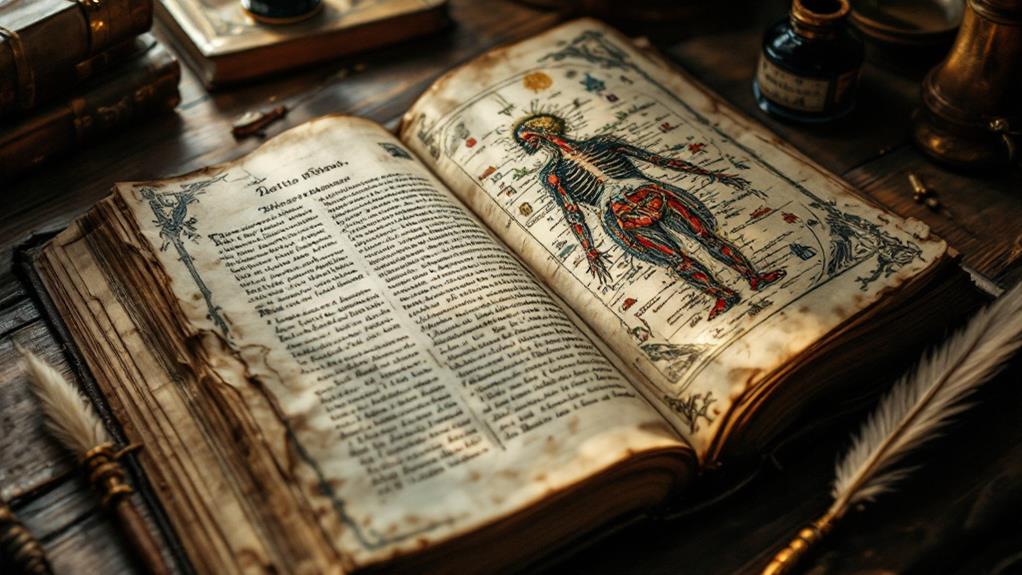
In examining medical knowledge in early folios, you uncover a fascinating glimpse into the evolution of healthcare practices and beliefs. These documents reveal how ancient civilizations tackled health issues using a mix of intuition, observation, and trial and error. You'll find that ancient remedies often relied on the natural world. Medicinal herbs were at the heart of these early treatments, showcasing a deep understanding of plant properties long before modern science.
As you explore these folios, you'll notice that many of the remedies were multifaceted, addressing not just the physical ailment but also attempting to balance the body's natural energies or humors. This holistic approach is a reflection of the early belief systems that intertwined health with spiritual and environmental harmony.
The folios also highlight the importance of documentation and sharing knowledge across generations and cultures. They served as both medical guides and historical records, preserving the evolution of medical thought. By studying these texts, you gain insight into how our ancestors' understanding of health laid the groundwork for modern medicine. Their reliance on medicinal herbs and ancient remedies continues to influence today's alternative medicine practices.
Role of Scribes and Scholars
Among the ancient folios, scribes and scholars played a significant role in the preservation and dissemination of knowledge. You might imagine scribes hunched over desks, carefully copying texts by hand. These scribal practices were fundamental in guaranteeing that important scientific and medical information survived through the eras. Without their diligent work, much of what we understand today could have been lost to time.
Scholars, on the other hand, contributed by forming scholarly communities that fostered intellectual exploration. These communities weren't just about gathering knowledge—they actively engaged in discussions, debates, and collaborations to expand on existing ideas. Their work was often shared within their circles, leading to the refinement and improvement of the information contained in the folios.
Here's how scribes and scholars impacted the preservation of knowledge:
- Careful Copying: Scribes guaranteed accuracy in transcribing texts, maintaining the integrity of the original information.
- Intellectual Collaboration: Scholars collaborated within their communities, exchanging ideas and refining knowledge.
- Knowledge Dissemination: Both scribes and scholars facilitated the spread of information, guaranteeing it reached wider audiences.
Transmission Across Cultures
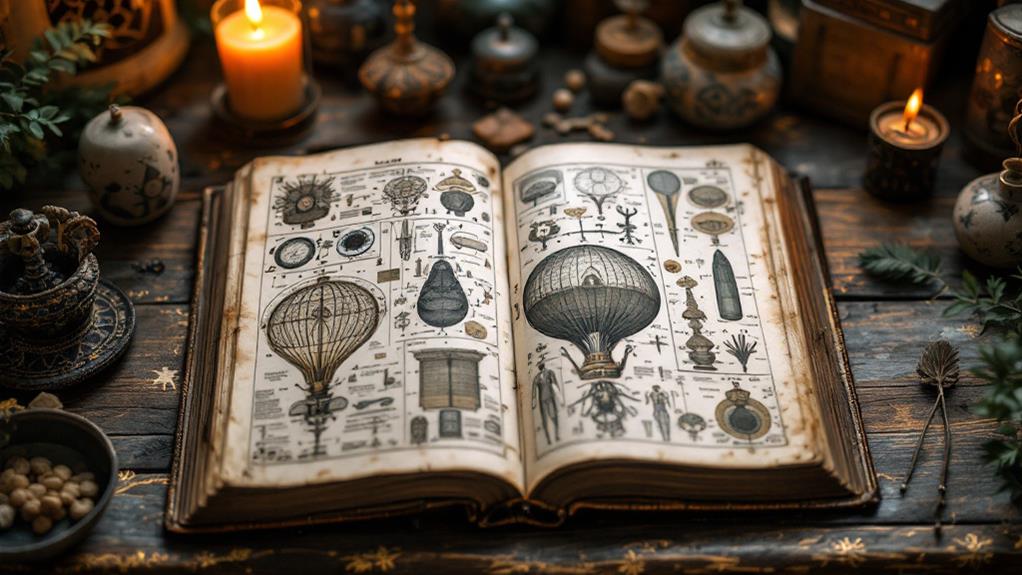
Imagine knowledge as a vast river flowing through time, with each culture acting as a tributary that adds to its depth and breadth. As you immerse yourself in the history of ancient folios, you'll uncover how cultural exchanges played an essential role in the transmission of scientific and medical knowledge across borders. Through trade routes, conquests, and pilgrimages, diverse civilizations shared their insights, allowing knowledge diffusion to thrive. This exchange wasn't just about passing on information; it was a dynamic process where ideas were adapted and enriched by each culture they encountered.
Consider the ancient Silk Road, a lively network connecting East and West, where merchants and scholars didn't just exchange goods but also ideas. You'd find Persian, Indian, Chinese, and Greco-Roman thinkers influencing each other, creating a colorful tapestry of shared wisdom. Manuscripts traveled alongside traders, with translators and scholars ensuring that new concepts were accessible to different audiences. As a result, ancient folios became repositories of collective human understanding, preserving invaluable insights that might have otherwise been lost. This cross-cultural transmission underscores the interconnectedness of human progress, highlighting how diverse societies contributed to a shared legacy of knowledge.
Impact on Future Generations
As you reflect on the lively exchanges of ancient cultures, consider how these interactions have shaped the knowledge and innovations we benefit from today. Ancient folios served as vessels of intergenerational knowledge, guaranteeing the survival of scientific and medical wisdom across centuries. They acted as bridges, allowing cultural continuity to thrive even as societies evolved. These documents provided a foundation for subsequent revelations, influencing countless generations.
You might wonder how exactly these ancient folios impact future generations. Here's a brief look:
- Preservation of Core Knowledge: Ancient texts captured fundamental understanding of the natural world and human health, forming the basis of contemporary science and medicine.
- Inspirational Legacy: These folios inspire future generations to investigate, question, and innovate, driven by the curiosity and dedication of those who came before.
- Cultural Transmission: They maintain cultural continuity by passing down traditions, beliefs, and practices, fostering a shared cultural heritage that informs community identities today.
Modern Discoveries of Ancient Folios

Uncovering ancient folios in modern times has revealed a wealth of forgotten knowledge, shining a light on the intellectual achievements of our ancestors. Imagine stumbling upon a dusty, forgotten manuscript that contains insights into early scientific methods or medical practices. These revelations have been crucial in reshaping our understanding of history and the progression of human thought. You'd be amazed at how ancient translations of these texts have revealed secrets from periods long past, allowing scholars to connect the dots between ancient theories and modern science.
As you explore these manuscripts, you'll notice the intricate manuscript illustrations that accompany many of them. These aren't just decorative; they serve as essential visual aids that clarify complex concepts and highlight the sophistication of early thinkers. They provide a tangible connection to the past, offering a glimpse into how knowledge was shared and preserved.
In today's world, technology plays a significant role in exposing these gems. With advanced imaging and analysis tools, we're able to decode and preserve these fragile works for future generations. Every revelation enriches our collective knowledge, showing how the past continues to inform our present and future.
Related posts