Why Historical Folios Are Essential to Museum Collections

Incorporating historical folios into museum collections lets you preserve cultural heritage and provide a window into the past. These folios offer unique insights into historical events, societal norms, and artistic techniques, bridging the gap between past and present. By following careful preservation methods, such as controlled environments and digital archiving, you guarantee these valuable documents remain accessible for future generations. Historical folios support scholarly research and enrich educational programs, encouraging deeper connections with history. By exploring these aspects, you'll uncover how vital folios are in shaping our understanding of history and culture's evolution over time.
Preserving Authentic Historical Records
Preserving authentic historical records is essential for maintaining the integrity and accessibility of our cultural heritage. When you think about it, the past is more than just dates and events; it's a tapestry woven with stories, documents, and artifacts that shape our collective identity. To protect this heritage, you must employ effective archival methods. These methods include organizing, cataloging, and storing records in controlled environments that prevent deterioration. Temperature, humidity, and light levels need to be carefully monitored to guarantee these materials remain intact for future generations.
In today's technological era, you're also responsible for incorporating digital preservation into your strategy. This involves creating high-quality digital copies of original documents. By doing this, you not only improve accessibility but also safeguard the information against physical damage or loss. Digital preservation assures that even if the original records are compromised, you'll have a reliable backup.
However, digital preservation isn't just about scanning documents. It requires regular updates to file formats and storage media to keep up with technological advancements. By combining traditional archival methods with digital preservation, you create a robust system that honors the past while preparing for the future.
Offering Unique Cultural Insights
At the heart of understanding our cultural heritage lies the ability to offer unique insights through historical folios. When you encounter these folios in museum collections, you're not just looking at old documents or illustrations; you're engaging with cultural narratives that have shaped societies over centuries. These folios serve as windows into the past, allowing you to see how people once lived, thought, and expressed themselves.
Visual storytelling plays an essential role in this process. Through detailed illustrations and carefully crafted texts, historical folios weave stories that transcend time. They provide you with a unique perspective on historical events, social norms, and artistic styles that have influenced today's cultural landscapes. By studying these artifacts, you gain a deeper appreciation for the diversity and complexity of human experiences.
Folios also challenge you to question your assumptions about the past. They reveal the interconnectedness of cultures and highlight the ways in which people have shared ideas across borders. Museums, by preserving and showcasing these folios, offer you a chance to explore the rich tapestry of human history, encouraging you to reflect on your own cultural identity and heritage.
Supporting Scholarly Research

When you investigate the domain of historical folios in museum collections, you're stepping into a world that greatly improves scholarly research. These folios are invaluable for academics seeking to understand the past because they offer direct access to primary sources. By digitizing these collections, museums create digital archives that make these resources more accessible to researchers worldwide. This digital transformation allows scholars to examine these materials without physical boundaries, fostering a global exchange of ideas.
Historical folios support scholarly research in multiple ways:
- Preservation of Primary Sources: Safeguard original documents for future generations while still allowing today's researchers to access their content.
- Facilitating Interdisciplinary Collaboration: Encourage collaboration across different fields, such as history, art, and literature, leading to a richer understanding of cultural contexts.
- Improving Data Accessibility: Provide a vast range of information readily available to scholars, promoting more thorough studies.
- Enabling Comparative Studies: Allow researchers to compare works across different cultures and time periods, offering fresh perspectives.
Enhancing Educational Programs
Museums are transforming educational programs by integrating historical folios into their curricula. As you investigate these institutions, you'll notice how they use these folios to create interactive exhibits that captivate and educate visitors of all generations. Imagine walking through a museum and encountering an exhibit where you're not just passively observing but actively engaging with the material. Historical folios provide a tangible connection to the past, allowing you to delve into history in a more engaging way.
Incorporating these folios into educational programs improves community engagement by fostering a deeper connection between you and the museum's offerings. As a visitor, you're not just a spectator; you become part of a broader dialogue about history and its impact on today's world. Museums encourage you to ask questions, share insights, and participate in discussions that bring history to life.
Bridging Past and Present
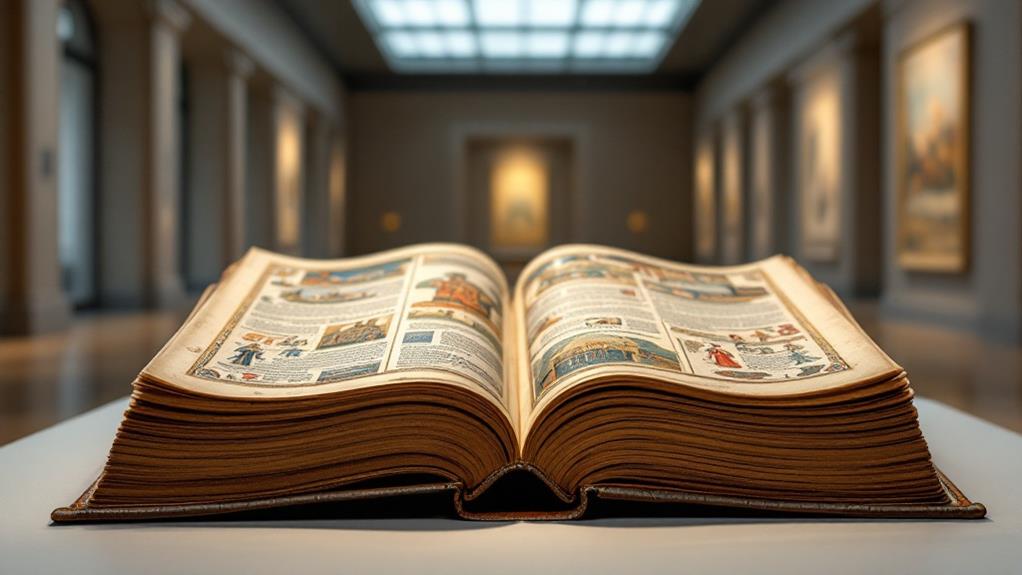
Throughout history, museums have served as custodians of the past, yet their role has evolved to bridge the gap between historical events and current times. You play a part in this evolution by exploring the cultural continuity that historical folios offer. These folios are more than relics; they're keys to understanding a world that once was while illuminating the present. They create temporal connections, allowing you to see how past decisions influence today's societal norms and cultural practices.
When you engage with these folios, consider:
- Cultural Narratives: They provide insight into the stories and customs of different periods, fostering a deeper appreciation for diversity.
- Historical Contexts: You gain a clearer perspective on how past events shape contemporary issues, helping you learn from history.
- Personal Reflection: Reflecting on historical documents encourages you to contemplate your place within this continuum.
- Community Dialogue: They spark discussions about shared history, bridging generational and cultural divides.
Showcasing Artistic Techniques
You'll find that historical folios in museum collections are not just windows into the past but also showcases of exquisite artistic techniques. These folios allow you to investigate the artistic evolution of different cultures and periods. Each piece tells its own story, capturing the unique essence and style of its time. As you study these works, you'll notice how artists experimented with forms, colors, and materials, leaving a visual storytelling legacy for future generations.
Imagine examining a centuries-old manuscript. You're not just looking at a collection of pages; you're witnessing an artist's expedition. The brushstrokes, the interplay of light and shadow, and the intricate details all reveal how techniques developed over time. These folios serve as a proof of the ingenuity and creativity of artists who pushed boundaries and contributed to the artistic evolution witnessed today.
Through these historical artifacts, you gain insights into the methods and materials that defined different artistic periods. It's like having a front-row seat to the creative process, allowing you to appreciate the mastery and dedication that went into each work. With each folio, you're invited to commence a visual storytelling adventure, connecting with artists across time.
Ensuring Longevity of Knowledge
Preserving knowledge across generations hinges on the careful attention and conservation of historical folios. As a curator or museum enthusiast, you understand the importance of maintaining these valuables. Guaranteeing the longevity of knowledge requires implementing effective archival strategies and embracing digital preservation. You can take several steps to assure the survival of these invaluable documents.
- Digitize collections: Transform physical folios into digital formats. This not only protects the originals but also makes the content accessible to a broader audience.
- Controlled environments: Store folios in temperature- and humidity-controlled spaces to prevent deterioration. Regular checks ascertain the conditions remain ideal.
- Use acid-free materials: When handling and storing folios, use acid-free folders and boxes. This prevents chemical reactions that can damage delicate paper.
- Regular assessments: Schedule routine evaluations to check for any signs of wear or damage. Early detection means quicker intervention and better preservation.
Related posts