
Treasures of the Islamic Golden Age: Manuscripts That Shaped Knowledge

Investigate the riches of the Islamic Golden Period that shaped today's knowledge landscape. Manuscripts from this timeframe include Al-Khwarizmi's groundbreaking work on algebra, defining new mathematical approaches, and Avicenna's "Canon of Medicine," which integrated numerous medical traditions. The House of Wisdom in Baghdad served as a key intellectual hub, propelling interdisciplinary collaboration. Scholars like Al-Biruni and Ibn Al-Haytham advanced astronomy and optics, respectively, transforming scientific thought. Andalusian scholars bridged cultures by translating Greek texts into Arabic and Latin, enriching European knowledge. Immerse yourself in the fascinating synthesis and scholarly innovations that altered understanding across different fields.
The House of Wisdom's Legacy
When you think of the House of Wisdom, imagine a guiding light of knowledge that illuminated the Islamic Golden Age. You find it situated in Baghdad, serving as a hub for Manuscript Preservation and Knowledge Exchange. This center wasn't just a library; it was a dynamic space where Cultural Syncretism flourished. Scholars from diverse backgrounds gathered here, contributing to a lively Scientific Collaboration that propelled the Islamic world to the forefront of intellectual thought.
The Translation Movement thrived within these walls, as texts from Greek, Persian, and Indian traditions were carefully translated into Arabic. This effort wasn't merely about converting words; it was about blending ideas and fostering an unparalleled Intellectual Flourishing. You'd see the Scholarly Networks that formed as scholars exchanged insights and debated groundbreaking concepts, ensuring that the House of Wisdom remained a guiding light of learning.
Al-Khwarizmi's Algebra Revolution
Al-Khwarizmi's groundbreaking work in algebra represents a pivotal moment in the history of mathematics. When you explore his contributions, you'll see how he transformed the field by moving away from geometric solutions to equations, which was the norm, and instead introduced a systematic, analytical approach. Al-Khwarizmi's influence stretched beyond his immediate environment, shaping the development of algebra in Europe and the Islamic world alike. His book, "Kitab al-Mukhtasar fi Hisab al-Jabr wal-Muqabala," is where the term "algebra" originates.
In the historical context of the Islamic Golden Era, a period marked by flourishing scholarship and innovation, al-Khwarizmi's work stood out. At a time when the House of Wisdom in Baghdad was a hub of intellectual activity, al-Khwarizmi thrived, drawing from Greek, Indian, and Persian sources. He didn't just translate and preserve knowledge; he expanded it. His methods provided a framework that future mathematicians built upon, influencing mathematical thought for centuries.
Avicenna's Canon of Medicine
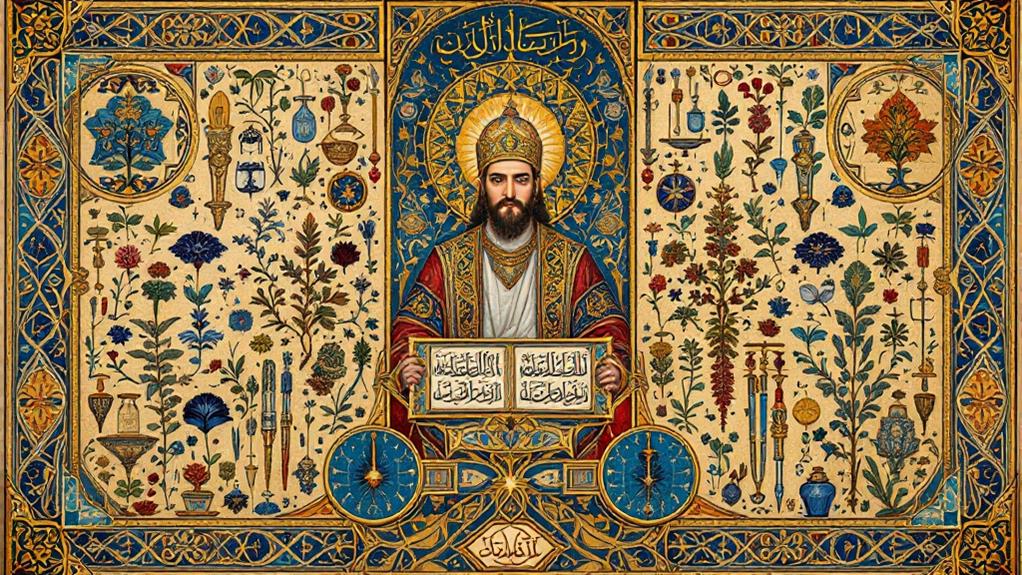
Among the most influential works of the Islamic Golden Age, Avicenna's "Canon of Medicine" stands as a monumental text in the history of medicine. When you investigate this masterpiece, you uncover Avicenna's influence on both ancient and modern medical practices. Written in the 11th century, it combines the medical knowledge of the Greeks, Romans, Persians, and Indians, reflecting an integrative approach that was revolutionary for its time.
You'll notice Avicenna didn't just focus on diagnosing diseases; he emphasized medical ethics, ensuring that healers practiced with integrity and compassion. This ethical foundation continues to resonate in the present medical training. The "Canon of Medicine" also examines healing practices like herbal remedies and dietary regulations, showcasing a holistic understanding of health.
Moreover, Avicenna's philosophical foundations underpin his medical theories, blending Aristotle's logic with Islamic thought to create a thorough medical system. This historical context highlights how Avicenna bridged cultures and knowledge, influencing both Eastern and Western medicine for centuries.
Al-Biruni's Astronomical Insights
Al-Biruni's astronomical insights illuminate the vast expanse of the cosmos with remarkable precision and depth. As you investigate his work, you'll find that he didn't just observe the stars; he painstakingly measured them. His celestial measurements were groundbreaking for his time, providing accurate data that many later astronomers would rely on. Al-Biruni's approach was systematic, involving detailed observations and calculations that mapped the heavens with unprecedented accuracy.
You'll also appreciate how Al-Biruni's work was not confined to a single culture. He actively engaged in cultural exchanges, drawing on knowledge from different civilizations, including Greek, Indian, and Persian sources. This synthesis of ideas allowed him to refine his astronomical models and contribute to a more thorough understanding of the universe. His openness to diverse intellectual traditions exemplifies the spirit of inquiry and collaboration that defined the Islamic Golden Era.
When you probe into Al-Biruni's manuscripts, you're not just witnessing astronomical progress; you're engaging with the legacy of a scholar who bridged cultural divides to improve human understanding of the stars. His work remains a reflection of the power of curiosity and collaboration in advancing scientific knowledge.
Ibn Al-Haytham's Optical Innovations

In the domain of optics, Ibn Al-Haytham stands as a pioneering figure whose innovations laid the groundwork for modern vision science. As you investigate his contributions, you'll uncover how he transformed the understanding of light refraction and visual perception. He didn't just accept the prevailing theories of his time; instead, he questioned them and conducted experiments to seek the truth. His most notable work, the "Book of Optics," introduced revolutionary ideas that challenged Greek theories on sight.
Ibn Al-Haytham proposed that vision occurs when light enters the eye, contrasting the notion that eyes emit rays to see objects. This insight fundamentally shifted how you understand visual perception. He carefully studied light refraction, observing how it bends as it passes through different mediums. His experiments with lenses and prisms paved the way for future developments in optical devices, like cameras and telescopes.
The Philosophical Works of Al-Farabi
You might not be familiar with all the influential figures of the Islamic Golden Age, but Al-Farabi's philosophical contributions are indispensable. Often called the "Second Teacher" after Aristotle, Al-Farabi played a crucial role in shaping medieval thought. His works laid the foundation for future scholars by bridging Greek philosophy and Islamic tradition.
In Al-Farabi's metaphysics, he investigates the nature of existence and the hierarchy of beings. He proposed a structured cosmology where everything emanates from a singular, ultimate source. This framework not only influenced Islamic philosophy but also resonated with medieval European scholars. By emphasizing reason and intellect, Al-Farabi provided a rational understanding of the divine and the universe.
Al-Farabi's ethics offered insights into human behavior and governance. He believed in the pursuit of happiness through virtuous living, emphasizing the importance of a just society. His work, "Al-Madina al-Fadila" (The Virtuous City), examines the idea of a utopian state led by philosopher-kings. Al-Farabi argued that true happiness is achieved through moral and intellectual perfection, a concept that influenced both Eastern and Western thought. His philosophical legacy continues to inspire those investigating the intersections of ethics, reason, and society.
Impact of Andalusian Scholars

The brilliance of Andalusian scholars reshaped intellectual landscapes across both the Islamic world and medieval Europe. You can see the Andalusian contributions in numerous fields such as science, philosophy, and medicine. These scholars weren't just isolated thinkers; they were part of a dynamic cultural exchange that bridged varied worlds. Here's how they made a lasting impact:
- Translation of Greek Texts: Andalusian scholars played a crucial role in translating Greek philosophical and scientific texts into Arabic and later into Latin, making these works accessible to European scholars.
- Development in Medicine: Figures like Ibn Zuhr and Averroes improved medical knowledge, and their works were used in European universities for centuries.
- Philosophical Advancements: The integration of Aristotelian philosophy with Islamic thought by scholars such as Averroes greatly influenced both Islamic and Christian medieval philosophy.
- Astronomy and Mathematics: Innovations in these fields were fostered through the works of scholars like Al-Zarqali, whose astronomical tables were used as references for years.
Related posts