
Tracing Modern Ideas to Their Roots in Historical Folios

You might be surprised how closely modern ideas in governance, technology, and social justice are tied to historical folios. Ancient Greek principles laid the groundwork for democratic systems with citizen participation and equality. The Enlightenment period pushed rational thought and individual rights, influencing modern political philosophies. Renaissance thinkers sparked a scientific revolution that shaped today's inquiry methods. The Industrial Revolution transformed production, impacting today's economics. Social movements draw from past grassroots efforts and civil rights struggles. Even literature has preserved cultural identities and shaped societal values. As you investigate further, you'll uncover how these historical foundations continue to influence today.
Ancient Greek Democratic Principles
One can trace many modern democratic principles back to the ancient Greeks, who pioneered a system that empowered citizens to participate directly in governance. Imagine yourself in ancient Athens, where citizen participation wasn't just encouraged but was a fundamental aspect of daily life. Here, political equality meant that every citizen had a voice, fostering a sense of civic responsibility. You'd find yourself in lively ancient assemblies, where public debate was the norm, and everyone had the right to speak on matters affecting the community.
The Greeks established legal frameworks that laid the groundwork for what we recognize today as voting rights. They believed in the philosophical foundations of democracy, arguing that governance should reflect the will of the people. These ideas weren't just theoretical; they were lived experiences for the citizens who gathered to discuss, debate, and decide on public policies.
Renaissance Influence on Science
Building upon the intellectual resurgence of the Renaissance, the age profoundly transformed scientific thought and inquiry. You see this transformation in how scholars began to question ancient beliefs and pursue knowledge grounded in observation and experimentation. This period marked the beginning of the scientific method, a systematic approach that replaced reliance on authority and speculation. As a result, you start seeing thinkers like Galileo and Copernicus challenging established views about the universe.
The Renaissance wasn't just about scientific advancements; it was also a time of humanism resurgence. This philosophy placed human experience and rationality at the forefront, encouraging you to investigate the natural world and seek explanations rooted in reason. The blend of humanism and science created an environment where curiosity thrived, leading to groundbreaking revelations in anatomy, astronomy, and physics.
Enlightenment and Modern Philosophy

The Enlightenment, often hailed as the Age of Reason, brought a seismic shift in modern philosophy and intellectual thought. You're stepping into a world where rational thought became the backbone of understanding the universe. Thinkers like John Locke and Jean-Jacques Rousseau introduced groundbreaking ideas about individual rights and social contracts, which still influence political philosophy today. They argued that governments should be based on the consent of the governed, fostering the development of democratic societies.
During this timeframe, the revival of humanism emphasized the potential and value of individuals, encouraging you to examine long-held traditions and beliefs. Ethical frameworks evolved, urging society to reflect on morality through reasoned discourse rather than dogma. Philosophers like Immanuel Kant stressed the importance of using empirical evidence to guide decisions, promoting a world where knowledge is built on observation and experimentation.
This age also saw the birth of new political philosophies that prioritized freedom, equality, and justice. By engaging with these ideas, you're participating in a legacy that values critical thinking and the pursuit of knowledge. The Enlightenment didn't just change the world; it laid the groundwork for modern society, empowering you to think independently and shape your own destiny.
Industrial Revolution's Lasting Impact
As the Enlightenment sowed the seeds of rational thought and individual empowerment, a whirlwind of technological advancement and economic change followed, heralding the Industrial Revolution. You're probably familiar with this period as a monumental shift in how goods were produced and lives were transformed. Factory labor became the backbone of this transformation, fundamentally altering the daily lives of countless individuals. People flocked from rural areas to cities, spurring massive urban migration and changing the landscape of society forever.
The Industrial Revolution's impact is vast and still echoes today. Consider these enduring effects:
- Technological Advancements: The mechanization of industries laid the groundwork for modern manufacturing and innovation.
- Economic Growth: New industries and markets emerged, driving unprecedented economic expansion.
- Urbanization: As cities grew, they became hubs of cultural and economic activity, influencing lifestyles worldwide.
- Labor Movements: The harsh realities of factory labor led to the rise of labor unions and worker rights campaigns.
Reflect on how these changes continue to influence your world. The conveniences you enjoy and the urban environments you navigate owe much to this period. The Industrial Revolution reshaped societies, economies, and cultures, leaving a lasting legacy that still shapes your daily life.
Classical Economics Foundations

Many of the principles that guide today's economic systems can be traced back to the foundations of classical economics. You can see how value theory plays an essential role in understanding how goods and services are priced. This theory helps you grasp market dynamics and how they influence supply and demand. Classical economists also emphasized the labor theory, which suggests that the value of a product is determined by the labor invested in it.
Economic cycles, another significant concept, help you anticipate periods of expansion and contraction within economies. By understanding these cycles, you can better navigate the complexities of trade networks and their impact on global commerce. These networks are crucial for distributing wealth and fostering economic growth across different regions.
Policy implications stemming from classical economics often highlight the importance of fiscal responsibility. By managing resources wisely, governments can guarantee stable economic environments. You're also encouraged to examine wealth distribution, a topic extensively debated by classical economists, to understand how economic policies can affect different segments of society.
In essence, classical economics provides you with a foundational framework for analyzing and interpreting the intricate workings of modern economic systems.
The Evolution of Modern Medicine
Innovation in healthcare has continually reshaped the landscape of modern medicine, with each breakthrough offering new hope and possibilities. You're part of a world where medical ethics guide the integration of traditional remedies and cutting-edge treatments. Embracing holistic healing has become vital, as it considers the entire person, not just symptoms. Patient-centered care is at the forefront, guaranteeing that medical professionals prioritize your needs and preferences.
Modern medicine's evolution includes significant advancements:
- Surgical Advancements: From minimally invasive techniques to robotic-assisted surgeries, these innovations reduce recovery times and improve outcomes.
- Diagnostic Techniques: Precise diagnostic methods, like MRI and genetic testing, allow for early detection and personalized treatment plans.
- Pharmaceutical Developments: New drugs and therapies target diseases more effectively, improving your quality of life.
- Public Health Initiatives: Vaccination programs and awareness campaigns guarantee communities stay informed and protected against outbreaks.
As you navigate this constantly changing field, keep in mind that while technology plays a vital role, traditional remedies still hold value in certain contexts. Balancing these elements with a focus on medical ethics guarantees that the future of medicine remains both creative and compassionate.
Historical Roots of Social Movements
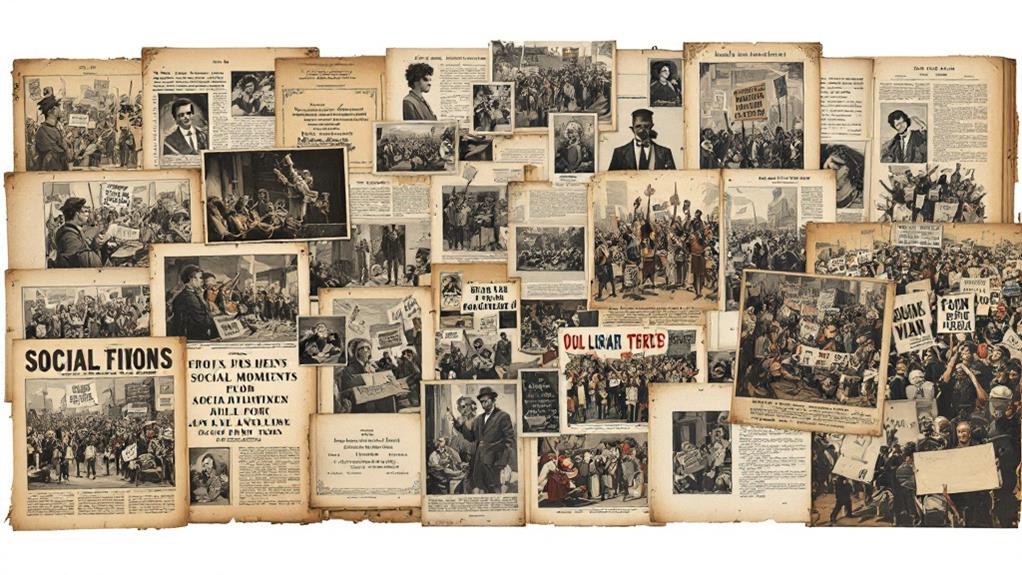
Just as modern medicine has evolved through the integration of traditional and creative practices, social movements have deep historical roots that shape their present-day dynamics. When you look at civil rights, for instance, you find a lineage of struggle against racial injustice that stretches back centuries. These movements are built on the efforts of countless individuals who dared to demand equality and justice. In a similar manner, feminist movements have been fighting for gender equality for generations, echoing the voices of women who sought the right to vote, work, and live free from discrimination.
Labor rights movements have their roots in the Industrial Revolution, when workers began to unite for fair wages and conditions. In environmental activism, you can trace the lineage of today's efforts to ancient practices of respecting and preserving nature, often championed by indigenous communities asserting their sovereignty. Anti-colonial struggles around the globe have inspired contemporary movements for social justice, emphasizing the importance of autonomy and cultural identity.
LGBTQ+ rights have progressed from secretive gatherings to global pride parades, symbolizing the ongoing expedition toward acceptance and equality. Each of these movements is part of a tapestry woven through history, continually evolving and inspiring change.
Literary Works Shaping Culture
Literature has always been a powerful force in shaping culture and influencing societal values. When you immerse yourself in literary works, you're not just reading stories; you're exploring the depths of human experience and understanding. Through poetic traditions and narrative structures, authors craft worlds that reflect and challenge the norms of their time. Think about how classic novels and poems continue to resonate and inspire change.
Consider these ways literature influences culture:
- Moral Lessons: Books often embed moral lessons, encouraging you to reflect on your values and ethics.
- Social Commentary: Many literary works address societal issues, urging readers to question and contemplate changes in their world.
- Cultural Identity: Literature preserves and promotes cultural identity, offering insights into diverse traditions and customs.
- Empathy and Understanding: By presenting unique perspectives, literature fosters empathy and understanding among diverse groups.
When you engage with literature, you're not just entertained; you're participating in a dialogue that spans generations. Stories from the past, crafted with rich poetic traditions and complex narrative structures, continue to shape modern thought and culture. Literature is a timeless adventure that connects the past to the present, challenging you to see the world anew.
Technological Innovations Through History

Throughout history, technological innovations have profoundly transformed societies and molded human progress. You can't overlook how the information era has reshaped the way you interact with the world. Digital communication now connects people across continents instantaneously, a leap from sending letters by ship. This transformation is just one part of a larger tapestry of inventions that continue to influence your daily life.
Consider the role of sustainable technologies and renewable energy. As you endeavor for a more eco-friendly future, these innovations offer solutions for reducing your carbon footprint. Wind turbines and solar panels are now common sights, driven by the necessity for sustainable living. Meanwhile, artificial intelligence is transforming industries, from healthcare to finance, by automating processes and providing insights previously unimaginable.
Space exploration has advanced your understanding of the universe, pushing the boundaries of what's possible and inspiring dreams of interplanetary travel. In biotechnology, advancements have paved the way for breakthroughs in medicine and agriculture, improving quality of life. Quantum computing promises to solve complex problems beyond the reach of classical computers, opening new frontiers. Each of these innovations draws from historical roots, demonstrating how humanity builds upon past achievements.
Related posts