The Impact of the Medieval Church on Manuscript Production
You're looking at a time when the Medieval Church had a major impact on manuscript production. It was the driving force behind education, providing church schools and libraries that fostered literacy and learning. Monastic scriptoria became centers for creating and preserving illuminated manuscripts. The Church's support guaranteed high-quality materials and skilled scribes flourished under patronage. Theological themes colored the texts, while the art of illumination added spiritual depth. Bookbinding techniques guaranteed durability, safeguarding classical works for generations. Through these efforts, the Church shaped cultural narratives across Europe. There's much more going on beneath the surface of this fascinating period.
The Church's Role in Education
The medieval Church played an important role in shaping education during the Middle Ages. You'd find that church schools were at the center of educational activities, mainly focusing on clergy training. These schools developed an education curriculum that emphasized scriptural studies and theological education. By attending church schools, students—often future clergy—improved literacy rates within the religious community. This was significant during a time when most people couldn't read or write.
In these institutions, you'd learn to read and write using manuscript notation, a key skill for interpreting religious texts. The curriculum often included Latin, as it was the Church's official language, and understanding it was essential for studying scriptures and theological texts. Monastic libraries, which housed a wealth of knowledge, supported these educational endeavors by providing access to religious and philosophical works.
You'd notice that the Church's influence extended beyond just teaching scriptures. It shaped how education was structured across Europe, creating a uniform approach to learning. By fostering educational development, the Church made certain that its teachings were preserved and disseminated effectively, maintaining its authority and influence during the medieval period.
Monastic Scriptoria and Manuscripts
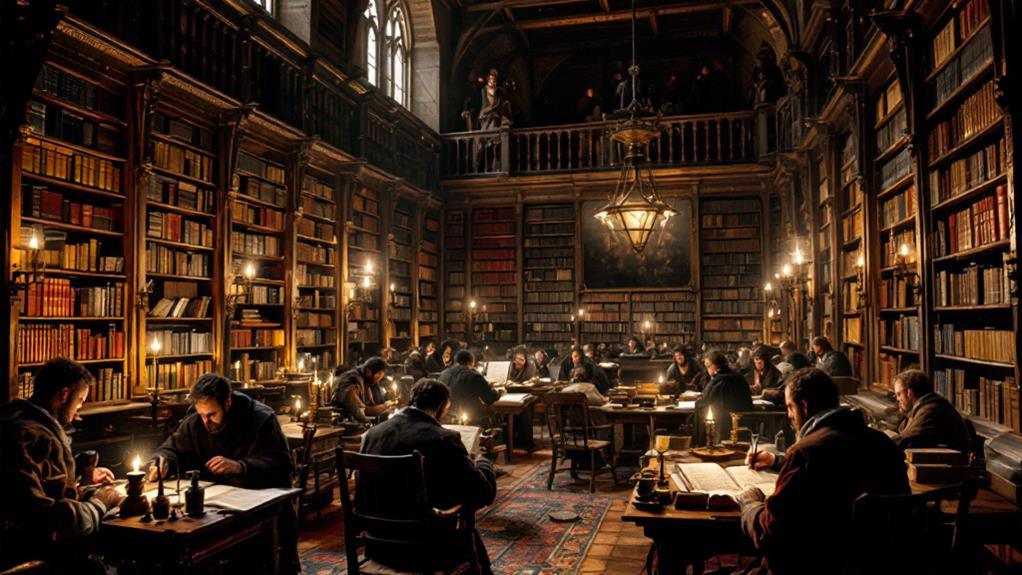
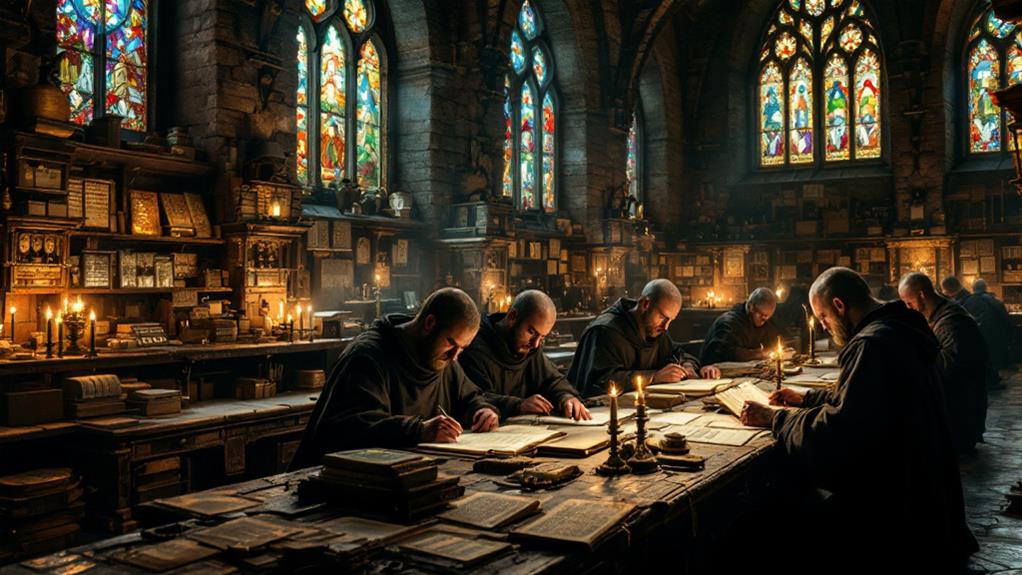
Church schools laid the groundwork for education, and monastic scriptoria played a significant role in manuscript production during the medieval period. When you think about these scriptoria, imagine lively centers of learning and writing within monastic communities. These spaces weren't just rooms; they were carefully designed with scriptorium architecture in mind, ensuring ideal light and space for the monks' delicate work of copying texts by hand.
In these monastic communities, every member had a role. As a monk, you'd wake early, dedicate yourself to prayer, and then head to the scriptorium. Your task was to copy religious texts, classical works, or even create illuminated manuscripts. The quiet hum of quills on parchment filled the room, each stroke contributing to the preservation and dissemination of knowledge.
The architecture of the scriptoria was vital. Large windows allowed natural light to flood the room, reducing eye strain for the monks. The layout promoted concentration and efficiency, making it easier for you to focus on your work. It's fascinating how these dedicated spaces in monastic communities became the backbone of manuscript production, ensuring that knowledge was carefully preserved for future generations.
Patronage and Resource Allocation
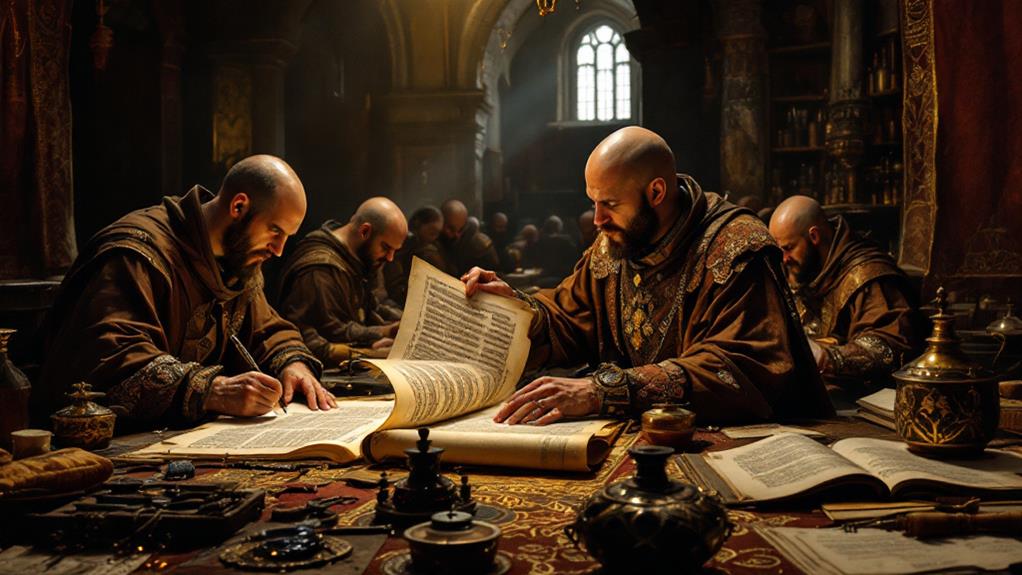
During the medieval period, patronage played a significant role in manuscript production. You'd find that clergy involvement was often central to this process, with bishops and abbots commissioning manuscripts to reflect their religious and political aspirations. Manuscript commissions weren't solely the domain of the church, though; wealthy lay patrons also provided financial support. This funding was critical for securing high-quality materials like parchment and ink, which were sourced from diverse regions, leading to notable regional variations in manuscripts.
In terms of skill development, workshops were lively hubs where scribes and illustrators honed their craft. Artistic collaborations flourished as artisans worked closely with patrons to guarantee the final product met specific aesthetic and thematic requirements. These workshop practices were fundamental for translating the patrons' visions into tangible manuscripts, showcasing the intricate artistry and textual accuracy demanded by the period.
Understanding the allocation of resources, you'd notice how it influenced the quality and content of manuscripts. Patrons drove the artistic direction and resource distribution, directly impacting the manuscript's style and production techniques. With the support of patrons, manuscripts became not only religious texts but also symbols of power and prestige.
Theological Themes in Texts
Manuscript production in the medieval period wasn't just about aesthetics and patronage; it served as a vehicle for expressing theological themes that shaped medieval thought. As you investigate these manuscripts, you'll find they reflect a tapestry of doctrinal interpretations and theological debates. The church wielded ecclesiastical authority to guide these texts, ensuring alignment with its core beliefs and addressing doctrinal controversies.
Within these texts, you'll encounter:
- Liturgical texts that offer spiritual guidance and moral teachings, providing frameworks for religious practices.
- Scriptural exegesis aimed at unraveling complex biblical passages, enriching believers' understanding.
- Hagiographical literature that recounts saints' lives, using religious symbolism to inspire piety and devotion.
- Records of theological debates, showcasing the dynamic discourse that challenged and refined medieval theology.
These manuscripts weren't mere records; they were instruments of ideological influence, embedding moral teachings and spiritual guidance into the fabric of society. The church's role was vital, as it curated these themes to reinforce its doctrinal interpretations. As you investigate these texts, you'll see how they reflect the complexity and depth of medieval religious thought, offering insight into the period's spiritual landscape.
Art of Illumination
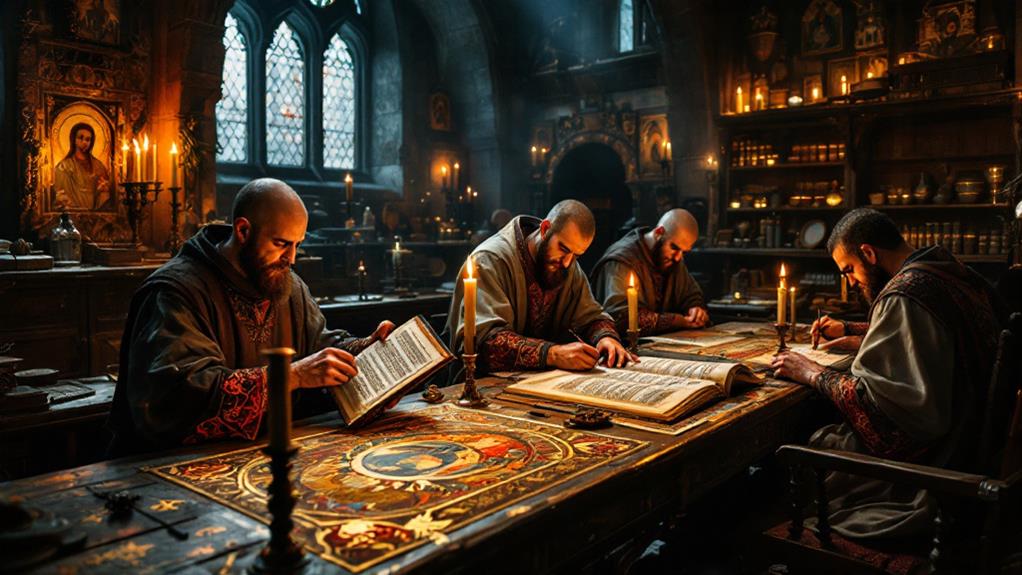
A significant aspect of medieval manuscript production, the art of illumination, captivated the eyes and souls of those who encountered these intricate works. When you examine illuminated manuscripts, you're witnessing a fusion of art and spirituality. These manuscripts weren't just books; they were visual representations of divine truths designed to inspire and instruct. The pages shimmered with gold leaf and lively colors, drawing you into a world where text and image coexisted in harmony.
As you explore these manuscripts, notice the symbolic imagery that adorns the pages. Each image served a purpose beyond decoration. For instance, a peacock might symbolize immortality, while a lamb could represent Christ. These symbols weren't randomly chosen; they conveyed deeper meanings meant to guide the reader's spiritual quest. Illuminators, often monks, painstakingly crafted each page, focusing on the harmony between text and imagery.
The Church played a fundamental role in commissioning and preserving these works, ensuring that the art of illumination flourished. By fostering this creative process, the Church didn't just support the spread of religious doctrine but also enriched the cultural and artistic heritage of the medieval world, leaving a lasting legacy.
Evolution of Script Styles
As you investigate the evolution of script styles, you'll uncover how medieval scribes transformed the way written language was presented. During this period, script evolution was deeply influenced by the Church, which demanded manuscripts for religious texts. This led to notable stylistic shifts as scribes developed new scripts to meet ecclesiastical needs and regional preferences.
You can see the progression from the early, dense script forms to more legible and aesthetically pleasing styles. The Church's emphasis on clarity and beauty in religious texts spurred this change. As you probe deeper, you'll find these key aspects of script evolution:
- Carolingian Minuscule: Introduced in the 8th century, this script was a turning point, offering clarity and uniformity, setting a standard for future scripts.
- Gothic Script: Emerged in the 12th century, characterized by its angularity and compactness, it reflects the stylistic shifts towards more ornate designs.
- Cursive and Bastarda Scripts: Used for non-religious texts, these scripts allowed faster writing, showing a shift in priorities.
- Humanist Script: In the 15th century, a return to classical forms, emphasizing readability, mirrored the Renaissance's humanistic values.
Understanding these changes offers a glimpse into the medieval mindset and the Church's critical role in shaping written communication.
Bookbinding Techniques
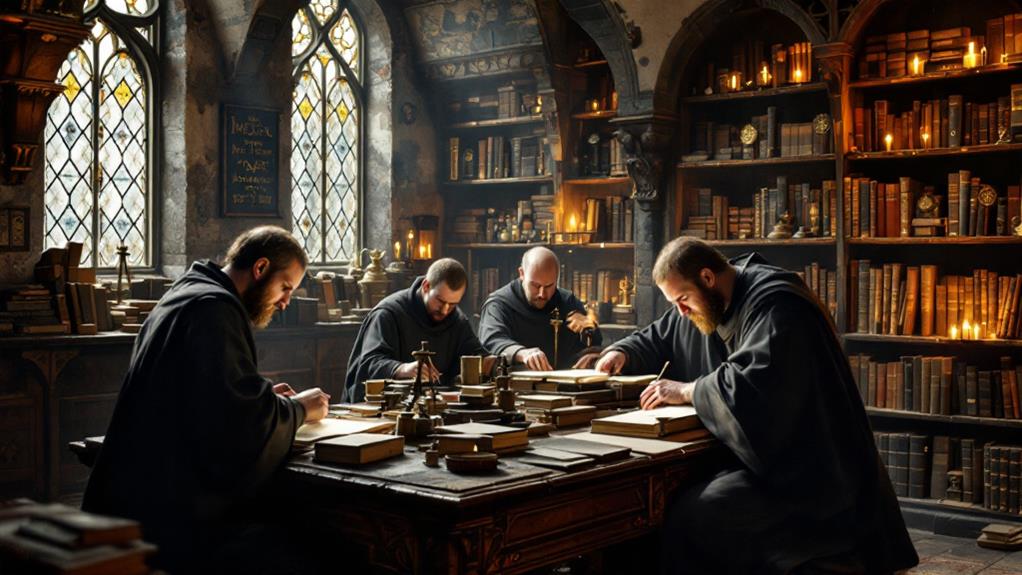
While script evolution played a vital role in manuscript production, the physical assembly of these texts was similarly significant. In the medieval age, bookbinding techniques were an integral part of ensuring that manuscripts were durable and functional. You'd find that medieval materials like leather, wood, and parchment were frequently used in the process. These materials were chosen for their durability and ability to protect the delicate vellum or paper pages inside.
When it comes to binding methods, medieval craftsmen used a variety of techniques that have influenced bookbinding to this day. You'd notice that they often sewed quires, or groups of pages, onto leather or linen cords, which were then attached to wooden boards. This method created a sturdy spine and allowed the book to open easily. Covers were typically made from wood and covered with leather, offering both protection and aesthetic appeal.
Additionally, metal clasps or ties were sometimes added to keep the book closed tightly, preserving the contents from wear and tear. Understanding these techniques gives you insight into the craftsmanship and care that went into creating these enduring works of art during the medieval period.
Preservation of Classical Works
Although the medieval church wielded significant power and influence, its role in preserving classical works can't be underestimated. You might not realize it, but the church played an essential part in ensuring that ancient texts survived the test of time. Monasteries became centers of learning and manuscript copying, where dedicated monks carefully transcribed works from Greek and Roman philosophers. Without this diligent effort, many of these priceless works would've been lost forever.
When you consider the church's contribution, think about how:
- Monasteries acted as safe havens for ancient texts during times of turmoil.
- Scribes focused on accuracy, ensuring that copies remained true to the originals.
- Libraries in cathedrals and monasteries stored these manuscripts, protecting them from decay.
- Scholastic endeavors thrived, fostering a culture of learning and preservation.
This commitment to preservation wasn't just an act of devotion but a necessary step in maintaining the knowledge of past civilizations. As you explore deeper into the history of manuscript production, it becomes clear that the medieval church's efforts in manuscript copying were vital in bridging the gap between the ancient and modern worlds, safeguarding the wisdom of the ancients for future generations.
Dissemination of Religious Texts
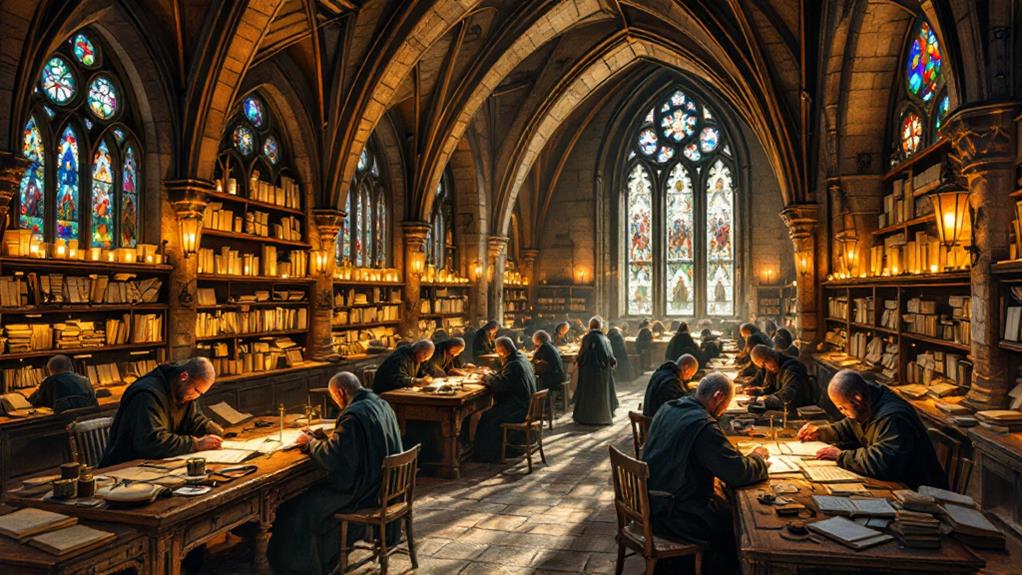
The medieval church didn't just preserve ancient texts; it actively spread its own religious doctrines through the dissemination of religious texts. By wielding its considerable religious authority, the church guaranteed that its teachings reached a wide audience. You'd find that monasteries became the epicenters of textual transmission, where scribes carefully copied manuscripts by hand. This labor-intensive process might seem intimidating, but it was vital for spreading religious knowledge across Europe.
When you explore the church's strategies, you see how it harnessed textual transmission to reinforce its influence. The church didn't just focus on copying the Bible; it also produced commentaries, sermons, and theological treatises that shaped religious thought. These texts were sent to monasteries and churches far and wide, extending the church's reach beyond local communities. By making these writings widely available, the church not only consolidated its religious authority but also guaranteed a unified interpretation of Christian doctrine.
As you consider the impact of this dissemination, you'll realize that the church's approach wasn't just about spreading information. It was an intentional effort to maintain control over religious narratives, guaranteeing that its teachings remained the dominant voice in spiritual matters.
Cultural Influence on Europe
Even as the medieval church focused on religious dissemination, it profoundly shaped European culture. By controlling manuscript production, the church embedded religious iconography into the fabric of society. You can see how this influence permeated diverse aspects of daily life. Art, for instance, often depicted biblical scenes, directing the cultural narrative and reinforcing the church's teachings. This wasn't just about religion; it was about creating a shared cultural identity across a fragmented Europe.
The church's influence extended beyond art. It played a significant role in the development of a rigid social hierarchy. Manuscripts often glorified the divine right of kings, underlining the idea that the social order was ordained by God. This helped maintain stability, but also justified the existing power structures.
Consider the following cultural impacts:
- Education: Monasteries became centers of learning, preserving knowledge and spreading literacy.
- Language: Latin became the lingua franca, unifying disparate regions under a common scholarly language.
- Architecture: Gothic cathedrals symbolized the church's power and influenced town development.
- Morality: Religious texts dictated ethical norms, guiding personal and communal behavior.
In these ways, the medieval church was a powerful cultural architect, shaping Europe for centuries.
Related posts