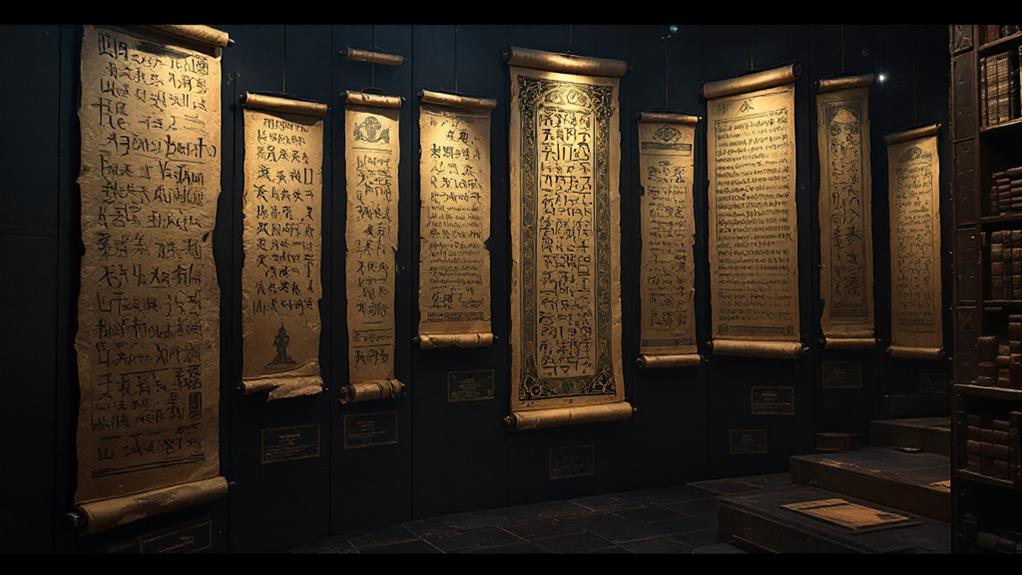
The Evolution of Historical Scripts: From Gothic to Kufic Folios
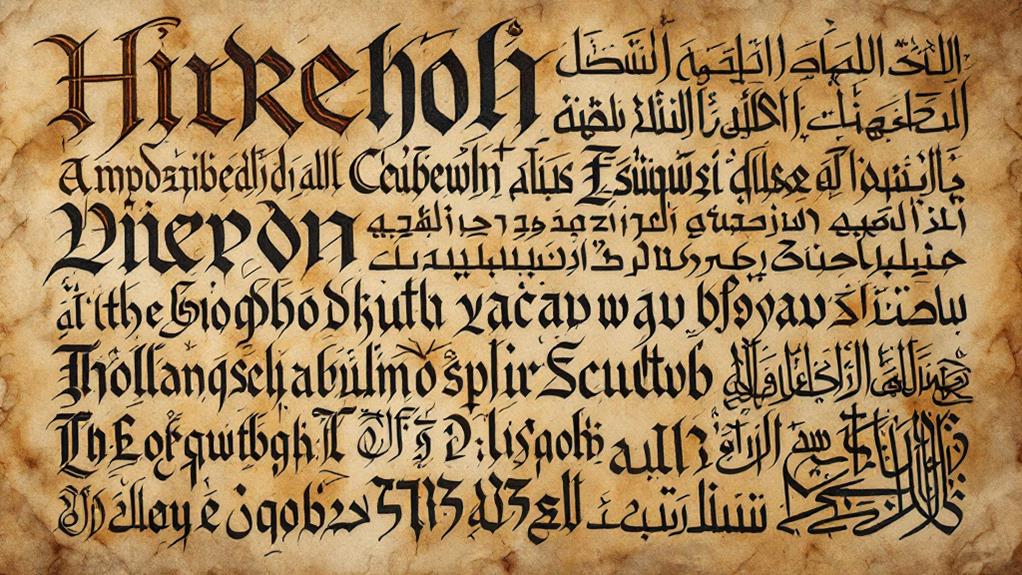
You'll uncover how historical scripts evolved, starting with Gothic script's intricate forms that defined medieval manuscripts with their angular strokes and ornate aesthetics. This script added a sense of sophistication to religious texts and legal documents. As the artistic and intellectual landscape changed, the shift to Kufic script began. Known for its bold, geometric precision, Kufic played a key role in Islamic art, transmitting religious texts and symbolizing cultural identity. Its influence is seen in modern typography, with its emphasis on clarity and structure. Exploring these transformations offers insights into societal values and artistic expressions across ages.
Origins of Gothic Script
Gothic script, often recognized for its intricate and angular style, emerged during the High Middle Period as a distinct evolution from earlier Latin scripts. You can trace its origins to the 12th century when scribes sought to create a writing style that matched the grandeur of medieval architecture. Gothic script became prevalent in medieval manuscripts, where it added an air of sophistication and complexity.
To create this script, scribes employed thorough scribal techniques, which included varying pen angles and pressure to achieve the script's signature sharpness and densely packed letters. By mastering these techniques, scribes could produce the characteristic pointed arches and elongated forms that defined Gothic script. This required not only skill but also a deep understanding of the script's form and function.
As you investigate Gothic script in medieval manuscripts, you'll notice how its evolution was influenced by the need for efficiency and legibility in copying religious texts and legal documents. The script's compact nature allowed more words to fit on a single page, which was vital during a time when paper and parchment were precious commodities. Understanding these origins highlights the practical and aesthetic considerations that guided its development.
Characteristics of Gothic Writing
Building on the origins of Gothic script, its defining characteristics further reveal its unique identity in the world of historical scripts. You'll notice its distinctive gothic aesthetics immediately: the angular, heavy strokes and compact lettering create a dense visual effect. This style often features elaborate and decorative elements, especially in the capital letters, which can look quite ornate. The script's uniformity and rigidity reflect a strong sense of order, making it particularly suitable for religious texts and official documents where clarity and formality are paramount.
As you investigate Gothic writing, consider its cultural significance. Originating in medieval Europe, this script was more than just a means to record information. It represented the period's artistic and intellectual movements, echoing the architecture of the grand Gothic cathedrals with its intricate designs. The script became a symbol of authority and tradition, capturing the spirit of the Middle Ages. When you study Gothic writing, you're not just looking at a script; you're engaging with a visual representation of a society's values and beliefs. This script, with its rich cultural history, continues to intrigue scholars and enthusiasts alike.
Transition to Kufic Script
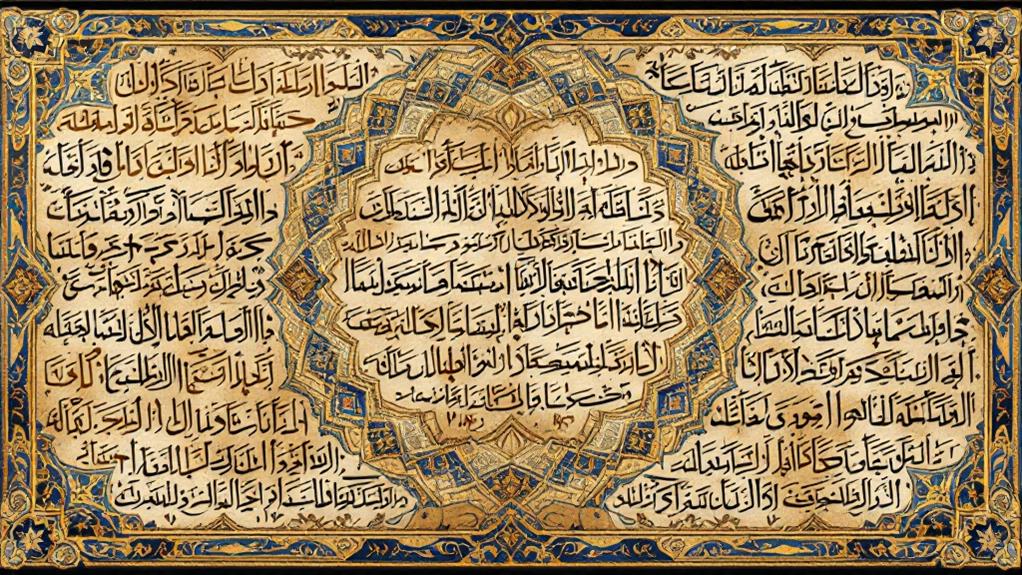
As you turn your attention to the change to Kufic script, you'll find yourself exploring a remarkable shift in the world of historical writing. This alteration doesn't just involve a change in lettering style; it's a reflection of deeper cultural significance. Kufic script, known for its angular and bold strokes, emerged as a dominant form of writing in the early Islamic world. Unlike the ornate curves of Gothic writing, Kufic's stylistic differences lie in its geometric precision and simplicity, which conveyed a sense of strength and clarity.
You can't overlook the impact of these stylistic differences on the societies that adopted them. While Gothic writing was deeply tied to the religious texts and manuscripts of medieval Europe, Kufic script played a crucial role in transmitting the Quran and other Islamic works across vast regions. This cultural significance of Kufic script extended beyond aesthetics; it became a symbol of identity and unity in the Islamic world.
In considering this change, you're witnessing more than just a shift in script. It represents an evolution in how societies express their values, beliefs, and artistic sensibilities, highlighting the profound connection between script styles and cultural identity.
Features of Kufic Calligraphy
Investigate the features of Kufic calligraphy, and you'll uncover a fascinating blend of artistry and function. As one of the oldest styles of Arabic script, Kufic calligraphy is distinguished by its angular and linear form, which lends itself to a striking visual presence. Its Kufic aesthetics are marked by the boldness of lines, often constructed with a ruler, resulting in a geometric precision. This makes Kufic not only legible but also an art form that captures the eye.
Kufic motifs play a significant role in the aesthetic appeal of this script. You'll notice that these motifs often consist of intricate arabesques and interlocking patterns, which serve to adorn religious texts and architectural elements. Kufic calligraphy thrives on symmetry and balance, making it a perfect fit for decorative purposes. The script's minimalist nature allows for creative interpretations while maintaining readability.
When you investigate the essence of Kufic calligraphy, you'll find a script that emphasizes both clarity and beauty. Its unique characteristics have made it a favorite for inscriptions on coins, monuments, and manuscripts. With each Kufic letter, there's a blend of form and function, creating a timeless art form.
Influence on Modern Typography
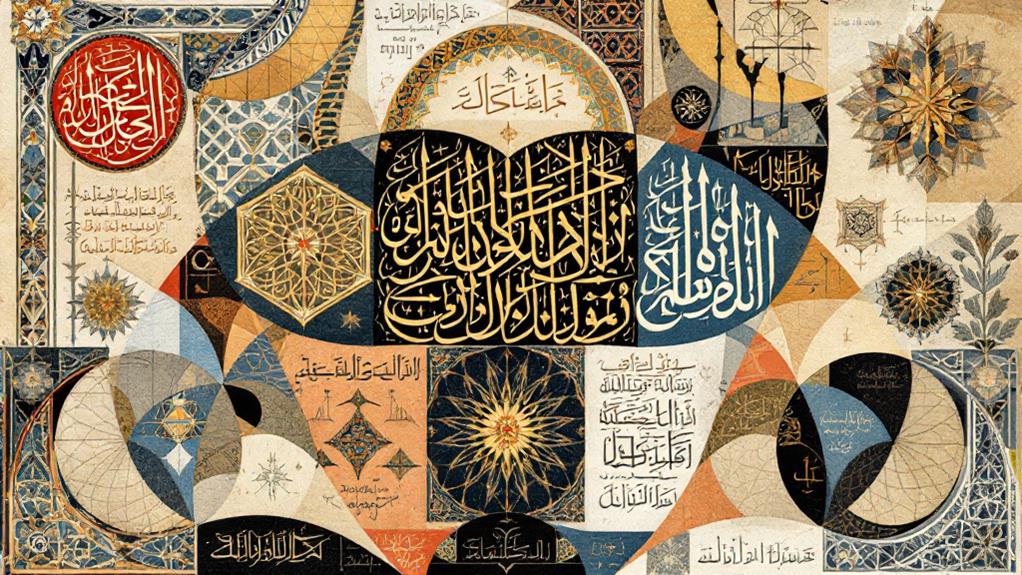
Although Kufic calligraphy belongs to a bygone era, its influence on modern typography is undeniable. You might not immediately notice it, but the angular and geometric qualities of Kufic scripts have seeped into today's typographic trends. Designers often draw upon its bold and structured aesthetic, which lends itself to creating typefaces that are both functional and artistic. When you're scrolling through digital fonts, you'll encounter ones that echo the strong lines and symmetry of Kufic styles.
By embracing these historical elements, modern typography gains a unique dimension. You see it in logos, branding, and even in web design, where clarity and visual impact are essential. Kufic-inspired fonts often serve as a bridge between the ancient and the contemporary, making them versatile tools in your design arsenal.
In the domain of digital fonts, the influence of Kufic is especially powerful. The digital era allows for endless experimentation, enabling you to blend traditional calligraphic elements with modern needs. This fusion results in fonts that are not only aesthetically pleasing but also highly readable on screens. So, when you investigate the world of typography, remember the lasting legacy of Kufic calligraphy.
Related posts