The Diamond Sutra: World’s Oldest Printed Book and Its Cultural Impact

You're stepping into the rich history of the Diamond Sutra, printed in 868 AD and the world's oldest printed book. Found in China's Mogao Caves, it showcased the dynamic exchange of ideas along the Silk Road. This ancient text wasn't just a religious manuscript; it transformed information sharing through woodblock printing, making Buddhist teachings accessible to many. With its emphasis on wisdom, non-attachment, and compassion, the Sutra influenced both Buddhist philosophy and global art. Today, its teachings support mindfulness and ethical living. If you're curious about its lasting impact on human culture, there's much more to uncover.
Discovery in the Mogao Caves
While exploring the Mogao Caves in the early 20th century, you would have stumbled upon one of the most significant archaeological finds—the Diamond Sutra. These caves, located near Dunhuang, China, are a repository of historical artifacts that offer a glimpse into a lively period of cultural exchange. As you navigate through the labyrinth of over 700 caves, the Diamond Sutra stands out as a remarkable proof of early printing technology and the spread of Buddhist teachings.
The revelation of this ancient text, printed in 868 AD, adds immense archaeological significance to the Mogao Caves. This artifact is not only the world's oldest printed book but also a symbol of the cultural and religious interactions along the Silk Road. The Sutra's presence in the caves highlights how ideas, beliefs, and artistic techniques traversed vast distances, enriching the local culture.
Your exploration would reveal that the Mogao Caves served as a melting pot of diverse influences, where traders, monks, and artists left their mark. Uncovering the Diamond Sutra in such a setting underscores the profound historical and cultural exchanges that shaped the region and its enduring legacy.
Historical Context and Significance
The finding of the Diamond Sutra in the Mogao Caves invites you to explore its historical context and significance. This ancient Buddhist manuscript, printed in 868 AD, marks a significant moment in the historical transmission of religious texts and ideas. Its existence highlights the profound religious influence of Buddhism in China during the Tang Dynasty. As you investigate deeper, you'll uncover that the Diamond Sutra is more than just a relic; it's a proof of the lively cultural exchange between India, where Buddhism originated, and China, where it flourished.
You'll find that the Diamond Sutra played a vital role in the spread of Buddhist teachings. By being one of the earliest dated printed texts, it facilitated the wider dissemination of religious doctrines, making them more accessible to the general population. This wasn't just about preserving religious knowledge; it was about sharing it widely, allowing for a broader cultural and intellectual engagement.
In examining the Diamond Sutra, you see the transformative power of written words in fostering cultural and religious connections across regions. This ancient manuscript stands as a guiding light of historical and cultural significance, bridging diverse communities and periods.
The Printing Technology of 868 AD

Innovation in printing technology during 868 AD marked a significant shift in the way information was shared and preserved. This period introduced woodblock printing, a technique that allowed texts to be reproduced efficiently and consistently. You'd carve an entire page of text onto a wooden block, apply ink, and press it onto paper. This method not only sped up the process of book production but also guaranteed that each copy was identical to the original.
Woodblock printing laid the groundwork for what you'd recognize today as early typography. While it wasn't exactly movable type, it represented the primary real attempt to standardize text presentation. This technology was revolutionary because it democratized knowledge, making it accessible to a wider audience. Before this, you would've had to rely on hand-copied manuscripts, which were time-consuming and prone to errors.
Key Teachings of the Sutra
As you investigate the remarkable printing advancements of 868 AD, you'll find that the true value of the Diamond Sutra lies in its profound teachings. At its core, the Sutra invites you to examine Buddhist ethics through the lens of Transcendental wisdom, which goes beyond ordinary knowledge and guides you toward deeper truths. A key aspect of this wisdom is the practice of Non-attachment principles, encouraging you to let go of material desires and emotional clinging.
The Emptiness doctrine plays a vital role in shaping your understanding of reality, teaching that all phenomena lack inherent existence. This insight helps you cultivate Compassion by recognizing the interconnectedness of all beings, fostering a genuine wish to alleviate their suffering. Through Mindful awareness, you learn to live in the present moment, honing your ability to see things as they truly are without biases.
The Sutra also emphasizes Impermanence understanding, reminding you that change is the only constant. By embracing this truth, you can better navigate life's challenges and uncertainties. Ultimately, the Diamond Sutra provides a roadmap on the Enlightenment path, guiding you toward liberation and spiritual awakening.
Influence on Buddhist Philosophy

Rooted deeply in Mahayana Buddhism, the Diamond Sutra has profoundly influenced Buddhist philosophy with its revolutionary teachings on emptiness and non-attachment. These concepts challenge you to rethink how you perceive the world. By understanding emptiness, you're encouraged to see beyond superficial appearances and accept the interconnectedness of all things. This insight extends to Buddhist ethics, promoting compassion and reducing suffering. The Sutra's philosophical interpretations inspire you to engage in mindfulness practice, fostering awareness and presence in everyday life.
Meditative readings of the Diamond Sutra can transform your approach to spirituality, offering clarity and deep insight. As it spread, the Sutra facilitated cultural exchanges and interfaith dialogues, allowing distinct communities to investigate these teachings together. Historical adaptations of the Sutra have been seen across different cultures, each adding their unique perspectives and enriching the philosophical discourse.
In contemporary applications, the Diamond Sutra's influence can be seen in how modern Buddhists apply its teachings to address today's ethical dilemmas. Whether through meditation retreats or scholarly study, its principles remain relevant, guiding you towards a more mindful and compassionate existence. By accepting these timeless teachings, you can cultivate a deeper understanding of yourself and the world around you.
Artistic Representations Over Time
Throughout history, the Diamond Sutra hasn't just shaped philosophical thought; it has also inspired a diverse array of artistic inquiries. When you look at the stunning array of visual interpretations, it's clear how the text transcends the written word. Artists, captivated by its profound teachings, have translated its essence into breathtaking works of art. From intricate scroll paintings to modern digital art, these visual interpretations reflect the enduring impact of the sutra.
You can see artistic adaptations in everything from traditional Asian art forms to contemporary Western styles. In ancient China, artists created elaborate woodblock prints to bring the sutra's teachings to life. These prints weren't just copies; they were lively, intricate artworks that conveyed spiritual messages through visual storytelling. Today, contemporary artists continue to investigate the sutra's themes, using mediums like painting, sculpture, and even digital installations.
Literary Impact Across Cultures
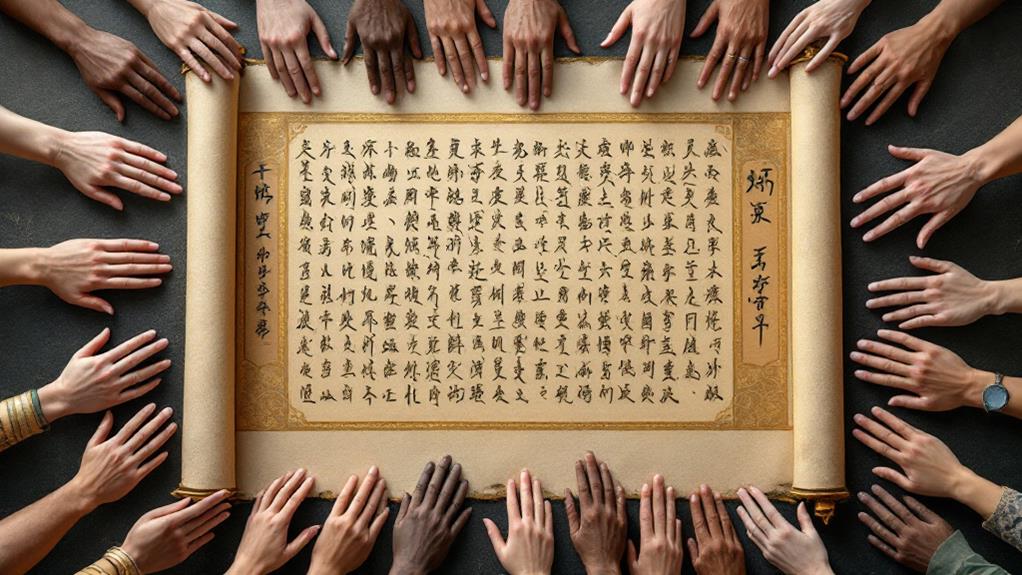
The Diamond Sutra's literary impact spans continents and centuries, influencing an extensive range of cultural narratives. You'll find that its themes have been accepted and adapted in diverse cultures, showcasing its universal appeal and wisdom. As you investigate its history, you'll notice how cross-cultural interpretations have allowed the text to transcend its original context and resonate with varied audiences.
- It inspires literary adaptations, with authors weaving its themes into novels and poetry, enriching the narrative with philosophical depth.
- Scholars examine its teachings, drawing connections between its insights and contemporary thought, expanding dialogues across literary landscapes.
- The text's influence is evident in spiritual literature worldwide, providing a foundation for meditative and reflective writing.
With its profound insights, the Diamond Sutra encourages you to contemplate impermanence and the nature of reality, themes that writers across cultures have accepted. As you investigate its literary exploration, you'll see how it fosters a shared human experience by bridging cultural divides. The Diamond Sutra's enduring legacy is a reflection of its ability to inspire and transform, continually shaping the literary world with its timeless wisdom.
Modern Relevance and Mindfulness
As you consider the Diamond Sutra's literary impact, it's clear that its themes remain deeply relevant in the current fast-paced world. The Sutra's emphasis on mindfulness practices provides a foundation for achieving mental clarity amidst daily chaos. Its teachings have undergone contemporary interpretations, making them accessible to modern audiences seeking spiritual growth. You can examine meditation techniques inspired by the Sutra to cultivate inner peace and improve focus.
In today's society, cultural adaptation of the Diamond Sutra allows you to apply its wisdom in diverse contexts, transcending religious boundaries. This adaptability has led to the rise of secular mindfulness, where the core principles are used to improve comprehensive well-being without religious connotations. You'll find that these practices encourage ethical living, emphasizing compassion and awareness in your daily actions.
Moreover, engaging with the Sutra's teachings can guide you toward a more mindful existence, helping you navigate life's complexities with a clear and centered mind. The timeless insights of the Diamond Sutra continue to offer valuable lessons, urging you to accept meditation and mindfulness as tools for personal transformation and a deeper understanding of yourself and the world around you.
Preservation and Global Legacy
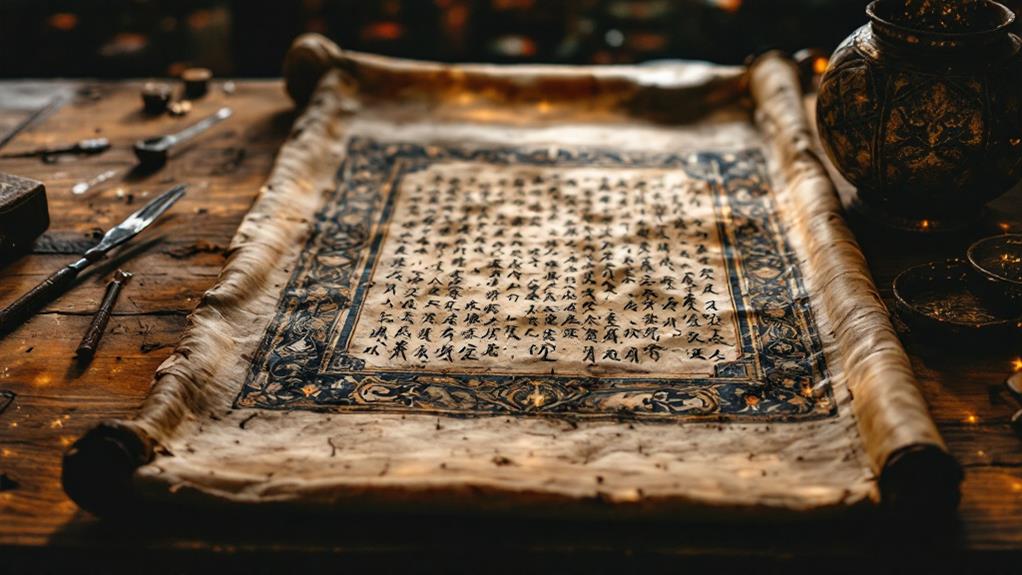
You might be surprised to learn that the Diamond Sutra is not only a profound spiritual text but also a remarkable artifact of human history, being the oldest known printed book. Preserving this invaluable piece has required advanced conservation techniques to maintain its delicate material. Experts have implemented methods like climate-controlled environments and careful handling procedures to guarantee its longevity. This attention to preservation highlights the global importance of the text as a piece of cultural heritage.
The Diamond Sutra's global legacy isn't just about its origin or antiquity; it's about the cultural impact it's had over centuries. As you investigate this legacy, consider how it has influenced numerous aspects of human culture:
- Philosophical thought: It's inspired countless philosophers and spiritual leaders worldwide.
- Artistic expression: Its themes have permeated artistic works, from visual art to literature.
- Linguistic studies: Scholars have studied its language and translation, bridging cultural gaps.
The Diamond Sutra serves as an indicator of humanity's shared cultural heritage, illustrating how ancient wisdom and modern conservation techniques can unite to preserve history. By cherishing and studying it, you contribute to its enduring story and help maintain its relevance for future generations.
Related posts