
Science, Philosophy, and Faith: Exploring the Manuscripts of the Islamic Golden Age

Exploring the manuscripts of the Islamic Golden Period, you'll uncover a remarkable harmony between science, philosophy, and faith. The age thrived due to lively cultural exchanges and the support of intellectual hubs like the House of Wisdom. Thinkers developed algebra, advanced medicine, and deepened astronomical understanding, showcasing their groundbreaking spirit. They translated Greek philosophy, integrating it with Islamic thought, to shape a new rational discourse. Scholars welcomed faith alongside reason, arguing that science revealed divine creativity. This unique blend didn't just influence Islamic societies but also paved the way for the European Renaissance. Immerse further to see their enduring legacy.
The House of Wisdom
During the Islamic Golden Age, Baghdad's House of Wisdom stood as a guiding light of intellectual pursuit and scholarly excellence. Imagine walking through its grand halls, witnessing scholars from different backgrounds engaged in lively discussions. Here, you'd find a melting pot of ideas and cultures, where manuscript preservation was paramount. The House of Wisdom wasn't just a library; it was the epicenter of cultural exchange. Scholars worked tirelessly, translating and preserving ancient texts from Greek, Persian, Indian, and other civilizations, ensuring that this knowledge survived for future generations.
In this dynamic environment, you'd encounter a spirit of collaboration. The House of Wisdom attracted thinkers, scientists, and philosophers, each contributing to a profound cultural exchange that transcended geographical and linguistic barriers. Manuscripts were not only copied but also expanded upon, integrating varied insights and innovations. You'd see how this blending of knowledge laid the foundation for breakthroughs in numerous fields like medicine, astronomy, and philosophy.
Visiting the House of Wisdom during this age would've opened your eyes to a world where the pursuit of knowledge was boundless, and the preservation of manuscripts was a reflection of the enduring human quest for understanding.
Pioneers of Mathematics
Mathematics flourished during the Islamic Golden Age, driven by pioneering scholars who redefined the very fabric of the discipline. You'd find yourself amazed by their contributions, which laid the groundwork for modern mathematics. These scholars were not just mathematicians; they were visionaries who welcomed cultural exchanges and shared their insights with the world. They paved the way for the algebra origins that transformed equations into powerful problem-solving techniques.
Imagine the excitement of uncovering geometric innovations that reshaped your understanding of space and shape. These breakthroughs were carefully documented in mathematical treatises, preserving knowledge for generations. The introduction of new numerical systems altered how people performed calculations, replacing cumbersome methods with streamlined processes.
Consider the emotional impact of these achievements:
- The joy of revealing algebra's potential, turning abstract concepts into tangible solutions.
- The awe of geometric discoveries, offering beauty and symmetry in unexpected places.
- The relief of simplified calculations, thanks to advanced numerical systems.
- The gratitude for clear mathematical notation, ensuring clarity across diverse languages.
These mathematical scholars left an indelible mark on history, their passion and intellect echoing through the eras, shaping the world as you know it today.
Advances in Medicine
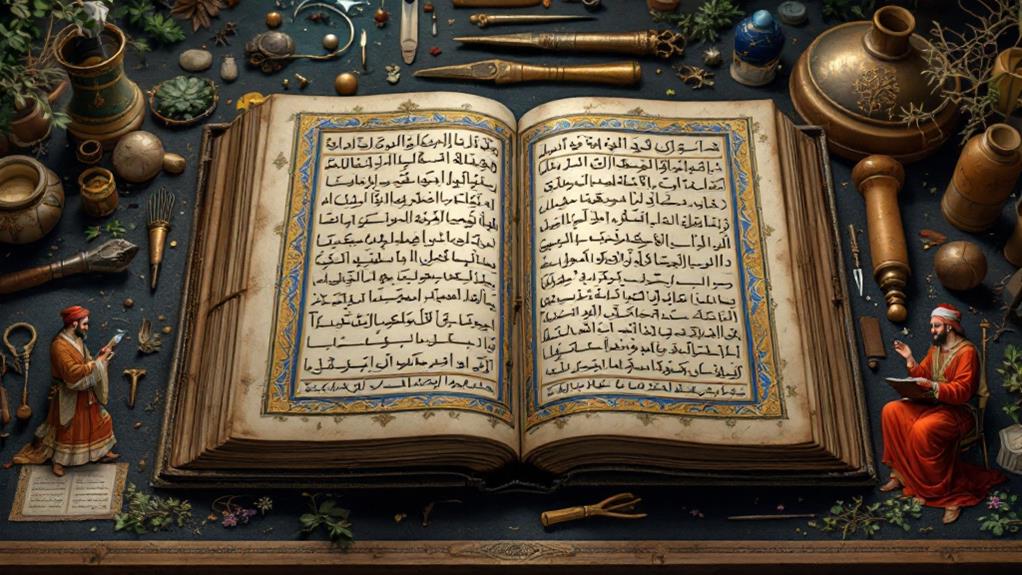
While the brilliance of mathematical minds illuminated the Islamic Golden Age, another field saw remarkable advancements that changed the course of human history: medicine. You'd find scholars diligently studying anatomy, endeavoring to understand the human body in unprecedented detail. These studies laid the foundation for refined diagnostic practices, enabling more accurate identification of ailments. The significance of medical ethics wasn't lost on these pioneers; they emphasized compassionate care and integrity, a legacy that still influences modern medicine.
During this age, herbal remedies became a staple in treatment, with physicians carefully documenting the effects of diverse plants. You'd find that these remedies were often combined with advanced surgical techniques. Surgeons of the time developed creative methods, making strides in procedures that previously seemed impossible. Their dedication to improving surgical outcomes underlines the ingenuity of this period.
Public health measures also saw significant progress. You'd notice efforts to improve sanitation and prevent the spread of disease, reflecting an early understanding of community health. The Islamic Golden Age's medical advancements left an indelible mark, demonstrating the profound impact thoughtful, ethical, and scientific inquiry can have on human well-being.
Astronomy and the Stars
The Islamic Golden Period's fascination with the cosmos propelled astronomical knowledge to new heights. You can imagine scholars peering into the night sky, their eyes tracing the dance of stars and planets. These celestial observations weren't just for admiration; they served practical purposes, too. Stellar navigation, for example, was transformed during this period, allowing adventurers to traverse vast deserts and unpredictable seas with newfound confidence.
Consider the emotional impact of this period:
- Wonder: Imagine the awe of gazing at a sky full of stars, each one a guiding light of mystery waiting to be unraveled.
- Adventure: Think of the thrill as navigators relied on the stars to guide them through uncharted territories, opening new worlds.
- Discovery: Feel the excitement of scholars as they recorded and predicted celestial events, laying the groundwork for future astronomers.
- Unity: Picture a world where diverse cultures came together to share knowledge, leading to groundbreaking advancements.
You find that manuscripts from this time not only detailed the movement of celestial bodies but also offered insights into the universe's vastness. The Islamic Golden Period's dedication to astronomy fueled centuries of scientific inquiry, bridging the heavens and Earth in a timeless quest for understanding.
Philosophical Dialogues

Amid the intellectual fervor of the Islamic Golden Period, philosophical dialogues flourished as scholars engaged in spirited debates and exchanged groundbreaking ideas. You would find yourself captivated by the lively discussions that occurred in centers of learning like Baghdad's House of Wisdom. These scholars didn't shy away from challenging questions; they sought to understand the universe, human nature, and the divine.
In these philosophical dialogues, ethical inquiries played a significant role. You'd see scholars grappling with questions about what constitutes a good life and the nature of justice. They examined how ethical principles could be applied to governance and personal conduct, laying the groundwork for future philosophical thought.
Metaphysical debates were likewise prominent. Imagine scholars passionately debating the nature of reality, existence, and the relationship between the material and spiritual worlds. These discussions often drew from Greek philosophy and were enriched by Islamic thought, leading to unique perspectives on timeless questions.
Faith and Knowledge Integration
During the Islamic Golden Age, scholars seamlessly wove together faith and knowledge, demonstrating a profound commitment to both spiritual beliefs and intellectual inquiry. This period was marked by an extraordinary blend of spiritual epistemology and rational belief, allowing scholars to investigate the universe without abandoning their faith. You'd find that the pursuit of knowledge wasn't seen as separate from spiritual wisdom but rather as an extension of it. These scholars believed that understanding the world was a form of worship and a way to appreciate the divine.
Imagine a world where:
- Science and spirituality walk hand in hand, each enriching the other.
- Curiosity isn't stifled by dogma, but rather fueled by it.
- Intellectual pursuits become acts of devotion, each revelation a step closer to understanding the divine.
- Rational belief guides inquiries, ensuring that faith and reason coexist harmoniously.
In this age, faith didn't limit knowledge; it expanded it. The scholars' commitment to spiritual epistemology inspired groundbreaking advancements in numerous fields. You'd see how they believed that every scientific revelation was a demonstration of divine creativity, urging you to seek knowledge with both heart and mind.
Related posts