Restoration and Ethics: How Experts Tackle Manuscript Challenges
When tackling manuscript restoration, you face the challenge of balancing preservation with ethical considerations. Experts use advanced technology like digital imaging and infrared scanning alongside traditional craftsmanship to maintain manuscripts' integrity. Ethics guide them in deciding how much alteration is appropriate to preserve authenticity. Provenance research helps tailor restoration approaches, guaranteeing each manuscript's story remains intact. Collaborative efforts with specialists assure transparency and maintain historical value. By adopting novel techniques without overshadowing original craftsmanship, you can preserve history while embracing innovation. Uncover how this delicate balance between preservation and technology safeguards our cultural heritage.
Historical Context of Manuscripts
While delving into the historical context of manuscripts, it's essential to grasp their significant role in preserving human knowledge across centuries. Manuscript origins trace back to ancient civilizations where scribes carefully recorded everything from religious texts to scientific knowledge on materials like papyrus and parchment. These early records laid the groundwork for our understanding of history and culture, providing priceless insights into societies long gone. You'll find that manuscripts weren't just about recording facts; they were an indication of human curiosity and creativity.
Understanding the cultural significance of manuscripts involves appreciating their impact on literacy and education. As you investigate their passage through time, you'll notice how they served as the primary means of transmitting knowledge before the invention of the printing press. Manuscripts enabled the sharing of ideas, philosophies, and revelations across regions, influencing countless generations. They're more than just old texts; they're cultural artifacts that reveal the values, beliefs, and aspirations of their creators. By preserving these manuscripts, societies guaranteed that future generations could learn from the past, making them a significant link in the chain of human progress. Recognizing this importance helps you appreciate the efforts taken to protect and restore these invaluable artifacts.
Modern Restoration Techniques
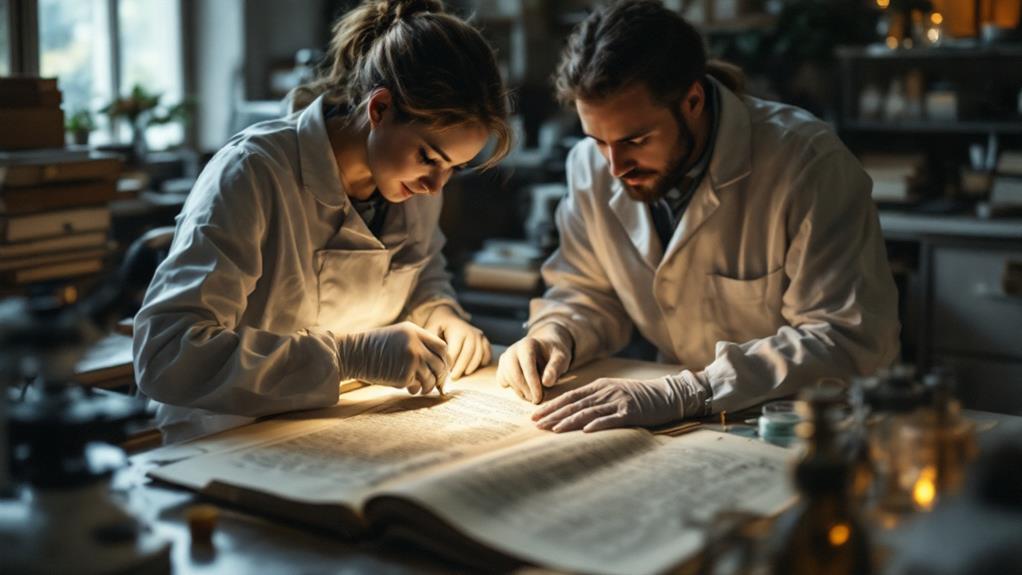
As you investigate modern restoration techniques, you'll find that they blend advanced technology with traditional craftsmanship to preserve the integrity of ancient manuscripts. These techniques guarantee that the historical essence of each document remains intact, while utilizing cutting-edge tools to extend their longevity.
Digital preservation plays a significant role in this process. By creating high-resolution digital copies, you help protect the original manuscripts from excessive handling and environmental damage. This digital approach allows for easy access and study, making it possible for researchers worldwide to examine and analyze texts without the risk of deterioration.
Conservation technology is another essential component. For instance, you might employ infrared imaging to uncover hidden layers of writing or faded text that the naked eye can't see. This non-invasive method allows you to understand the document's complete history without physically altering it. Additionally, you can use specialized software to simulate restoration processes, predicting outcomes and preventing potential damage before any physical restoration begins.
Ethical Considerations in Restoration
The ethics of manuscript restoration hinge on the delicate balance between preservation and alteration. As someone involved in this field, you're constantly faced with decisions that impact a manuscript's integrity and historical value. Provenance research becomes vital, as understanding a manuscript's origin helps determine the best restoration approach. You need to respect the artifact's story while guaranteeing its longevity for future generations.
Conservation ethics guide you in making informed choices that prevent unnecessary alterations. You ask yourself: Should I intervene at all? If so, to what extent? These questions demand careful consideration. Your goal is to protect the manuscript's authenticity without overshadowing its original essence. Every decision should be rooted in a thorough understanding of its historical context and physical condition.
You also collaborate with other experts to weigh the potential benefits and risks of restoration techniques. This collaboration helps you maintain transparency and accountability in your work. By adhering to conservation ethics, you ascertain that your restoration efforts honor the manuscript's past while securing its future. Remember, your role isn't just about fixing what's broken; it's about preserving a piece of history with care and respect.
Balancing Authenticity and Innovation
In manuscript restoration, you face the challenge of balancing authenticity with creativity. The authenticity debate often centers on how much creativity can be applied without compromising the original essence of a manuscript. You must weigh the importance of preserving historical integrity against the benefits of using modern techniques. This balance is vital, and it involves:
- Assessing Material Integrity: Determine if creative methods will strengthen or alter the manuscript's original materials. It's important to maintain the core authenticity while introducing modern stabilization techniques.
- Respecting Historical Context: Consider if your creativity respects the manuscript's historical significance. You must guarantee that any updates or restorations don't overshadow the original creators' intent.
- Embracing Technological Advances: Implement new technologies carefully. Digital imaging, for example, allows you to improve readability and accessibility without altering the physical document. However, you should use these tools judiciously to preserve authenticity.
Balancing these factors requires a deep understanding of both traditional and modern restoration practices. You're constantly maneuvering the fine line between preserving history and embracing progress. The authenticity debate will continue, but with thoughtful application, creative methods can coexist with respect for the past.
Case Studies of Notable Restorations
Examining real-world examples provides clarity on how authenticity and innovation intertwine in manuscript restoration. When you look at famous restorations, like the Dead Sea Scrolls, you see the delicate balance experts maintain. The scrolls presented restoration challenges due to their *duration* and fragility. Conservators had to innovate, using infrared technology to read and piece together fragments without causing further damage. This case highlights how technology can aid in preserving authenticity.
Another notable example is the restoration of the Codex Sinaiticus, one of the oldest known Bibles. The challenge here was to reunite scattered pages from libraries around the world. Digital imaging played a *vital* role, allowing scholars to virtually reconstruct the manuscript. You can see how such innovations preserve the integrity of the text while making it accessible to a broader audience.
Then there's the Archimedes Palimpsest, where modern imaging techniques revealed hidden texts beneath religious writings. The challenge was to recover the original content without harming the overlying script. This required careful handling and advanced imaging technologies, showcasing how restoration efforts address both preservation and recovery. Each of these cases demonstrates the intricate dance between preserving history and embracing new techniques.
Future Trends in Manuscript Preservation
Imagine a future where artificial intelligence and machine learning revolutionize manuscript preservation. You'll find that these technologies can predict degradation patterns and suggest tailored restoration techniques. Digital archiving will also play a vital role, guaranteeing that even if physical manuscripts deteriorate, their digital counterparts remain pristine and accessible.
Consider these three upcoming trends that will transform how you approach manuscript preservation:
- AI-Powered Restoration: AI can analyze millions of data points, offering insights into the best restoration methods. You'll have the ability to address manuscript issues with precision and efficiency.
- Advanced Climate Control: With climate control systems becoming more sophisticated, you'll maintain ideal conditions for manuscripts. These systems will automatically adjust temperature and humidity, minimizing environmental threats.
- Enhanced Digital Archiving: As digital archiving technologies advance, you'll see more intuitive interfaces and greater storage capacity. This guarantees that manuscripts are preserved in high-resolution formats, accessible from anywhere.
Incorporating these trends, you can confidently navigate the challenges of manuscript preservation. By embracing technology, you're not only safeguarding the past but also preparing for a future where cultural heritage is more accessible than ever.
Related posts