
Manuscripts of the Islamic Golden Age: A Journey Through Knowledge and Faith

You're about to investigate the lively manuscripts of the Islamic Golden Era, where knowledge and faith entwine to tell stories of intellectual brilliance and spiritual depth. Beginning in the 8th century under the Abbasid Caliphate, these texts flourish through trade, religious tolerance, and political stability. You'll witness great scholars like Al-Khwarizmi and Avicenna revolutionize fields such as algebra and medicine. Uncover how cities like Baghdad and Cordoba became guiding lights of learning. These manuscripts reflect a dynamic blend of cultural exchange and philosophical discourse that continues to inspire today. There's much more to reveal about this period of enlightenment.
Origins of the Islamic Golden Age
The origins of the Islamic Golden Period can be traced back to the 8th century, during the reign of the Abbasid Caliphate. You'll find that this time was marked by significant cultural exchange, facilitated by the Caliphate's vast network of trade routes. These routes connected the Islamic world with distant lands, enabling the flow of ideas, goods, and people. It was a time when religious tolerance played a vital role in shaping the social dynamics that allowed diverse cultures to interact harmoniously.
In this historical context, the Abbasids fostered political stability, which was fundamental for nurturing intellectual growth. You can see how this stability allowed for the preservation and translation of manuscripts from multiple languages into Arabic. This language evolution not only enriched Arabic literature but also made significant scientific, philosophical, and medical texts accessible to a broader audience.
Manuscript preservation became a priority as scholars dedicated themselves to collecting, translating, and commenting on works from ancient civilizations. This dedication guaranteed that knowledge was not only maintained but also expanded and adapted to the Islamic world's needs. You'll appreciate how these efforts laid the foundation for the remarkable achievements of the Islamic Golden Epoch.
Centers of Learning and Innovation
In the heart of the Islamic Golden Age, centers of learning and innovation thrived, transforming cities into hubs of intellectual activity. You could walk through the streets of Baghdad, Cairo, or Cordoba and feel the lively pulse of knowledge. These cities were home to educational institutions that became the lifeblood of cultural and scientific advancement. They didn't just teach; they preserved vast bodies of knowledge, ensuring that the wisdom of the past wasn't lost to time.
Here's what made these centers so remarkable:
- Libraries and Translation Houses: Libraries like the House of Wisdom in Baghdad collected manuscripts from around the world. Translators worked tirelessly to convert texts into Arabic, expanding access to global knowledge.
- Institutes of Higher Learning: Places like Al-Qarawiyyin and Al-Azhar weren't just religious centers. They offered a wide curriculum, from mathematics to medicine, fostering an environment where learning was diverse and inclusive.
- Scholarly Communities: These centers attracted scholars from different backgrounds, promoting an exchange of ideas that led to groundbreaking innovations.
Key Scholars and Thinkers

Imagine being a part of a universe where intellect and inquiry are celebrated, and scholars like Al-Khwarizmi and Avicenna aren't just names in history but leading figures shaping the future. Al-Khwarizmi's mathematics laid the groundwork for algebra, transforming how calculations were approached. You'd find Ibn Sina, also known as Avicenna, whose impact on medicine and philosophy echoes through centuries, guiding modern practices.
Al Farabi's philosophy examined the relationship between society and knowledge, while Al Ghazali's critiques challenged philosophical notions, emphasizing faith's role in understanding. His arguments sparked discussions that continue to be relevant. In the domain of ethics, Al Razi's writings investigated morality and human conduct, offering profound insights into the nature of good and evil.
Rumi's spirituality, through his poetry, invited you to look inward, finding peace and unity with the divine. Averroes' commentaries broadened the understanding of Aristotle, bridging gaps between Islamic thought and Western philosophy. And then there's Islamic astronomy, where scholars mapped the heavens, driven by a thirst for knowledge. These thinkers didn't just preserve knowledge—they ignited a legacy that continues to inspire curiosity and wisdom.
Scientific Manuscripts and Discoveries
As you investigate the rich tapestry of the Islamic Golden Age, you'll reveal how scientific manuscripts became the cornerstone of groundbreaking findings that propelled human understanding forward. These manuscripts covered a vast array of disciplines, laying the foundation for future inquiries and innovations.
- Astronomical Observations: Islamic scholars carefully recorded celestial movements, advancing navigation and timekeeping. These observations were vital in accurately predicting solar and lunar eclipses.
- Mathematical Advancements: The age saw remarkable progress in algebra and geometry. Manuscripts detailed complex calculations, contributing to everything from architecture to commerce.
- Optical Discoveries: Pioneers like Ibn al-Haytham examined the behavior of light, leading to early theories of vision and optics that would later influence Western science.
Delve into alchemical texts that sought the transformation of substances, capturing the age's quest for knowledge. Botanical studies cataloged plants and their properties, enhancing both medicine and agriculture. Geographical maps drawn during this period improved the understanding of the world's layout, facilitating trade and inquiry. Engineering innovations produced ingenious devices, while musical theory manuscripts offered a deeper understanding of rhythm and harmony. Each manuscript tells a story of curiosity and dedication, underscoring a period where faith and intellect flourished hand in hand.
Philosophical Works and Influence
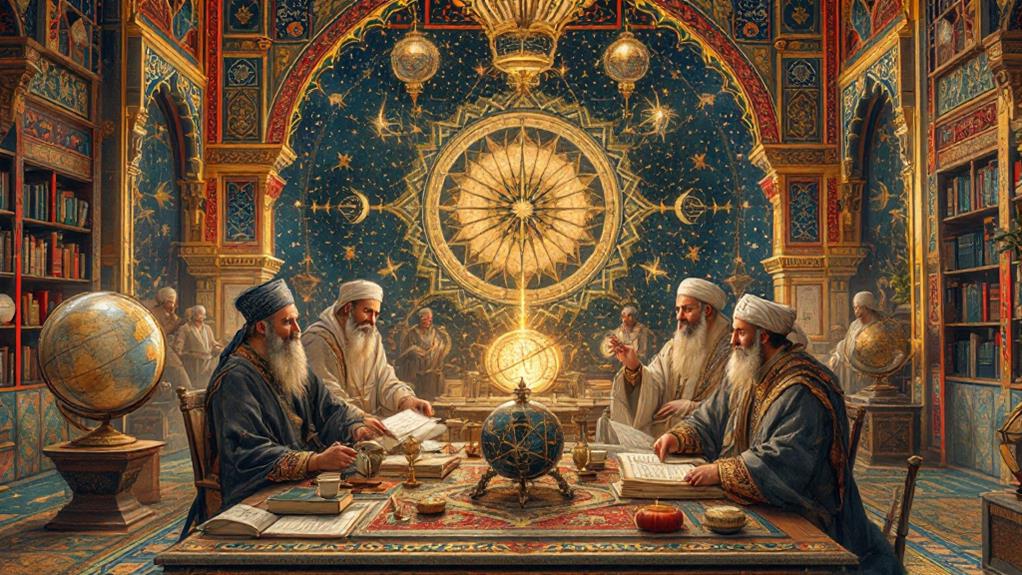
Many profound philosophical works emerged during the Islamic Golden Age, shaping intellectual thought across cultures. As you investigate this rich period, you'll find that thinkers like Al-Farabi, Avicenna, and Averroes made significant contributions to moral philosophy and metaphysical inquiries. They didn't just interpret existing Greek philosophy but expanded upon it, blending it with Islamic thought to create a unique intellectual tradition.
You might examine Al-Farabi's works, where he analyzes the nature of the ideal state, emphasizing ethics and the role of the philosopher in society. His writings challenge you to reflect on how moral philosophy can guide governance and individual actions. Avicenna, known for his "Book of Healing," intertwines metaphysical inquiries with a deep understanding of existence, urging you to question the nature of the soul and its relation to the divine.
Averroes, or Ibn Rushd, offers compelling commentaries on Aristotle, inviting you to reconcile reason and faith. His works encourage a dialogue between philosophy and religion, pushing you to think critically about their coexistence. By engaging with these manuscripts, you gain insight into a time when philosophy was a bridge between diverse cultures and ideas.
Contributions to Medicine and Healthcare
While philosophers like Al-Farabi, Avicenna, and Averroes broadened intellectual horizons through their explorations of thought and reason, their contemporaries were making groundbreaking strides in medicine and healthcare. You'd be amazed at the creative approaches they developed, which continue to influence modern practices. These pioneers accepted a holistic approach, integrating herbal remedies and advanced diagnostic methods to treat patients effectively. They laid the foundation for medical ethics, emphasizing patient care and confidentiality.
Consider these three remarkable contributions:
- Surgical Techniques: Surgeons like Al-Zahrawi transformed procedures with detailed manuals, improving precision and patient outcomes.
- Anatomical Studies: Scholars conducted extensive anatomical studies, enhancing understanding of the human body, which informed better treatment plans.
- Public Health: Early initiatives in public health focused on hygiene and disease prevention, setting the stage for future advancements in community health.
You'll find that these manuscripts also explore pharmacy practices, offering insights into the preparation and use of medicinal compounds. This period's emphasis on evidence-based practices and scientific inquiry not only enriched the medical field but also fostered a culture of learning and creativity that echoes even today.
Theological Texts and Interpretations
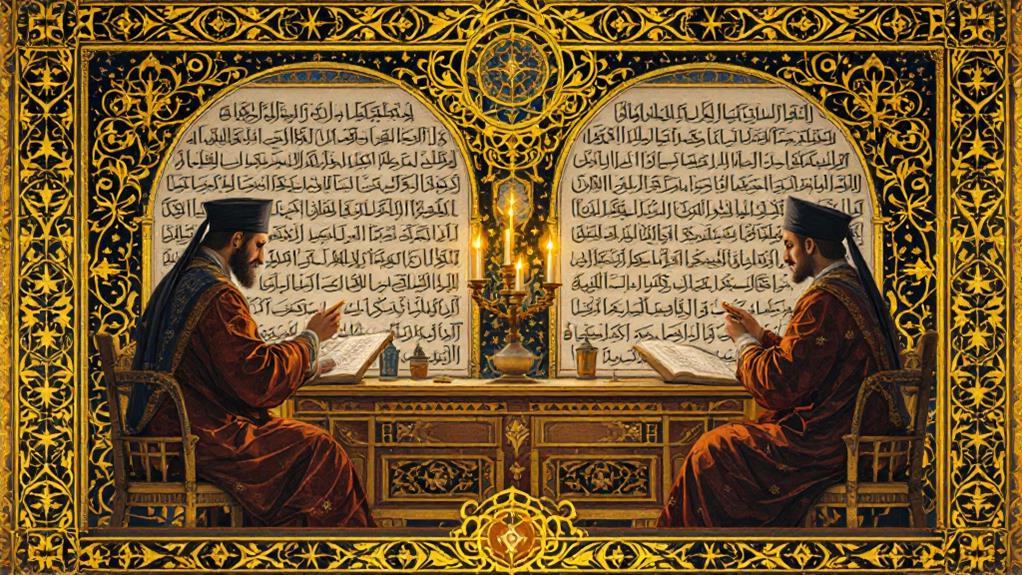
Often, the theological texts from the Islamic Golden Age offer profound insights into the spiritual and philosophical dimensions of Islam. As you investigate these manuscripts, you'll encounter mystical interpretations that bolster your understanding of faith. These writings invite you into religious debates where scholars rigorously examined scriptural analysis, aiming to clarify complex theological frameworks.
The age's theological texts aren't just scholarly pursuits; they're rich with faith-based ethics that guide personal and societal conduct. You'll find that these writings laid the groundwork for interfaith dialogues, fostering mutual respect and understanding across diverse religious communities. By traversing these texts, you gain a deeper appreciation for how doctrinal developments shaped Islamic thought.
Spiritual writings from this period tap into the essence of divine love and humanity's connection to the Creator. They examine themes that resonate with the heart, offering comfort and guidance. As you read, you'll see that these theological inquiries are not static; they evolve, reflecting the dynamic nature of faith throughout history. Ultimately, these manuscripts serve as a demonstration of the enduring power of knowledge and belief, inspiring both personal reflection and broader cultural understanding.
Artistic Expression in Manuscripts
As you examine the rich tapestry of theological texts from the Islamic Golden Age, you'll also reveal that these manuscripts aren't just vessels of knowledge but are adorned with lively artistic expression. The artistry in these manuscripts isn't just for decoration; it's a profound expression of faith and creativity. You'll notice how calligraphy techniques transform words into flowing art, with script styles that vary across regions, reflecting diverse cultural influences.
Manuscript illumination brings vivid life to the pages, using gold leaf and colorful pigments to create intricate designs. These illuminations often include visual symbolism, where even a single motif can convey deep meanings. Decorative motifs, like geometric patterns and floral designs, are woven seamlessly into the storytelling traditions, enhancing the narrative while preserving the manuscript's sacred nature.
Here are three intriguing aspects to investigate:
- Artistic Styles: Identify how regional artistic styles shaped manuscript design and layout.
- Material Craftsmanship: Recognize the skillful material craftsmanship that went into selecting the finest papers and inks.
- Cultural Influences: Understand how cultural influences and exchanges enriched the artistic expression within these manuscripts.
Each aspect of these manuscripts offers a glimpse into a world where art and knowledge were inseparable.
Legacy and Modern Relevance
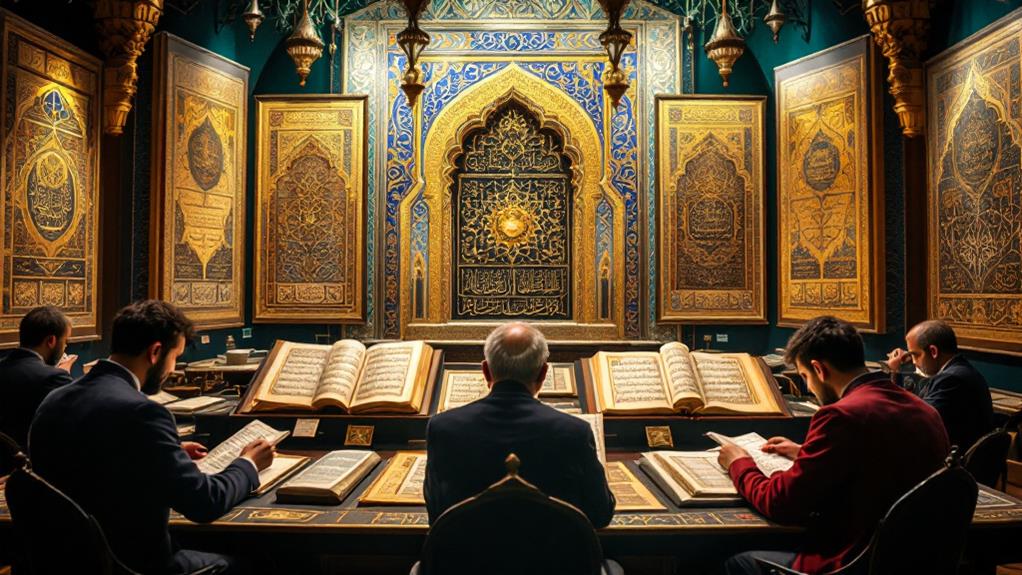
The legacy of Islamic Golden Period manuscripts is undeniably profound, as these texts continue to influence both historical scholarship and contemporary art. You can see their impact through cultural exchange, where manuscripts traveled across borders, fostering dialogues between civilizations. This period's dedication to manuscript preservation has allowed these works to survive, offering a window into a world of linguistic diversity and religious tolerance that shaped the intellectual landscape.
These manuscripts weren't just academic relics; they contributed considerably to educational impact. Scholars today still refer to these texts for insights into the past, appreciating their historical importance. They serve as a demonstration of an period where interdisciplinary collaboration was the norm, blending science, philosophy, and theology in ways that are still relevant today.
Modern applications of these manuscripts are plenty. You'll find their influence in digital humanities projects, which aim to bring these ancient texts into the digital era, ensuring wider access and continued study. Artists and designers draw inspiration from their intricate patterns and calligraphy, merging tradition with innovation. Their legacy teaches you the value of preserving knowledge and fostering an environment where diverse ideas and beliefs can coexist harmoniously.
Related posts