
Islamic Golden Age Manuscripts: Contributions to Astronomy, Medicine, and More

During the Islamic Golden Era, manuscripts played a significant role in advancing fields like astronomy and medicine. You'd find detailed records on refining astronomical instruments, predicting celestial events, and influencing navigation. In medicine, they examined anatomy, ethical practices, and improved surgical techniques. These texts didn't just preserve knowledge; they transformed it, contributing to algebra and even shaping Western philosophical thought. Scholars translated and shared Greek, Persian, and Sanskrit works, fostering intellectual growth across cultures. Their legacy continues to impact diverse domains, and by investigating these manuscripts, you're initiating a quest through a rich tapestry of interconnected knowledge.
Astronomical Innovations
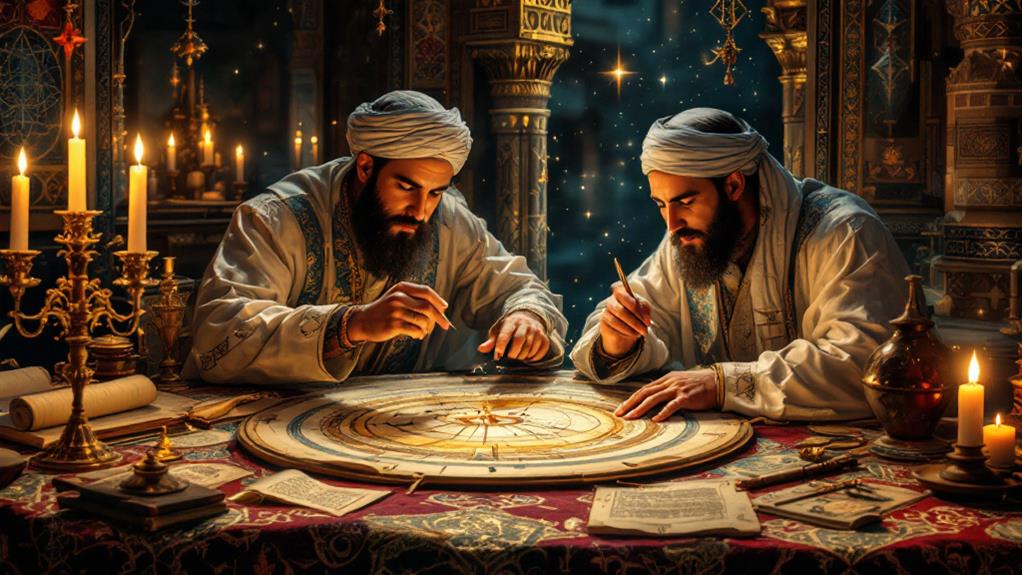
During the Islamic Golden Age, remarkable astronomical advancements emerged that transformed the way we comprehend the cosmos. You're about to uncover how scholars of this period developed tools and techniques that changed celestial navigation and the study of heavenly bodies. They crafted sophisticated astronomical instruments, like the astrolabe, which allowed you to measure the positions of stars and planets with impressive accuracy. This was essential for navigation, enabling sailors to chart their courses across vast oceans with greater precision.
These scholars also refined existing tools, improving their accuracy and usability. The quadrant and armillary sphere are other examples of their creative spirit. With these tools, you could determine the time of day or night, broaden your understanding of celestial movements, and even predict eclipses. Such advancements weren't just about observing the heavens; they were practical, directly impacting trade and exploration.
The careful work of these astronomers laid the foundation for future generations, influencing European Renaissance thinkers and beyond. Their manuscripts, rich with knowledge and observations, are a reflection of a time when curiosity and creativity were at the heart of understanding the universe. You can still feel their legacy in the modern astronomy of today.
Medical Advancements
In the heart of the Islamic Golden Age, medical advancements flourished, transforming the field of healthcare and leaving an indelible mark on medical sciences. You'd find that scholars of the time explored anatomical studies, laying the groundwork for modern anatomy. They carefully analyzed human bodies, bringing clarity to the structure and function of diverse organs.
Herbal remedies were a cornerstone in their approach to treatment. They didn't just rely on surgical techniques but also tapped into the natural world, crafting medicines from plants and herbs. The emphasis on medical ethics was paramount, guiding physicians to practice medicine with compassion and integrity.
Public health and disease prevention were not ignored. They prioritized creating environments that reduced the spread of illnesses, understanding the importance of sanitation and clean water. This thorough approach to healthcare guaranteed that communities thrived.
Surgical techniques were also advanced during this period. Physicians refined procedures, guaranteeing safer and more effective operations. These innovations set the stage for future generations, showcasing a blend of science and empathy. By integrating these principles, Islamic scholars of the Golden Age profoundly shaped the trajectory of medicine, influencing practices even today.
Mathematical Achievements
Amidst the intellectual fervor of the Islamic Golden Age, mathematicians made groundbreaking strides that would alter the course of history. You'd be amazed at how these scholars laid the foundation for modern mathematics. Algebra development was one of their most significant contributions. The term "algebra" itself originates from the Arabic word "al-jabr," introduced by the mathematician Al-Khwarizmi in his seminal work, "The Compendious Book on Calculation by Completion and Balancing." This text formalized the basic methods for solving linear and quadratic equations, and it's considered a cornerstone in the field.
But it wasn't just algebra where they excelled. Geometric theories flourished as well, thanks to the efforts of figures like Omar Khayyam, who not only was a talented poet but also a formidable mathematician. He made significant advancements in understanding the properties of conic sections, which would later influence European mathematicians during the Renaissance.
Through careful translations and commentaries, these scholars preserved and expanded upon the works of ancient Greeks, infusing them with original insights. This intellectual exchange set the stage for future innovations, emphasizing the enduring impact of their mathematical achievements on the world.
Philosophical Insights
The Islamic Golden Age wasn't just about scientific and mathematical brilliance; it was also a period rich with philosophical insights that continue to resonate today. You investigate the works of thinkers like Al-Farabi, Avicenna, and Al-Ghazali and uncover a wealth of ideas that challenge your mind. These scholars didn't just ponder the universe; they tackled ethical considerations and metaphysical inquiries that still provoke thought and debate.
During this time, philosophers grappled with questions about existence, morality, and the nature of knowledge. They examined the interplay between faith and reason, aiming to harmonize religious beliefs with philosophical thought. Their work laid the groundwork for many philosophical traditions that followed.
Consider these key aspects of their philosophical contributions:
- Metaphysical investigation: Examining the nature of reality and existence.
- Ethical frameworks: Developing systems of morality that guide human behavior.
- Integration of faith and reason: Balancing spiritual beliefs with intellectual inquiry.
- Influence on Western philosophy: Providing foundational ideas for later European thinkers.
- Interdisciplinary approaches: Merging philosophy with science, medicine, and the arts.
Preservation and Legacy

While you investigate the profound philosophical insights of the Islamic Golden Period, it's vital to recognize how these ideas have endured and evolved through the careful preservation of manuscripts. Scholars of this period understood the importance of safeguarding knowledge, and their efforts guaranteed the survival of invaluable texts. Through thorough copying and storage, these manuscripts became a bridge between ancient and medieval thought.
Manuscript translation played a significant role in this process. You'd find that scholars translated works from Greek, Persian, and Sanskrit into Arabic, facilitating an unparalleled cultural exchange. This translation movement wasn't just about preserving existing knowledge; it sparked a wave of intellectual growth and innovation. As Arabic texts later found their way into Latin and other languages, the knowledge dissemination continued, impacting European Renaissance thought considerably.
The historical impact of these preserved texts is immense. They laid the groundwork for advancements in astronomy, medicine, and more, serving as a proof of the enduring legacy of the Islamic Golden Age. By understanding and valuing this legacy, you contribute to a tradition of learning and enlightenment that transcends borders and generations, reminding us all of the profound interconnectedness of human knowledge.
Related posts