How Political Power Influenced the Production of Historical Folios
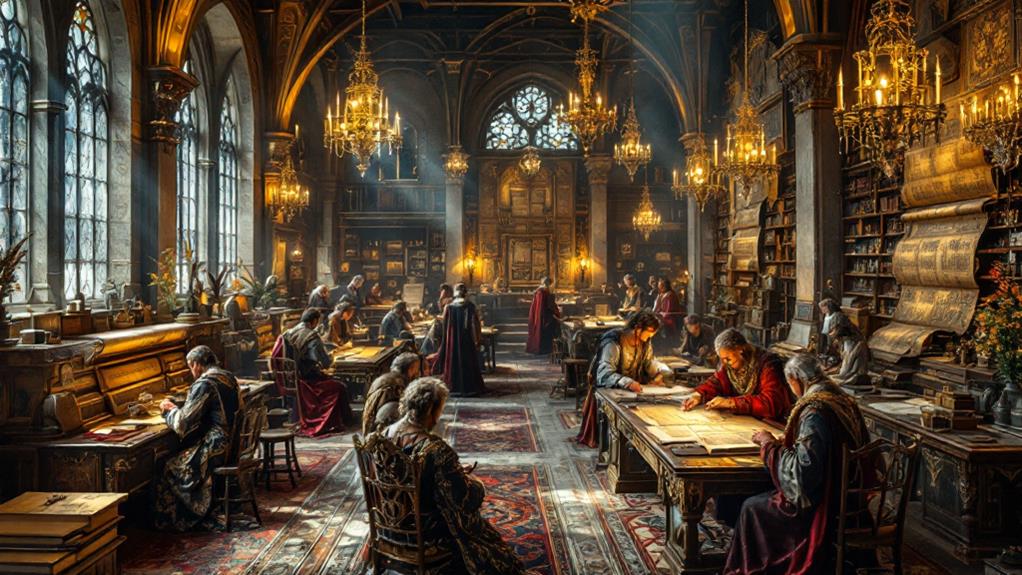
Political power greatly shaped the production of historical folios. Rulers often used patronage to strengthen their reign, backing artists whose works reinforced their authority and aligned with political agendas. Those creating these folios operated under constraints, as censorship and state intervention clamped down on narratives contrary to the ruler's ideology. Folios served as propaganda tools, glorifying leaders and obscuring uncomfortable truths. The selective storytelling favored by those in power erased marginalized voices, leaving gaps in our understanding of the past. Engaging with these influences uncovers deeper insights into how history was documented and remembered.
Patronage and Political Agendas
When you investigate the intricate relationship between patronage and political agendas, you'll uncover how rulers and influential figures have historically used patronage as a strategic tool to consolidate power. By offering support to artists, these powerful patrons not only influenced the artistic freedom but also guaranteed that the content created aligned with their political motives. This sponsorship often came with strings attached, as artists were subtly or overtly directed to produce work that mirrored the values or glorified the achievements of their patrons. In many cases, these works were designed to reinforce the ruling elite's authority and legitimacy.
Understanding the historical context is vital here. Throughout history, be it during the Renaissance or in the courts of medieval monarchs, the arts flourished under the watchful eye of patronage. Artists, while granted some degree of creative expression, were expected to navigate the delicate balance between their own artistic freedom and the desires of those who funded their work. This relationship wasn't merely about creativity; it was a calculated exchange where art served as a vehicle for political expression. The patronage system illustrated how art and politics were intricately intertwined, each shaping the other in profound ways.
Censorship and Content Control
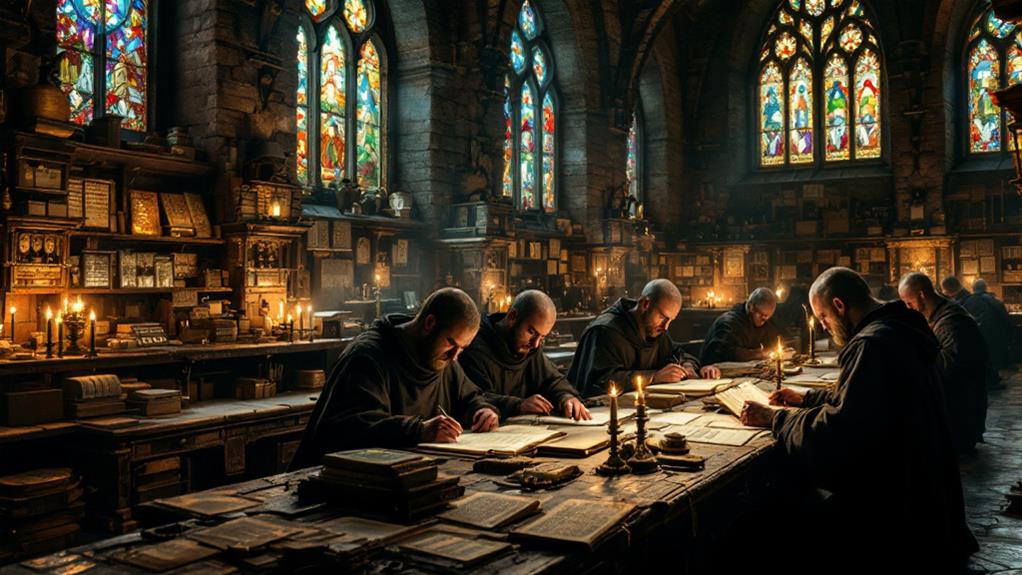
Exploring the domain of censorship and content control reveals how authorities have historically sought to manipulate and restrict artistic expression to maintain their power. You might not realize how deeply state intervention can reach into the creative world, reshaping narratives to fit a specific agenda. Through ideological filtering, those in power have controlled what gets published, ensuring that only favorable interpretations of history and culture see the light of day.
Consider the emotions stirred when:
- Voices are silenced: Imagine your work getting banned or altered because it challenges the prevailing ideology.
- History is rewritten: Your understanding of the past becomes a tool for those in power, distorting facts to suit their narrative.
- Fear stifles creativity: You're forced to self-censor, afraid of repercussions if your art doesn't align with sanctioned views.
The impact of these actions can't be overstated. They shape societies, influence beliefs, and often rewrite the collective memory of entire cultures. State intervention and ideological filtering have left indelible marks on history, affecting not only the creators but also the audiences who consume these narratives. Your awareness of this control can empower you to question and seek the truth beyond censored pages.
Propaganda in Historical Narratives
Throughout history, propaganda has been a powerful tool wielded by those in power to shape historical narratives. When you examine historical folios, you can see how narrative framing is used to influence public perception. Leaders often mold these narratives to present themselves and their actions favorably, guaranteeing that their ideological bias permeates the records. By doing so, they aim to legitimize their rule and policies, often glossing over unfavorable events or opponents.
You might notice how certain events are highlighted while others are minimized or omitted, creating a skewed view of history. This selective storytelling isn't accidental; it's a deliberate attempt to control the collective memory of society. Propaganda in historical narratives often involves glorifying victories, demonizing enemies, and portraying the ruling class as benevolent. The resulting narrative framing guarantees that these stories align with the prevailing ideological bias.
As you read these historical accounts, it's vital to question who benefits from the narrative and what perspectives might be missing. By recognizing the presence of propaganda, you gain a deeper understanding of how power dynamics have shaped the way history is recorded and remembered.
Forgotten Voices and Omissions
Amidst the grand narratives of history, forgotten voices and omissions often lurk in the shadows, waiting to be rediscovered. As you explore deeper into historical folios, you'll notice how political power has often dictated which stories are told and which are muted. Marginalized narratives, those of the oppressed and silenced, frequently fall by the wayside. Their exclusion is not mere oversight but a deliberate act, shaping our understanding of the past. These historical silences leave you with an incomplete picture, filled with gaps and unanswered questions.
Consider the emotional impact of these omissions:
- Loss of Identity: Imagine losing the stories that define your cultural heritage, erased because they didn't serve the dominant narrative.
- Injustice Unseen: The tales of suffering and resilience of countless individuals remain untold, denying justice and understanding.
- Voices Silenced: Generations miss out on diverse perspectives, as only the loudest voices are heard and remembered.
Legacy and Historical Memory
Consider how the stories we choose to remember shape our collective legacy. You're constantly influenced by historical narratives—those carefully curated tales that decide which events become cornerstones of collective memory. Political power plays an essential role in this process, subtly guiding which stories are amplified and which are silenced. When you think of history, you're really recalling a tapestry woven by those in power, highlighting victories and downplaying defeats to create a desired image.
Your understanding of history is often a reflection of these narratives. Political forces have long shaped historical memory by deciding which figures become heroes and which are relegated to footnotes. This selective remembrance impacts your perception of the past and, consequently, the present. It informs how societies understand themselves and their evolution, influencing national identity and cultural pride.
As you explore historical folios, question the motives behind the narratives they present. Ask yourself whose voices are missing and why. By actively engaging with history, you contribute to a more inclusive collective memory. This isn't just about preserving the past; it's about shaping the future's understanding of itself. Your role in this is more significant than you might think.
Related posts