
How Islamic Golden Age Manuscripts Preserved and Advanced Ancient Knowledge

During the Islamic Golden Era, you'd find that scholars weren't just preserving ancient knowledge from Greek, Persian, Indian, and other civilizations; they were actively enhancing it. Through translation movements, these scholars transformed Arabic into a major language of scientific discourse by translating and refining texts. Manuscripts acted as hubs of knowledge, circulating innovations in mathematics, medicine, and astronomy from centers like Baghdad's House of Wisdom. These advancements didn't just stay within the Islamic world; they greatly impacted Western thought, laying the groundwork for the Renaissance. Exploring further will reveal the profound influence these manuscripts had on global intellectual development.
Foundations of the Islamic Golden Age
The foundations of the Islamic Golden Period are intricately tied to a confluence of cultural, scientific, and intellectual advancements that began in the 8th century. You'd find that during this time, the Islamic world became a melting pot of ideas, where cultural exchanges flourished. As you investigate this era, you'll notice how diverse civilizations, including Greek, Persian, Indian, and Chinese, contributed to the rich tapestry of knowledge and innovation. Scholars enthusiastically participated in philosophical dialogues, fueling an intellectual curiosity that would define the epoch.
In this dynamic environment, you'd see that individuals were not just passive recipients of knowledge, but active contributors. They engaged in debates and discussions, pushing the boundaries of existing thought. Philosophical dialogues weren't confined to the abstract; they addressed practical issues, laying the groundwork for advancements in medicine, mathematics, and astronomy. By embracing and synthesizing these diverse influences, the Islamic Golden Age became a guiding light of enlightenment.
Your understanding of this period reveals a society driven by a quest for knowledge, where cultural exchanges and philosophical dialogues were at the heart of its lively intellectual ecosystem. This foundational synergy set the stage for remarkable achievements and lasting legacies.
Role of Translation Movements
As you examine the dynamic intellectual landscape of the Islamic Golden Age, one can't overlook the transformative role of translation movements. These movements were crucial in bridging knowledge across civilizations. You see, scholars from the Islamic world didn't just translate texts—they refined translation techniques to guarantee accuracy and clarity. They carefully converted works from Greek, Persian, Sanskrit, and other languages into Arabic. This wasn't merely about language; it was about preserving and enhancing the essence of scientific, philosophical, and medical wisdom.
Translation movements facilitated lively cultural exchange. Imagine the thriving centers where scholars gathered, sharing insights and debating ideas. They weren't just translators; they were intellectual adventurers, maneuvering through the complexities of ancient texts to reveal their secrets. This dynamic exchange enriched Islamic culture and propelled it to the forefront of global intellectual development.
Centers of Learning and Innovation

Picture lively cities like Baghdad, Cordoba, and Cairo during the Islamic Golden Period, where centers of learning and innovation thrived. These cities weren't just bustling marketplaces; they were lively hubs of intellectual activity. You'd find scholars from different backgrounds engaging in spirited discussions, exchanging ideas, and sharing knowledge. Scholarly networks connected thinkers across vast distances, creating a web of intellectual collaboration that spanned continents.
In these centers, you'd witness an unparalleled fusion of distinct cultures and traditions. Cultural exchanges were abundant, as scholars translated texts from Greek, Persian, Indian, and other sources into Arabic. This melting pot of information fueled advancements in science, philosophy, mathematics, and medicine. It wasn't just about preserving ancient knowledge; it was about building upon it, refining it, and making groundbreaking revelations.
Institutions like the House of Wisdom in Baghdad attracted the brightest minds, acting as magnets for innovation. Here, scholars didn't work in isolation. They collaborated, debated, and inspired one another, fostering an environment where creativity thrived. So, when you think of the Islamic Golden Era, imagine not just the preservation of ancient wisdom, but the dynamic centers that propelled humanity forward.
Manuscripts as Knowledge Hubs
Imagine opening a manuscript from the Islamic Golden Period, where pages brim with knowledge from diverse disciplines, acting as lively knowledge hubs. You'd find that these manuscripts weren't just static documents; they were dynamic vessels for preserving and disseminating knowledge across generations. Scholars carefully copied and translated works from Greek, Persian, Indian, and other cultures, guaranteeing that valuable insights weren't lost to time. Through manuscript preservation, the wisdom of the ancients was safeguarded and shared widely, transcending geographical and cultural boundaries.
In this colorful period, manuscripts served as conduits for knowledge dissemination. They connected scholars, allowing them to build on existing ideas and contribute new insights. Libraries, like the renowned House of Wisdom in Baghdad, became centers where these manuscripts were housed, studied, and circulated. As you investigate these texts, you'll witness how they facilitated an exchange of ideas in fields like astronomy, medicine, and philosophy. Manuscripts became crucial tools for learning and innovation, fostering a culture of intellectual growth and curiosity. By preserving these significant works, Islamic scholars guaranteed that the flame of knowledge burned brightly, guiding future generations in their quest for understanding.
Advancements in Mathematics

While manuscripts acted as lively knowledge hubs, they also paved the way for remarkable advancements in mathematics during the Islamic Golden Age. You'd find that scholars didn't just preserve ancient mathematical texts; they expanded on them, creating groundbreaking concepts. One of the most significant contributions was in the domain of algebraic innovations. Mathematicians like Al-Khwarizmi introduced systematic solutions to linear and quadratic equations, laying the foundation for algebra as it is understood today. His works, translated into Latin, heavily influenced Western mathematics, proving that these manuscripts were instrumental in the global spread of mathematical knowledge.
Along with algebra, you'd see immense progress in geometric applications. Islamic mathematicians excelled in developing geometric solutions to problems, advancing the field well beyond its classical roots. They applied geometry to architecture, creating intricate designs and structures that still awe modern architects. This period saw the introduction of trigonometry as a separate discipline, with scholars calculating precise astronomical measurements and contributing to navigation techniques.
Medical Knowledge and Practices
During the Islamic Golden Period, numerous manuscripts served as invaluable repositories of medical knowledge and practices. You'd find that these texts didn't just preserve ancient wisdom but also advanced it considerably. Physicians of the time focused on refining diagnostic methods, ensuring they'd accurately identify a patient's condition. They emphasized observing symptoms closely, a practice that laid the groundwork for modern diagnostics.
Herbal remedies were a cornerstone of their medical treatments. Manuscripts detailed diverse plants and their healing properties, offering you insights into how natural elements could be used for health. You'd uncover that these texts carefully cataloged treatments for ailments, ranging from common colds to more complex diseases.
Surgical techniques also saw remarkable advancements. Surgeons in the Islamic Golden Time developed sophisticated tools and methods, which they documented in these manuscripts. It's fascinating how they performed surgeries with precision, often underpinned by principles of medical ethics that stressed patient care and safety.
Contributions to Astronomy
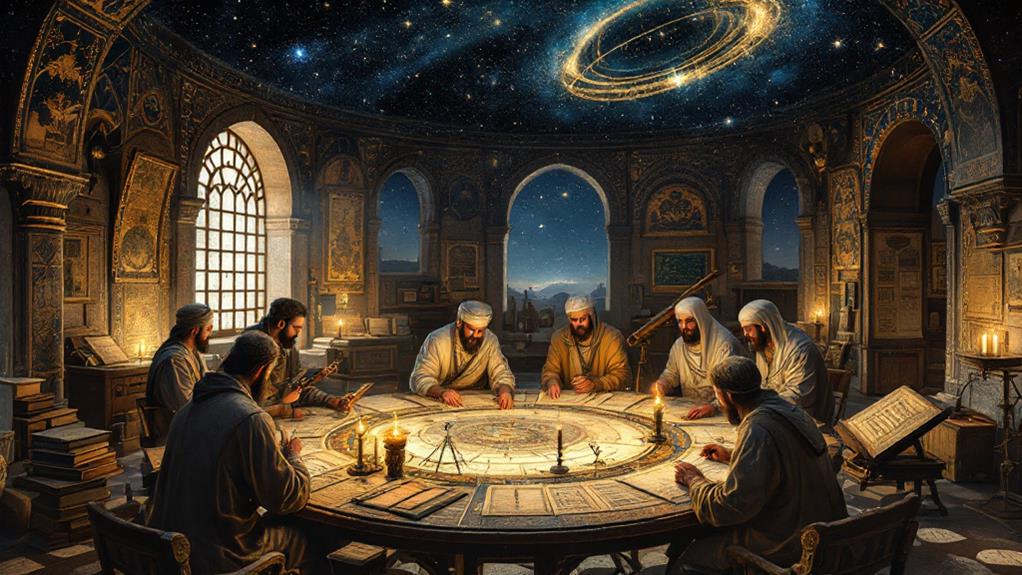
As you shift your gaze from the medical manuscripts to the stars, you'll uncover that the Islamic Golden Period was likewise transformative in the domain of astronomy. During this time, scholars made remarkable advancements through precise celestial observations. They carefully recorded the movement of stars and planets, refining the knowledge inherited from ancient civilizations like the Greeks and Persians. Their dedication to observing the heavens led to significant improvements in astronomical understanding.
In these pursuits, they developed sophisticated astronomical instruments that improved their ability to study the cosmos. Instruments such as the astrolabe and the armillary sphere became cornerstones of observational astronomy. These devices not only helped astronomers map the skies with unprecedented accuracy but also facilitated navigation and timekeeping. The astrolabe, in particular, became an essential tool, enabling users to determine the positions of celestial bodies at any given time.
Moreover, scholars like Al-Battani and Al-Sufi made substantial contributions by compiling star catalogs and improving the accuracy of astronomical tables. These advancements laid the groundwork for future astronomical endeavors, ensuring that the Islamic Golden Period's legacy of celestial exploration would endure for generations to come.
Influence on Western Thought
The legacy of the Islamic Golden Age is a demonstration to the power of intellectual exchange and its profound influence on Western thought. During this period, Islamic scholars didn't just preserve ancient knowledge; they expanded it with groundbreaking philosophical insights. You'll find that their contributions were essential in shaping the intellectual landscape of the West. Through a dynamic cultural exchange, they transmitted significant works of Aristotle, Plato, and other Greek philosophers, which would later inspire the European Renaissance.
Here's how they influenced Western thought:
- Philosophical Insights: Islamic scholars like Avicenna and Averroes provided new interpretations of Greek philosophy, which were later studied extensively in European universities.
- Mathematical Innovations: Algebra and trigonometry, developed further by mathematicians like Al-Khwarizmi, became foundational for European scientific advancements.
- Medical Knowledge: Compilations such as Avicenna's "The Canon of Medicine" guided Western medicine for centuries.
- Astronomical Contributions: The work of astronomers like Al-Battani was fundamental in developing the heliocentric model of the solar system in Europe.
Related posts