
How Historians Use Folios to Uncover Insights About the Past

To uncover insights about the past, you should explore folios, which are primary sources such as personal letters, diaries, official records, and legal documents. These artifacts reveal societal norms, governmental structures, and personal stories, providing a firsthand look into historical events and contexts. You have to navigate challenges like deciphering old handwriting and ensuring proper preservation to prevent damage. Using these insights, you can trace lineages, understand cultural shifts, and appreciate the nuances of past lives. Each folio tells part of a larger story, inviting you to unravel the complexities of history in fascinating ways.
Understanding Folios in History
In the historian's toolkit, folios play a vital role in piecing together the past. You're opening a window to history when you explore these rich documents. Folios are significant because they contain firsthand accounts, official records, and other invaluable data that help you understand historical contexts and events. They present a tangible connection to the past, offering insights that are often absent in secondary sources. By examining the folio significance, you can uncover details about societal norms, governance, and cultural practices of a bygone period.
Mastering archival practices is fundamental for efficiently working with folios. You need to know how to access, preserve, and interpret these documents. Libraries and archives have specific protocols to guarantee that folios remain intact for future generations. You'll often find yourself in environments where careful handling and thorough organization are paramount. Developing these skills allows you to extract meaningful information without damaging the historical artifacts.
Types of Folios Analyzed
When exploring the types of folios historians analyze, you'll uncover a wide range of documents that each tell a unique story. Folio types range from personal letters and diaries to official records and maps. Each type offers a different perspective, enriching your understanding of the past. Personal letters reveal intimate details of daily life, relationships, and cultural norms, while diaries provide a chronological account of individual experiences and emotions.
Official records, such as census data and legal documents, offer insights into governmental structures, population demographics, and societal rules. Maps present geographical changes and territorial understandings throughout history. Each of these folio types requires specific archival methods to preserve and interpret them effectively.
As you investigate these folios, you'll notice historians employ numerous archival methods to handle these delicate documents. Preservation techniques are essential in maintaining their integrity over time, ensuring that future generations can access these invaluable resources. Organizing and cataloging folios systematically allows historians to efficiently locate and analyze them. By understanding the different folio types and the archival methods used to manage them, you gain a deeper appreciation for the careful work historians do to piece together historical narratives.
Deciphering Historical Handwriting

Deciphering historical handwriting often presents a unique challenge for historians, as each script conveys the writer's personality and period's stylistic nuances. When you immerse yourself in old texts, you're not just reading words; you're uncovering stories about the past. The difficulty lies in interpreting different scripts, some of which may be completely unfamiliar. That's where paleographic techniques come in. These methods help you understand and identify distinct handwriting styles, allowing you to piece together the puzzle of historical documents.
To achieve transcription accuracy, you need to pay close attention to detail. Each letter's form, the flow of the pen, and even the ink's pressure can reveal meaning. It's like solving a mystery, where every small clue counts. You'll often compare multiple examples of a scribe's work to ascertain consistency and correct interpretation.
Using digital tools can also aid your efforts. Software that improves faded ink or magnifies tiny script can be invaluable. However, nothing beats the skill developed through practice and experience. As you refine your ability to decipher these texts, you reveal the stories and truths they hold, bringing history to life one letter at a time.
Contextualizing Document Content
As you master the art of deciphering historical handwriting, the next step involves understanding the context in which these documents were created. Contextualizing document content is essential for accurate document analysis and content interpretation. You need to take into account the time period, cultural norms, and socio-political climate that influenced the creation of these texts. This helps you understand not just what's written, but why it was written in a particular way.
Start by identifying the author and their position within society at that time. Understanding their perspective and potential biases can help you assess the reliability and intent behind the document. Reflect on the document's purpose—was it meant to inform, persuade, or record? This will guide your interpretation, allowing you to distinguish between factual reporting and subjective opinion.
Additionally, look at the language and terms used within the document. Language evolves, and terms might have had different meanings in the past. Cross-reference with other documents from the same period to identify common themes or contrasting viewpoints. By placing the document within its broader historical framework, you gain a more nuanced understanding of its significance and the insights it offers into the past.
Tracing Lineage Through Folios

Tracing lineage through historical folios offers a fascinating glimpse into the past, connecting you with your ancestors' stories and heritage. As you engage in genealogical research, these folios serve as invaluable tools to piece together family trees. They contain records, letters, and personal accounts that reveal the lives of those who came before you. By examining these documents, you'll uncover the paths your ancestors took and the connections they forged.
When you investigate historical folios, you can:
- Discover birth, marriage, and death records which are essential in building your family tree.
- Gain insights into historical events that shaped your ancestors' lives, offering a personal perspective on history.
- Identify patterns and trends in your family's past, such as migrations or occupations that were passed down through generations.
- Connect with distant relatives who might share your lineage, providing a broader sense of family.
With each folio, you're not just learning about your ancestry; you're preserving your family's legacy for future generations. Your genealogical research enriches not only your understanding of your roots but also the historical tapestry of human experience. Welcome this expedition and let the past illuminate your present.
Legal Documents as Historical Evidence
Legal documents serve as essential historical evidence, providing a window into the societal norms and personal lives of past generations. When you examine these documents, you uncover the legal terminology that reveals how laws were shaped and enforced. This terminology can tell you a lot about the priorities and challenges of a historical society. For instance, legal codes might emphasize property rights, indicating a society focused on wealth and land ownership.
When you're delving into legal documents, evaluating document authenticity is fundamental. Authentic documents offer accurate reflections of the past, while forgeries or alterations can mislead. Analyzing the paper, ink, and handwriting can help verify a document's authenticity. You should also pay attention to the context in which a document was created to guarantee it's genuine.
Legal documents, such as wills, contracts, and court rulings, provide insights into economic transactions and social hierarchies. They help you understand how people interacted with legal systems and how those systems affected their lives. By studying these documents, you gain a richer understanding of history, filling in gaps that other records might leave. Legal documents aren't just about laws; they're about the people who lived by them.
Personal Letters and Daily Life
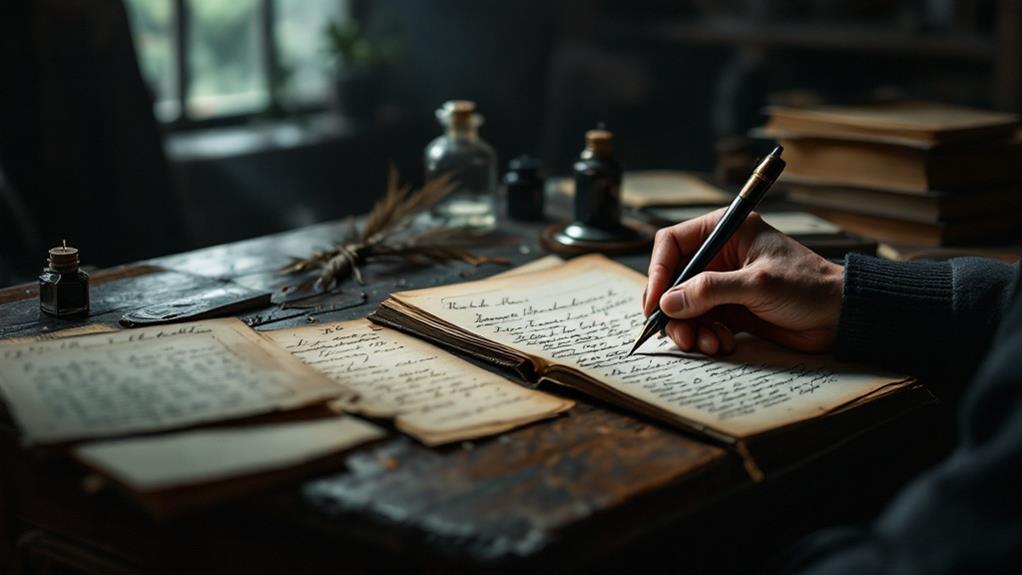
How do personal letters offer a glimpse into the daily life of past societies? When you explore personal correspondence, you're not just reading words; you're uncovering the essence of everyday existence. These letters reveal the daily routines and intimate thoughts of individuals from another time, providing a unique perspective that textbooks can't match. They highlight how people communicated, managed their households, and navigated their social interactions.
Consider what personal letters can reveal:
- Daily Routines: They often describe chores, meals, and leisure activities, painting a vivid picture of what a typical day looked like.
- Social Connections: Letters capture relationships, from romantic entanglements to friendships, offering insight into the social fabric of the time.
- Emotional States: Personal correspondence often explores feelings, fears, and aspirations, giving you a direct line to their emotional world.
- Cultural Norms: By reading these letters, you can understand societal expectations and cultural values that shaped behavior.
Government Records and Policies
To truly understand the inner workings of past societies, investigate their government records and policies. These documents provide a detailed look at how decisions were made and implemented. When you dig into these records, you uncover layers of government transparency, or lack thereof, revealing how openly or secretly policies were created and enforced. This transparency, or the absence of it, can show you a lot about the power dynamics and priorities of a particular time period.
As you examine these records, pay attention to policy evolution. Look at how laws and regulations changed over time and what factors influenced these shifts. Were they responses to social movements, economic pressures, or external threats? By tracking these changes, you gain insights into the adaptability and resilience of governments. Sometimes, policy evolution reflects a government's effort to maintain control, while other times, it shows a genuine attempt to address societal needs.
Government records aren't just about dry facts; they're rich with stories of conflict, compromise, and change. By analyzing these documents, you piece together the puzzle of how societies functioned and how they navigated their challenges.
Folios in Cultural Studies

Exploring folios in cultural studies opens up a world of insights into the societies that produced them. When you probe into these historical documents, you uncover layers of cultural narratives that reveal the values, beliefs, and traditions of past communities. Folios, with their rich content and context, hold significant importance in understanding how different cultures have evolved over time.
By studying folios, you can:
- Uncover the folio significance in preserving cultural heritage.
- Analyze how cultural narratives were constructed and passed down through generations.
- Examine the artistic styles and techniques used in folio illustrations and text.
- Gain insight into the daily lives, struggles, and triumphs of people in different periods.
Each folio offers a unique perspective on the cultural narratives that shaped societies. They serve as windows into the past, providing you with tangible connections to historical events and personal stories. As you investigate these documents, you'll find that folios not only reflect the historical context in which they were created but also influence future interpretations and scholarship. Understanding the folio significance in cultural studies allows you to appreciate the diverse ways in which societies have expressed their identities and experiences throughout history.
Challenges in Folio Preservation
Preserving folios presents a series of challenges that demand careful attention and expertise. You need to take into account the impact of temperature fluctuations, which can wreak havoc on delicate paper and ink. If the temperature isn't stable, folios might warp or crack, and ink could fade, undermining their historical value. It's imperative to maintain a controlled environment to prevent damage over time.
Archival storage plays a significant role in folio preservation. You must guarantee that folios are stored in acid-free folders and boxes to avoid chemical reactions that could deteriorate the material. Humidity is another factor you can't ignore; too much moisture can lead to mold growth, while too little can make the paper brittle. Both scenarios spell disaster for preservation efforts.
Moreover, handling folios improperly can cause irreparable damage. Always use clean, dry hands or wear gloves to protect the folios from oils and dirt. Furthermore, it's important to avoid direct sunlight and harsh lighting, as they can accelerate fading and degradation. By adhering to these practices, you can help guarantee these invaluable historical documents remain accessible for future generations.
Related posts