How Folios Serve as a Bridge to Understanding Ancient Cultures
Folios bring you closer to ancient cultures, revealing their narratives, beliefs, and intricate artistry. They traveled with traders, spreading ideas and transforming texts into art through calligraphy and illuminations. You'll unearth their role in sharing scientific knowledge, from astronomical charts to medical texts. They illuminate social structures, family dynamics, and the everyday lives of the past. Each page serves as a time capsule, offering religious and philosophical insights that still resonate today. By preserving and studying these manuscripts, you connect with a continuum of human experience. Stay engaged to uncover more about these cultural gems.
Historical Significance of Folios
When delving into the historical significance of folios, you'll find they serve as invaluable windows into ancient cultures. They offer more than just text; they encapsulate the narratives, beliefs, and values of civilizations long gone. As you investigate these documents, you'll notice how folios acted as conduits for cultural exchanges. They facilitated the sharing of knowledge across borders, enabling societies to learn from each other's innovations and philosophies. Regardless of trade or conquest, folios traveled, and with them, the seeds of new ideas and traditions were sown.
In examining these manuscripts, pay attention to the narrative techniques employed within. Ancient authors used folios to weave stories that not only entertained but also educated. They incorporated allegories, myths, and historical accounts that reflected their worldview. By analyzing these techniques, you can gain insights into how these societies prioritized knowledge, communicated values, and understood their place in the world. Folios are not just remnants of the past; they're dynamic records that reveal the complexities of human interaction and the evolution of thought. Through them, you'll grasp the profound impact of cultural exchanges on shaping civilizations.
Artistry and Craftsmanship
Artistry and craftsmanship in folios are evident in every detail, from the intricate calligraphy to the brilliant illuminations. When you investigate these ancient manuscripts, you'll notice how each element serves as a piece of visual storytelling. The artisans who created them weren't just skilled; they were masters of cultural symbolism. By examining these works, you can appreciate the effort and dedication it took to produce them.
- Intricate Calligraphy: Every stroke was deliberate, turning text into an art form that conveyed more than words.
- Brilliant Illuminations: The use of lively colors and gold leaf wasn't just decorative; it brought stories to life.
- Cultural Symbolism: Symbols and motifs were carefully chosen to reflect the beliefs and values of the time.
- Detailed Marginalia: Even the margins were filled with artistic flourishes, adding layers to the narrative.
- Masterful Bookbinding: The physical construction of folios was an art in itself, designed to protect these valuables for generations.
Religious and Philosophical Insights

The folios' pages offer a window into the religious and philosophical insights of ancient cultures, revealing profound beliefs and ideas that shaped their worldview. As you investigate these texts, you'll uncover a tapestry of spiritual practices that guided everyday life. These practices weren't just rituals; they were deeply embedded in the fabric of society, influencing everything from governance to personal behavior. By studying these ancient documents, you gain an understanding of how communities connected with the divine and sought to explain the mysteries of existence.
You'll also find ethical teachings scattered throughout these folios, offering guidance on morality and human conduct. These teachings often highlight the importance of virtues like honesty, compassion, and justice. As you examine these ethical frameworks, you might notice similarities with modern values, revealing that the quest for a virtuous life transcends time and culture. These texts can challenge you to reflect on your own beliefs and actions, prompting deeper introspection.
Scientific Knowledge and Discoveries
Delving into the folios reveals a trove of scientific knowledge and findings from ancient cultures. These ancient manuscripts are more than just relics; they're a window into the minds of early scholars who laid the groundwork for modern science. By studying these texts, you gain insights into how scientific ideas were born and disseminated across regions and generations through cultural transmission.
Consider what you might uncover:
- Mathematical Treatises: Uncover complex calculations and proofs that were ahead of their time.
- Astronomical Charts: Investigate how ancient civilizations mapped the stars and predicted celestial events.
- Medical Texts: Learn about early medical practices, remedies, and anatomical drawings that inform today's medicine.
- Botanical Studies: Identify ancient understanding of plants, their uses, and benefits for health and agriculture.
- Engineering Schematics: Examine the ingenuity in ancient architecture and mechanical devices.
These folios highlight how ancient cultures contributed to the scientific knowledge we take for granted today. Each manuscript tells a story of revelation, showing how information was shared and adapted. By engaging with these texts, you don't just learn about past scientific pursuits—you connect with the very essence of human curiosity and innovation.
Social Structures and Daily Life
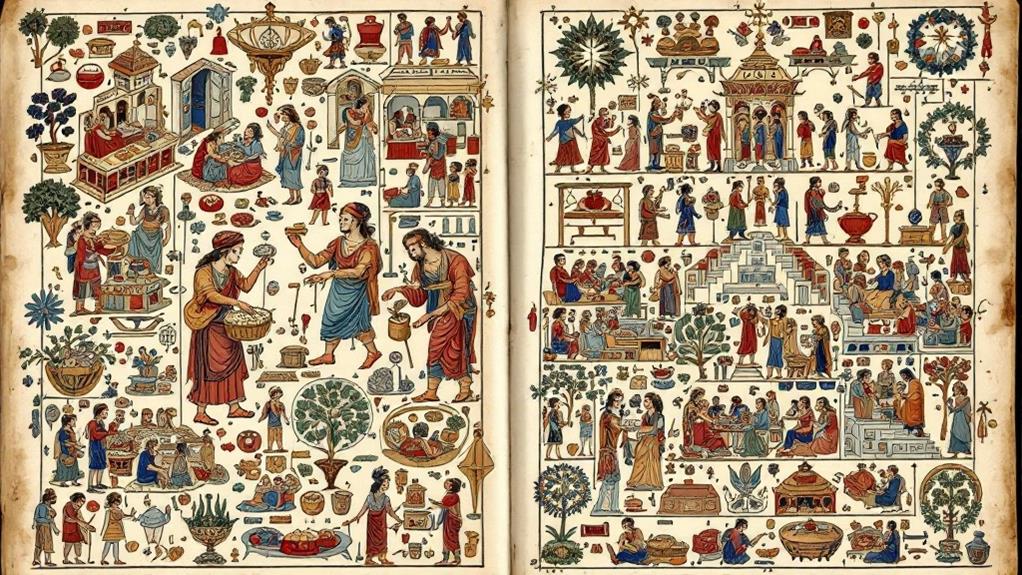
Amid the pages of ancient folios, you'll uncover the intricate web of social structures and daily life that defined past civilizations. These documents reveal how societies organized themselves, shedding light on family dynamics and the roles individuals played within their communities. You'll see that families were often the cornerstone of social order, with roles clearly delineated based on stage, gender, and social status. Folios describe how kinship ties influenced social standing and power, forming the backbone of daily interactions.
As you investigate further, you'll notice how trade networks connected distant regions and cultures. These networks were crucial for economic stability and cultural exchange. Merchants and traders became significant figures, bridging gaps between societies by exchanging goods, ideas, and technologies. The folios illustrate how these interactions shaped societal norms and practices, influencing everything from cuisine to fashion.
In deciphering these ancient texts, you gain insight into not just the hierarchical structures but also the rich tapestry of daily life. From the lively markets to the intimate family gatherings, folios provide a window into a world where social structures were as complex as they were fundamental to survival.
Preservation and Restoration Efforts
Preserving the legacy of ancient folios demands careful attention and unwavering dedication. These fragile works hold stories and insights into past cultures, making their preservation vital for future generations. You play an important role in guaranteeing their survival by using a combination of traditional and modern conservation techniques. Digital archiving has become an invaluable tool, allowing you to store high-resolution images of folios, reducing the need for physical handling. This approach not only safeguards the originals but also makes these artifacts accessible to a wider audience.
Consider these key aspects of preservation:
- Climate Control: Maintain ideal temperature and humidity levels to prevent deterioration.
- Gentle Handling: Always use gloves and proper support to avoid damage.
- Digital Archiving: Create digital copies to minimize direct contact and promote long-term preservation.
- Restoration Skills: Learn techniques to repair and stabilize damaged folios.
- Collaboration: Work with experts in different fields for thorough preservation strategies.
Modern Interpretations and Applications

As you investigate modern interpretations and applications of ancient folios, you'll find they've transcended their original contexts to influence contemporary culture. By probing into these historical documents, you can uncover rich cultural narratives that provide insight into the values, beliefs, and daily lives of ancient civilizations. These narratives aren't just historical relics; they serve as crucial educational tools, offering a window into the past that can inform and inspire present-day thinking.
In classrooms, folios are used to engage students with history in a dynamic way. They allow you to investigate ancient storytelling techniques and artistic expressions, making history tangible and relatable. Museums and digital platforms have also adopted these texts, using them to create interactive exhibits that invite you to connect with ancient cultures on a personal level. This approach fosters a deeper understanding and appreciation for the diversity and complexity of human history.
Moreover, artists and writers draw inspiration from these ancient texts, reinterpreting themes and motifs to create works that resonate with today's audiences. By bridging the gap between past and present, folios continue to shape cultural narratives and serve as powerful educational tools in modern society.
Related posts