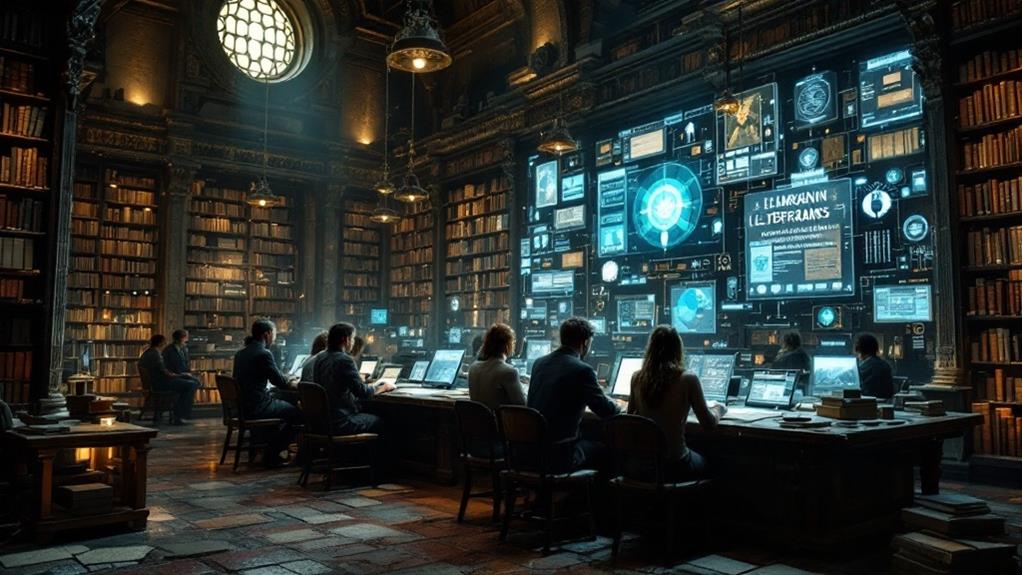
Historical Folios Meet Digital Innovation: Expanding Accessibility

You're seeing how digital innovation is transforming the accessibility of historical folios. By scanning fragile pages into high-resolution images, and using metadata standards and OCR technology, you can investigate these priceless documents without geographical constraints. Online platforms present an interactive way for you to zoom, annotate, and search with ease, fostering a deeper understanding of cultural heritage. Although challenges like metadata maintenance and copyright issues exist, ongoing advancements promise to improve your engagement with history. With these transformative tools, the door opens to even more revelations and enriched historical investigations.
The Evolution of Historical Folios
Throughout history, countless folios have evolved from simple handwritten manuscripts to intricately printed books. As you investigate this evolution, you'll recognize the importance of manuscript preservation in maintaining archival integrity. These folios aren't just relics; they embody the historical significance of our cultural heritage, serving as fundamental resources for scholarly research. By preserving these documents, you help guarantee that future generations can investigate and understand the rich tapestry of human history.
Engaging the public with these historical folios is important. When you present them as educational resources, you're fostering a deeper appreciation for the past. This public engagement can spark curiosity and inspire new generations to investigate historical studies. Additionally, you'll find that digital storytelling plays an essential role in bringing these stories to life, making history accessible and engaging for a broader audience.
Digitization Techniques and Technologies
As you investigate the world of historical folios, you'll notice how digitization has become a significant player in preserving and sharing these valuable documents. Scanning methods are at the forefront, allowing you to capture detailed images of fragile pages without causing damage. High image resolution is vital, guaranteeing every detail is preserved for future study.
Once scanned, metadata standards help you organize and categorize these digital images. They provide fundamental information like the folio's origin, author, and date, making it easier for researchers to find what they're looking for. Optical character recognition (OCR) technology allows you to convert scanned images into searchable text, vastly improving content accessibility for users.
Choosing the right file formats is another significant step. Formats like TIFF and PDF/A are commonly used for their balance of quality and file size, fitting well within preservation strategies. User interfaces play a pivotal role, too, as they offer intuitive ways for you to navigate and interact with the digital collections.
Incorporating these technologies guarantees that historical folios aren't just preserved but also accessible to a wider audience, effectively bridging the gap between past and present.
Enhancing Global Access

Digital innovation has opened countless doors for enhancing global access to historical folios. You can now investigate your cultural heritage from anywhere around the world. With open access platforms, these cherished documents are at your fingertips, fostering a deeper understanding of history. Global collaboration among institutions allows for the sharing of resources and expertise, making it easier for you to engage with these rich collections.
Archival partnerships play a significant role in this effort. By working together, archives and libraries can digitize and share their collections, increasing the availability of educational resources worldwide. This cooperation not only enriches the global pool of knowledge but also encourages community engagement. You have the opportunity to participate in discussions and projects that promote the appreciation and preservation of these historical works.
To fully benefit from these resources, digital literacy is fundamental. Understanding how to navigate digital platforms helps you access folios efficiently and responsibly. Educational programs focusing on digital skills are essential for guaranteeing everyone can partake in this cultural exchange. By embracing digital innovation, you help guarantee that historical folios remain accessible to all, fostering a more connected and informed global community.
Preserving Fragile Documents
How do we guarantee the longevity of fragile documents in an ever-changing online environment? The key lies in the detailed process of document conservation and archival preservation. You need to recognize that preserving these delicate items requires a strategic approach that combines traditional methods with modern technology. Start by making certain that physical documents are stored in a controlled environment. Use acid-free folders and boxes to prevent deterioration and keep them away from light, humidity, and pests.
Digital innovation plays a vital role here. By digitizing fragile documents, you create a backup that guarantees their content isn't lost to time. Use high-resolution scanners to capture every detail, and store these digital files in multiple secure locations. This way, even if the original document suffers damage, its digital counterpart remains intact.
Overcoming Geographical Barriers

Across the globe, people face the challenge of accessing historical documents due to geographical constraints. You're not alone if you've struggled to visit distant archives or libraries housing invaluable historical folios. These barriers limit your ability to engage with cultural artifacts and participate in meaningful cultural exchange. Fortunately, digital innovation is paving the way for overcoming these obstacles, making it easier for you to investigate historical documents from the comfort of your own space.
By digitizing collections, institutions break down physical barriers, allowing you to access documents that were once only available to those who could travel to them. This expansion isn't just about convenience; it's a significant educational outreach effort. You can now immerse yourself in history, improve your learning, and deepen your understanding of different cultures without geographical limitations.
Moreover, digital access to these documents fosters a global dialogue, encouraging you to share insights and findings with others across the world. This sharing enriches your perspective and contributes to a collective knowledge pool, driving forward cultural exchange. As geographical barriers crumble, you find yourself in a world where historical documents are just a click away, opening doors to endless possibilities.
Interactive Online Platforms
With geographical barriers fading thanks to digital innovation, interactive online platforms step in to revolutionize how you explore historical documents. No longer do you need to travel to distant archives or sift through dusty tomes. These platforms bring historical folios directly to your screen, transforming your exploration into an engaging digital expedition. By leveraging advanced user interfaces, they guarantee you navigate vast collections with ease, enhancing user engagement and making research more intuitive.
Imagine accessing a bounty of history from your living room. Interactive features like zooming into high-resolution images or clicking annotations provide a tactile sense of revelation, akin to handling the original documents. These platforms often include search functions to swiftly locate specific text or topics, saving you countless hours of manual research.
The user interface plays a significant role in your digital experience. A well-designed interface provides seamless interaction, allowing you to focus on content rather than technical hurdles. Many platforms also offer collaborative tools, enabling you and other users to share insights and discuss findings in real-time, fostering a lively community of history enthusiasts. Therefore, interactive online platforms don't just make history accessible—they make it alive.
Challenges in Digital Conversion

Digital conversion of historical folios isn't without its challenges. You might think it's a straightforward process, but there's a lot more to it. Maintaining metadata standards is essential for guaranteeing that digital records are both accurate and accessible. However, copyright issues can hinder access to some materials, leaving you frustrated. Balancing user engagement with respect for archival ethics adds another layer of complexity.
Funding is a significant hurdle. Without enough resources, you can't guarantee high quality control, and software limitations can exacerbate this issue, leaving you with imperfect or incomplete digital versions. Imagine the disappointment of encountering:
- Missing pages in a beloved manuscript
- Erroneous metadata leading you astray
- Restricted access due to unresolved rights
- Limited interactivity causing disengagement
- Disparities in technology hindering your access
The battle doesn't end there. You face technological disparities that limit how these digital folios can be accessed by diverse audiences. Regardless of whether it's outdated hardware or incompatible file formats, these issues can leave you feeling excluded. It's clear that overcoming these challenges requires not just technology, but also thoughtful planning and commitment to making history accessible to all.
The Future of Digital Archives
Looking forward, the future of digital archives promises exciting advancements that could transform how we engage with history. You'll find that user engagement and experience are at the forefront of this evolution. Imagine accessing collections with intuitive interfaces that make exploring historical documents as easy as browsing your favorite website. Achieving this requires robust metadata standards, guaranteeing that information is easily searchable and understandable.
Digital curation will play a significant role, guaranteeing that digital collections are not only preserved but presented in ways that improve learning. As you examine archival education, you'll uncover new tools and resources designed to train future archivists in managing these digital assets.
Funding models are vital too, as they determine the sustainability of digital archives. You'll see creative approaches like public-private collaborations and grants driving these projects forward. Collaborative projects will also become the norm, with institutions working together, sharing resources, and solving shared challenges.
Copyright issues can't be overlooked. As digital archives grow, traversing the complex landscape of intellectual property rights becomes fundamental. Addressing these issues guarantees that you and others can access and use digital collections responsibly and legally.
Related posts