Gothic, Carolingian, and Kufic Scripts: A Journey Through Folio History
You're entering a fascinating exploration of Gothic, Carolingian, and Kufic scripts that shaped historical narratives. Uncover how Gothic script transformed medieval writing with its angular and compact style, enhancing cultural movements. Learn about Carolingian minuscule's role in preserving classical texts with standard spacing and clear characters, unifying European written culture. Experience the beauty of Kufic script, which provided clarity in Quranic presentations and unified diverse Islamic regions. Each script influenced art, education, and cultural identity, driven by technological advancements and religious needs. To understand their full impact and legacy, there's much more to unearth.
Origins of Gothic Script
Gothic script, which emerged in the late Middle Period, has a fascinating origin story rooted in the evolution of medieval writing styles. As you immerse yourself in this time, you'll uncover how the need for more efficient writing systems led to the birth of Gothic script. Monasteries and universities, brimming with scholars, demanded a script that allowed for quicker transcription of knowledge, which was vital for the dissemination of ideas at the time. The Gothic manuscript emerged as a response, characterized by its compact and angular forms that enabled scribes to fit more text onto each page.
With the rise of medieval typography, the transformation from the earlier Carolingian script to Gothic wasn't merely a change in aesthetics; it was driven by practicality. You'd notice how the dense population in urban centers and the flourishing of trade called for a script that could address these societal shifts. This new script wasn't just a typographical innovation; it played a significant role in cultural and intellectual movements. By adopting Gothic script, you witness a time where the written word became more accessible, helping to shape the intellectual landscape of medieval Europe.
Characteristics of Gothic Letters
When you investigate the characteristics of Gothic letters, you'll notice their distinct angularity and compactness. These gothic letterforms are marked by sharp, pointed arches and a dense, vertical structure. Each letter appears narrow, emphasizing vertical lines and creating a striking presence on the page. You might observe how the letters seem to intertwine, forming a continuous flow of text that captures the eye with its intricate design.
One of the most fascinating aspects of gothic letterforms is their use of decorative elements. Flourishes and embellishments often adorn the letters, adding a layer of complexity and beauty. The capitals, in particular, are frequently improved with elaborate ornaments, sometimes extending into the margins. These decorative elements not only showcase artistic flair but also highlight the text's significance, often used in religious or official manuscripts.
As you explore deeper, you'll find that the consistent thickness of the strokes contributes to the robust nature of Gothic script. The uniformity across each letterform creates a rhythm, making it easily recognizable. Despite its complexity, the Gothic script's structured appearance guarantees clarity, even when used in lengthy manuscripts. This blend of form and function makes Gothic letters a remarkable chapter in the history of folio scripts.
Influence of Carolingian Minuscule
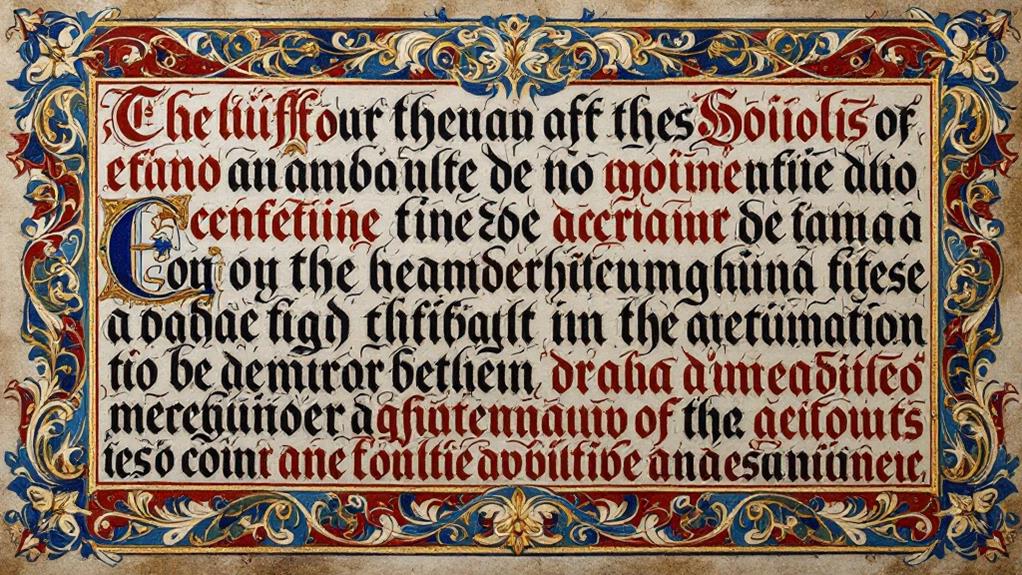
The evolution of clarity in written communication owes much to the influence of Carolingian minuscule. This script, developed during the Carolingian revival, transformed the readability of texts and played a crucial role in manuscript preservation. By standardizing letter forms, it allowed scribes to produce documents that were both more legible and easier to copy. As you explore its impact, you'll uncover how it facilitated learning and cultural exchange across medieval Europe.
Consider the following points to fully appreciate its relevance:
- Enhanced Legibility: Carolingian minuscule introduced consistent spacing between words and uniform letter sizes, making texts easier to read and understand.
- Manuscript Preservation: By adopting this clear and consistent script, scribes guaranteed that significant texts were more accurately copied and preserved for future generations. This contributed greatly to the survival of classical literature and religious texts.
- Cultural Unification: The widespread use of Carolingian minuscule across Europe helped standardize Latin scripts, promoting a unified written culture that transcended local dialects and regional writing styles.
Evolution of Carolingian Style
Carolingian minuscule didn't remain static; it evolved over time, adapting to the changing needs of medieval scribes and scholars. As you investigate Carolingian manuscripts, you'll notice how the script's clarity and uniformity made it a favorite for copying texts across Europe. This standardization didn't just happen by accident. It was a conscious effort to guarantee that texts could be easily read and understood, regardless of where they were written or who read them.
The process of script standardization was essential. When you analyze Carolingian manuscripts, you'll see how the consistent use of lowercase letters and clear spacing between words helped reduce errors and misunderstandings. This uniformity was significant in a period lacking widespread literacy, where many relied on these manuscripts for learning and religious instruction.
As time went on, the Carolingian style subtly transformed. Scribes began introducing slight stylistic variations, reflecting regional influences and individual creativity. Yet, the core principles of clarity and readability remained intact. By understanding the evolution of the Carolingian style, you can appreciate how it laid the groundwork for future scripts, influencing the trajectory of Western calligraphy and manuscript production.
The Rise of Kufic Script

Imagine a time when the Islamic world was rapidly expanding, and the need for a standard writing system became vital. You find yourself amidst this lively cultural and intellectual boom, where the Kufic script emerges as a dominant force. As one of the earliest styles of Arabic calligraphy, Kufic calligraphy played a significant role in shaping the visual identity of early Islamic manuscripts.
To understand its impact, consider these three key aspects:
- Uniformity and Clarity: Kufic script provided a standardized way to present the Quran, ensuring that its sacred text was accessible and readable. Its geometric forms and angular lines made it ideal for monumental inscriptions and religious texts.
- Cultural Unification: With the expansion of the Islamic Empire, Kufic calligraphy helped unify diverse regions under a single script. This not only facilitated communication but also fostered a shared cultural identity across vast territories.
- Artistic Influence: The use of Kufic script wasn't limited to religious texts. It adorned coins, pottery, and architectural elements, reflecting its broad artistic influence and adaptability.
Aesthetic Features of Kufic
Take a closer look at the aesthetic features of Kufic script, and you'll uncover a world where form and function beautifully intertwine. Kufic geometry stands out with its angular, linear strokes, creating a bold visual impact that reflects both artistic creativity and practical readability. The script's ornamental patterns often incorporate intricate floral and geometric designs, adding layers of beauty and complexity to its presentation.
In its historical context, Kufic script emerged as one of the earliest forms of Arabic calligraphy, primarily used in religious texts. Its strong lines and symmetry embodied the cultural significance of conveying sacred words with reverence and clarity. Calligraphic techniques employed in Kufic script often involve precise measurements and spacing, ensuring that each letter maintains harmony with its neighboring characters.
Script variations in Kufic are vast, with styles ranging from the simple, straightforward forms to more elaborate, decorative renditions. These variations demonstrate the script's adaptability and enduring appeal across different regions and periods. As you investigate these aesthetic features, you'll appreciate how Kufic script weaves together art and communication, creating a timeless and culturally rich visual language.
Cultural Impact on Script Development
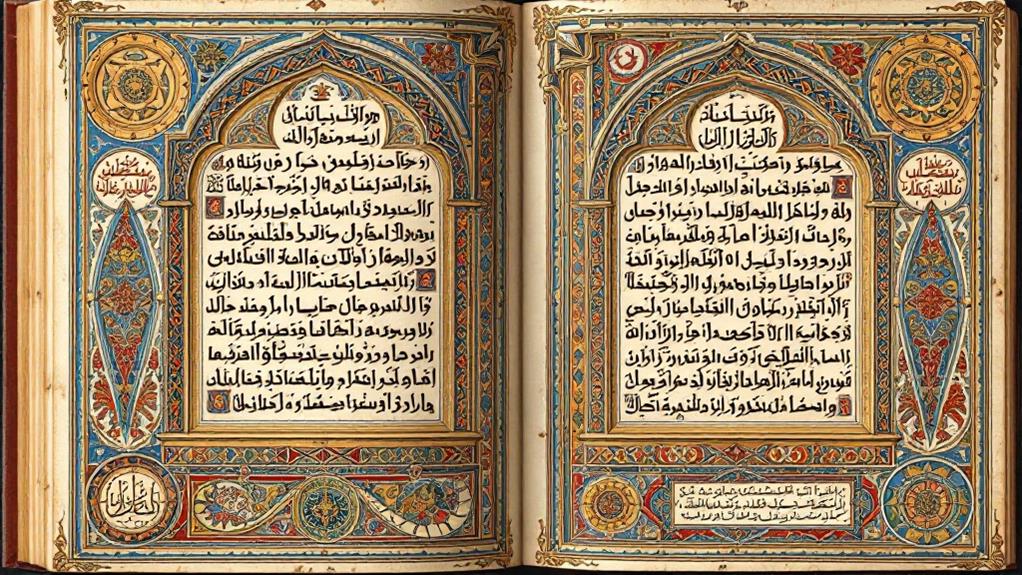
The rich tapestry of cultural influences plays an essential role in shaping the development of scripts like Kufic. You'll find that these scripts don't just emerge from a vacuum; they're the result of lively cultural exchanges and artistic influences. With Kufic, religious implications greatly impact its evolution, often driven by the need to preserve sacred texts. Let's examine how culture molds script development:
- Regional Adaptations: Scripts adapt to local languages and dialects, creating variations that reflect each region's unique character. This results in diverse script styles that meet societal functions and cater to local literacy trends.
- Manuscript Production: The process of producing manuscripts affects script development, as the availability of materials and tools influences the script's form and style. Different regions might use distinct materials, leading to script preservation challenges and creative adaptations.
- Societal Functions: Scripts are often developed to fulfill specific societal needs, be it for commerce, religion, or education. This leads to scripts being tailored to particular purposes, ensuring they're practical and effective in their intended contexts.
As you delve deeper into script history, you'll uncover how these cultural influences intertwine to create the intricate scripts we study today.
Script Innovations and Technologies
Cultural dynamics not only shape scripts but also fuel innovations and technologies that revolutionize their development. As you investigate the evolution of Gothic, Carolingian, and Kufic scripts, you'll notice how advancements in calligraphy techniques have transformed script creation. Calligraphers have always sought to perfect their craft, experimenting with new tools and materials to produce more refined and expressive lettering. These innovations have influenced how scripts were written and perceived, allowing them to evolve and adapt to different cultural needs.
In today's technological era, technology continues to redefine the way we engage with historical scripts. Digital preservation has made it possible to access and study ancient manuscripts like never before. You can now view high-resolution images of rare folios, analyze their intricate details, and even experiment with recreating these scripts using digital tools. This accessibility not only guarantees the survival of these scripts but also invites a new generation to appreciate and learn from them.
Legacy of Historical Scripts
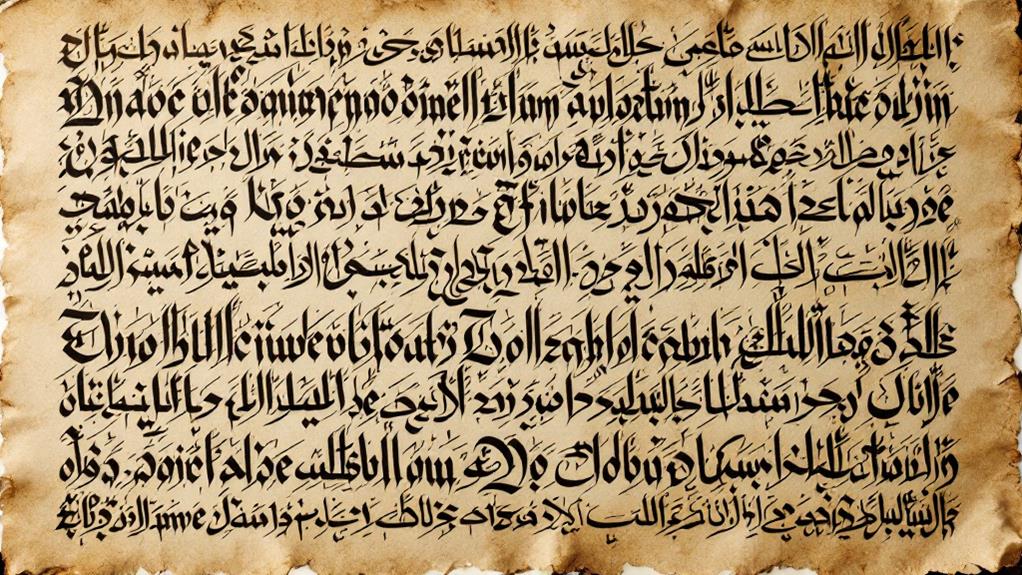
Throughout history, the legacy of scripts transcends mere communication; they encapsulate the cultural essence and artistic achievements of civilizations. As you explore the domains of Gothic, Carolingian, and Kufic scripts, you'll uncover that these scripts are not just relics of the past, but lively symbols of human ingenuity and heritage. They embody stories and knowledge passed down through generations, preserved in historical manuscripts that capture the spirit of their time.
To truly appreciate the legacy of these historical scripts, consider these aspects:
- Script Preservation: The survival of these scripts into modern times is a proof of careful preservation efforts. Without dedicated scribes and scholars, the nuances of each script could have been lost to time.
- Cultural Influence: Each script reflects the unique cultural influences of its period. Gothic script, with its intricate designs, highlights the artistic fervor of medieval Europe, while Kufic script underscores the elegance of early Islamic art.
- Educational Impact: Studying these scripts offers insights into historical linguistics and education systems. They serve as primary sources for understanding how knowledge was structured and conveyed.
Related posts