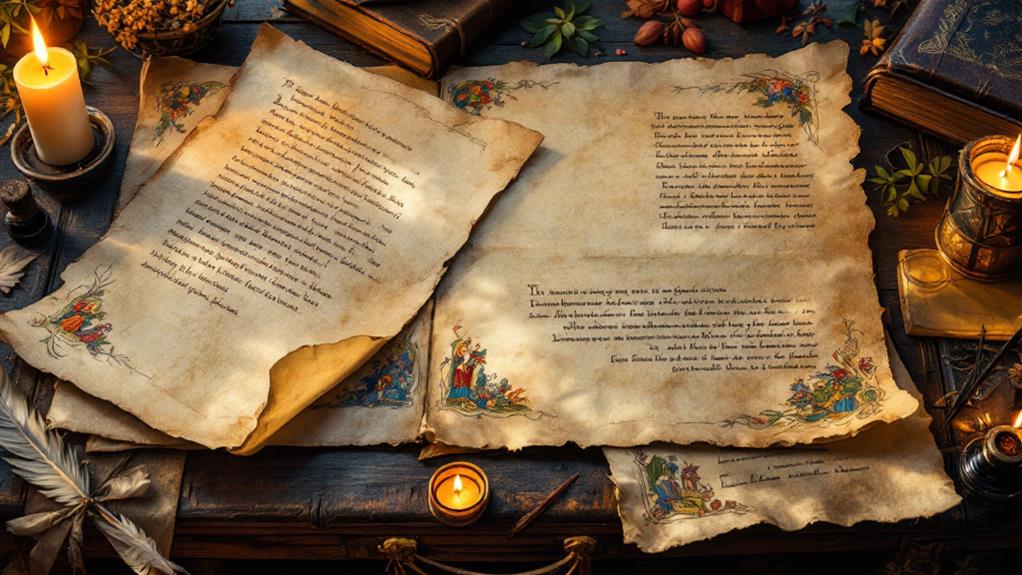
Exploring the Inks and Dyes Used in Ancient Folio Production

You're exploring the colorful history of inks and dyes in ancient folio production. Ancient civilizations created unique inks like carbon-based mixtures from Egypt or Chinese ink sticks from pine soot. Iron gall ink became a favorite for its durability and rich color. Plant-based pigments from indigo and turmeric added lively hues, while minerals like malachite provided long-lasting brilliance. Scribes combined these inks with expertly crafted tools, turning simple folios into artistic masterpieces. But don't forget the preservation challenges—keeping these artifacts alive requires special care and attention. There's an enchanting tale behind every stroke on those ancient pages.
Origins of Ancient Inks
Many ancient civilizations contributed to the development of inks, each with unique ingredients and techniques. As you investigate the origins of ancient inks, you'll uncover how these early creations held cultural significance and demonstrated historical innovations. Ancient Egyptians, for instance, used carbon-based inks, blending soot with water and gum to create a medium for writing on papyrus. This ink wasn't just a practical tool; it played a crucial role in documenting religious texts and daily life, thereby preserving their culture for future generations.
Meanwhile, the Chinese made significant strides with their invention of ink sticks, combining pine soot and animal glue. This innovation marked a critical moment in the history of ink, influencing artistic and literary expressions. You'll find that in India, the use of plant-based inks from sources like indigo and turmeric added lively hues to manuscripts, reflecting their cultural significance.
Iron Gall Ink
Among the most notable developments in ink technology, iron gall ink stands out for its widespread use and lasting impact. You're probably wondering why this ink was so crucial. Well, its historical significance can't be overstated. From the Middle Ages through the Renaissance, scribes and artists relied heavily on iron gall ink for its rich, dark hue and permanence. It was the go-to choice for creating manuscripts, official documents, and artworks that needed to withstand the test of time.
Now, let's talk about production methods. Making iron gall ink involved a fascinating process. You'd start by mixing tannin-rich oak galls with iron salts, like ferrous sulfate. Afterward, you'd add water and sometimes a binding agent like gum arabic to thicken the mixture. This concoction would darken over time as the tannins reacted with the iron, resulting in a deep, lasting black ink. The simplicity of these ingredients meant that even though the ink was durable, it was also accessible to many people.
Iron gall ink's ability to etch into the paper fibers made it nearly impossible to erase, ensuring the words and images it captured would endure for centuries.
Plant-Based Pigments

Engage yourself in the world of plant-based pigments, where nature's palette comes to life in lively hues. Ancient scribes and artists relied on these natural sources to create colorful folios that have stood the test of time. You'll find that plant-based pigments offered a wide range of color variations, each derived from different parts of plants such as roots, leaves, flowers, and bark. For instance, indigo, extracted from the leaves of the Indigofera plant, produced deep blues. Madder, from the roots of the Rubia plant, yielded rich reds.
Going deeper, you'll uncover how saffron, a spice from the crocus flower, provided a brilliant yellow, while the walnut tree's husks gave a warm brown. These natural sources were not only abundant but also sustainable, allowing artists to experiment with blending techniques to achieve even more complex shades and tones. By understanding the extraction and preparation methods, you can appreciate the skill and knowledge required to produce these diverse colors.
When you investigate plant-based pigments, you step into a tradition of creativity and resourcefulness. You'll gain insight into how ancient artisans harnessed the beauty of the natural world to enrich their work, crafting pages that continue to captivate us today.
Mineral-Derived Colors
Delving into mineral-derived colors, you'll find a fascinating assortment of lively hues sourced from the earth itself. These pigments owe their brilliance and appeal to different mineral sources that ancient artisans skillfully harnessed. Minerals like malachite and azurite provided rich greens and blues, while cinnabar and ochre offered brilliant reds and earthy tones. By grinding these minerals into fine powders, scribes could produce a spectrum of colors that adorned manuscripts with a natural elegance.
Mineral-derived colors weren't just about visual impact; their appeal also stemmed from remarkable color stability. Unlike organic pigments, which could fade over time, mineral pigments maintained their brilliance and integrity for centuries. This long-lasting quality made them valuable for creating documents meant to endure, ensuring that the messages and artistry within ancient folios remained vivid through the generations.
As you investigate these mineral sources, appreciate how they contributed to the durability and aesthetic excellence of historical texts. The careful selection and preparation of these minerals were critical in crafting inks and dyes that not only captured the eye but also stood the test of time, preserving history in radiant hues.
Techniques of Scribes
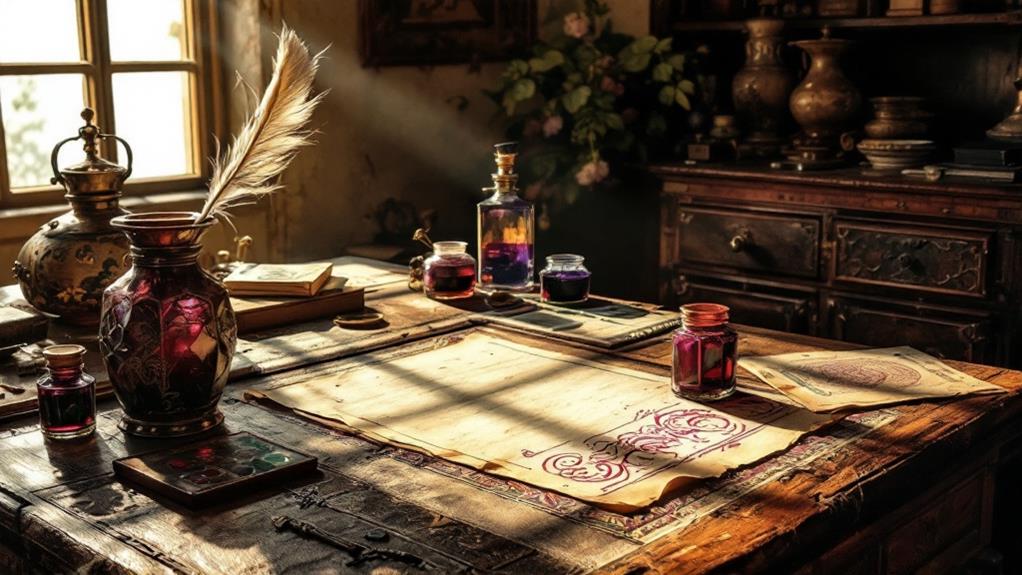
In the intricate world of ancient folio production, scribes employed a myriad of techniques to bring their manuscripts to life. As a scribe, you'd rely on a set of specialized scribe tools, each essential to the art of manuscript creation. Your quill, often made from a bird feather, served as your primary writing instrument, carefully cut to achieve the perfect nib. Inkstones held your precious inks, and you'd use a stylus for inscriptions and precise markings.
Understanding manuscript techniques was vital. Initially, you'd prepare the parchment by carefully stretching and smoothing it to create an ideal writing surface. Then, you'd skillfully apply guidelines to guarantee uniformity in text lines. As you wrote, you'd maintain consistent pressure on the quill, allowing the ink to flow smoothly and evenly, preventing blotches.
Mastery over your scribe tools allowed you to incorporate intricate flourishes and calligraphy that distinguished your work. You'd blend colors from different inks and dyes to improve illustrations, adding depth and vibrancy. Each stroke of your quill was deliberate, contributing to a manuscript that was not only a text but a work of art, reflecting the craftsmanship of ancient scribes.
Preservation Challenges
Preserving ancient folios presents several formidable challenges that demand careful attention and expertise. As you explore the world of ancient manuscripts, you'll quickly realize that they are incredibly vulnerable to a variety of threats. Environmental factors such as humidity, temperature fluctuations, and light exposure can wreak havoc on these delicate artifacts. If you don't manage these factors effectively, you risk accelerated deterioration of inks and dyes, leading to fading, discoloration, or even complete loss of text and imagery.
To combat these issues, it's crucial to implement effective conservation methods. Initially, you should guarantee that the storage area maintains a stable, cool, and dry environment. Specialized climate control systems can help regulate temperature and humidity levels, reducing the risk of mold growth or ink bleeding. Furthermore, consider using UV-filtered lighting to minimize light damage.
Handling practices also play a key role in preservation. Always wear gloves to avoid transferring oils and dirt, and support the folio properly to prevent stress on the binding. By adopting these conservation methods, you'll greatly extend the life of ancient folios, allowing future generations to appreciate their historical and cultural significance.
Related posts