Deciphering Folios: The Role of Translation in Ancient Manuscripts

When you investigate the role of translation in ancient manuscripts, you bridge the gap between lost worlds and today's understanding. Translators not only decode the text but also breathe new life into the beliefs and stories ancient scripts preserve. Capturing historical and cultural nuances is vital to represent the authors' original intentions. Techniques like digital imaging and AI-driven tools have advanced the translation process, making even fragmented texts accessible. As you grasp these manuscripts, you'll uncover cultural identities and historical contexts that enrich global heritage. Delve deeper to find how translation illuminates the wisdom of the ancients.
Understanding Ancient Scripts
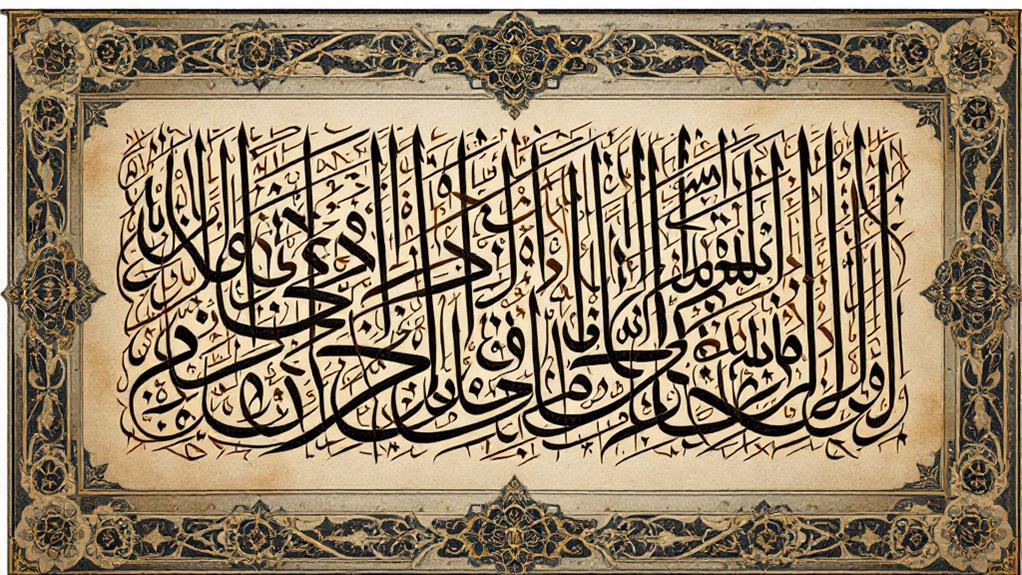
Deciphering ancient scripts is like unraveling a mystery that transports you back in time. You explore a world where symbols and strokes hold the secrets of civilizations long gone. To understand these scripts, you rely on paleographic analysis, a method that examines the form and style of ancient writing. This analysis helps you identify when and where a script was used, providing essential context for your investigation.
As you engage in script evolution study, you trace the transformation of writing systems across centuries. This evolution reflects cultural exchanges and technological advancements, giving you insights into how societies adapted their communication methods. You notice subtle changes in letter shapes, which can indicate shifts in linguistic influences or the introduction of new writing materials.
Your expedition through these ancient texts requires patience and precision. Each revelation adds a piece to the larger puzzle of human history. By understanding ancient scripts, you connect with the minds of those who crafted them, their thoughts preserved on parchment and stone. Your dedication to this intricate task helps illuminate the past, bridging the gap between modernity and antiquity.
The Art of Translation
The art of translation in ancient manuscripts is a delicate dance of language and meaning. You must navigate between literal interpretations and the rich tapestry of contextual nuances that each text presents. It's not just about translating words; it's about capturing the essence and intent behind them. You have to reflect on what the original author intended to convey and how those ideas can be expressed in a new language without losing their original charm or complexity.
When you approach an ancient text, you can't rely solely on literal interpretations. Words and phrases often carry historical and cultural weight that transforms their meaning. You have to examine the context—what was happening when the text was written, and how did those events influence its language? Contextual nuances shape your understanding, allowing you to see beyond the surface and grasp the deeper layers.
Your task is to respect the original while making it accessible to modern readers. It's a balancing act, requiring a sensitivity to both the past and the present. You become a bridge between worlds, ensuring the timeless wisdom of ancient manuscripts continues to resonate today.
Tools and Techniques
How do you unravel the mysteries of ancient manuscripts with modern tools and techniques? It starts with paleographic analysis, where you examine the handwriting styles used in historical texts. This helps you identify the period and region in which a manuscript was created. But don't stop there—digital tools are invaluable for bringing these ancient documents to life. By scanning manuscripts and using software to improve faded ink, you'll uncover insights that were previously hidden to the naked eye.
Modern techniques also allow you to collaborate with experts globally. You can share high-resolution images of texts with other historians and linguists, fostering a collective effort to translate and interpret these ancient works. Here are some of the key tools and techniques you can use:
- Paleographic analysis: Study handwriting styles to date and locate manuscripts.
- Digital imaging: Use scanners and software to improve and restore faded texts.
- Machine learning: Employ algorithms to recognize patterns and translate ancient languages.
- Online databases: Access vast repositories of images and transcriptions from anywhere.
- Collaborative platforms: Work with experts worldwide to share findings and interpretations.
Challenges Faced by Translators
Despite the advanced tools and techniques at your disposal, translating ancient manuscripts presents its own set of challenges. You're often faced with linguistic barriers that can make even the most advanced software stumble. Ancient languages may lack direct modern equivalents, and subtle shifts in meaning can occur over time. This makes it difficult to find precise translations for certain words or phrases. You need to dig deep into historical contexts and cultural backgrounds just to grasp what the original authors intended.
Contextual nuances add another layer of complexity. Manuscripts were often written in times and places vastly different from your own, with unique societal norms and practices. Understanding these nuances is essential to capturing the true meaning behind the text. A word or phrase in an ancient manuscript might have carried a particular connotation, linked to specific customs or beliefs, that doesn't translate well into today's language.
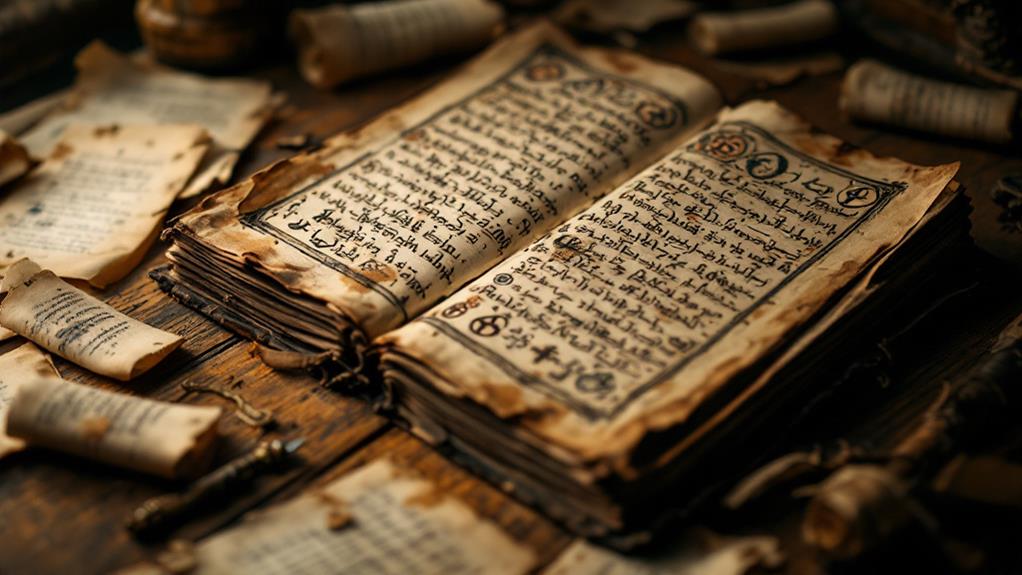
Furthermore, you'll likely face the challenge of incomplete texts. Manuscripts may be damaged or fragmentary, requiring you to piece together meaning from incomplete information. It's a bit like solving a puzzle, demanding both patience and creativity to fill in the gaps accurately.
Famous Manuscript Discoveries
Among the most remarkable manuscript findings in history are those that have reshaped our understanding of ancient civilizations. Imagine stumbling upon the Dead Sea Scrolls, a vast collection of manuscript fragments that offered unprecedented insights into early Jewish and Christian practices. Such revelations not only fill gaps in historical knowledge but also spark curiosity about ancient cultures.
Consider these famous manuscript revelations:
- Dead Sea Scrolls: Hidden in caves near the Dead Sea, these scrolls reveal ancient religious texts and practices.
- Codex Sinaiticus: One of the earliest complete manuscripts of the Christian Bible, found in the Sinai Peninsula, providing critical insights into early Christianity.
- Rosetta Stone: This ancient artifact enabled the translation of Egyptian hieroglyphs, bridging the gap between lost languages and modern scholars.
- Ancient papyri: Unearthed in Egypt, these documents contain everything from personal letters to literary works, offering a glimpse into daily life in ancient times.
- Viking sagas: These narratives, revealed in Icelandic manuscripts, illuminate the lives and voyages of Norse explorers.
Each revelation, like the lost libraries of antiquity, enriches your understanding of the past. As you investigate these findings, you're not just reading history; you're uncovering the stories and cultures long buried by time.
Cultural Significance Unveiled
Exploring these remarkable manuscript revelations reveals more than just historical facts; it opens a window into the rich cultural tapestries of ancient civilizations. When you investigate these ancient texts, you uncover the immense value of cultural preservation. Each manuscript serves as a proof of the beliefs, traditions, and daily lives of people who lived centuries ago. They're not just relics; they're lively connections to our past, showing how societies evolved and interacted with one another.
Translation plays a critical role in revealing this cultural significance. By breaking down linguistic barriers, you can appreciate the linguistic diversity that existed across regions and time periods. This diversity reflects the myriad ways people communicated and conveyed their thoughts, which in turn, shaped their cultural identities. You'll find that understanding these texts provides insights into everything from religious practices to scientific advancements.
As you engage with these manuscripts, you'll notice that they also highlight the importance of cross-cultural exchanges. By preserving these texts and their translations, you're ensuring that the lessons and stories of ancient civilizations continue to inform and enrich our global heritage today. You're participating in a timeless dialogue between past and present.
The Impact on Modern Studies
The translation of ancient manuscripts profoundly influences modern studies by bridging the gap between past knowledge and contemporary understanding. When you investigate these texts, you uncover insights that shape today's research and education. These translations have modern implications that extend beyond mere historical interest. They enrich diverse fields, from philosophy to science, offering a nuanced perspective on timeless questions and theories. By examining translated works, you gain access to the origins of many ideas that continue to influence current thought and innovation.
Understanding ancient texts through translation encourages interdisciplinary approaches. This means that you're not just limited to one field of study, but can investigate connections across different disciplines. It allows for a more thorough understanding of complex topics. Consider the following impacts:
- Revitalization of forgotten knowledge: Ancient wisdom becomes accessible and applicable.
- Enrichment of cultural studies: Provides context to cultural dynamics and evolution.
- Inspiration for modern technological advances: Ancient inventions and ideas fuel current innovations.
- Enhanced philosophical debates: Revisit old arguments with contemporary relevance.
- Growth in language studies: Offers insights into the evolution of language and communication.
Through translation, you're part of an ongoing dialogue between the past and present, enhancing how you understand the world today.
Collaboration Across Disciplines
You'll find that collaboration across disciplines is essential when translating ancient manuscripts. It's not just about linguists working in isolation; successful translations demand input from historians, archaeologists, and even scientists. Each discipline brings unique skills and insights that enrich the understanding of these ancient texts. Interdisciplinary approaches allow for a more thorough analysis, revealing cultural, historical, and scientific contexts that might otherwise be missed.
In collaborative projects, linguists might decipher the text's structure, while historians provide context about the time period. Archaeologists can contribute insights about artifacts or geographical references mentioned in the manuscripts. Meanwhile, scientists might analyze the physical properties of the materials, such as ink composition, to determine origin and authenticity. This teamwork guarantees a multifaceted view that boosts accuracy and depth.
Future Directions in Translation
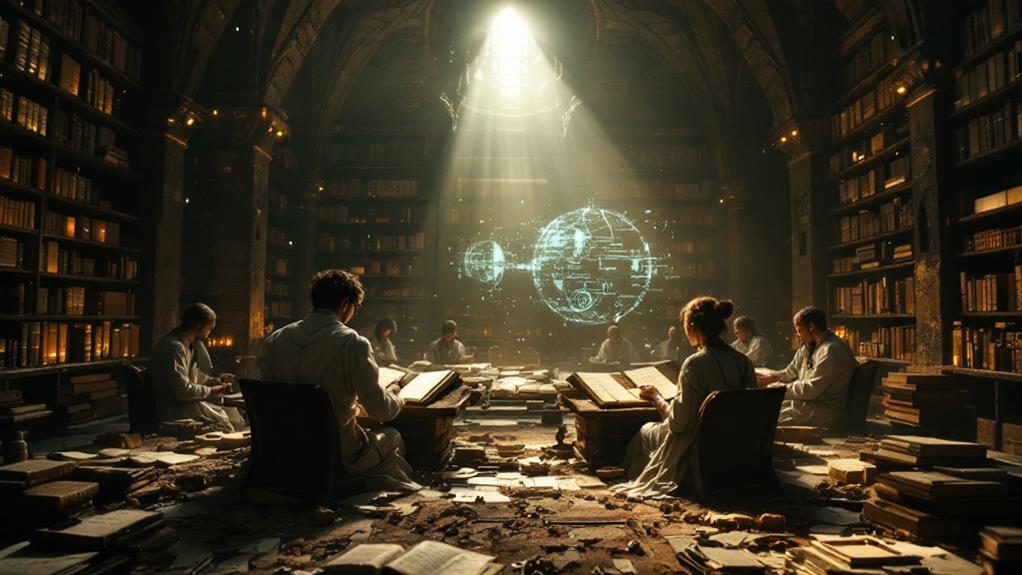
Building on the collaborative success of interdisciplinary approaches, the future of translating ancient manuscripts looks increasingly promising with advancements in technology. You're now witnessing a surge in tools that make it easier to decipher and translate these texts. Imagine AI algorithms that can recognize and interpret ancient scripts with remarkable accuracy. These technological advancements open doors to new insights and interpretations, enabling quicker, more precise translations than ever before.
However, as technology progresses, you must also consider the ethical implications. Who decides how these tools are used, and what happens when translations conflict with traditional interpretations? Ethical considerations become vital in maintaining the integrity of historical documents. Your role might involve maneuvering through these complexities to guarantee responsible use of technology.
In the future, you might investigate:
- AI-driven translation tools: Offering fast and accurate script recognition.
- Collaborative platforms: Allowing experts worldwide to contribute their insights.
- Virtual reality experiences: Bringing ancient texts to life for broader audiences.
- Open-access databases: Securing equitable access to translated manuscripts.
- Ethical guidelines development: Establishing standards for responsible translation practices.
Related posts