Asian Manuscripts: The Diamond Sutra, Tale of Genji, and Their Lasting Influence

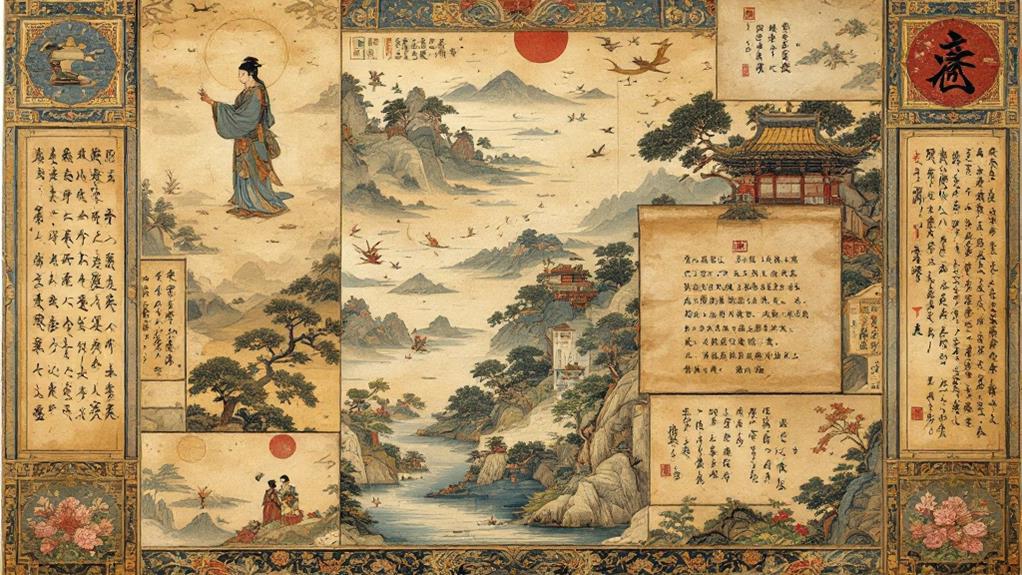
You'll uncover that the Diamond Sutra and The Tale of Genji are essential Asian manuscripts with profound cultural and literary influence. The Diamond Sutra, created in 868 AD, is the world's oldest dated printed book, marking a shift from handwritten scrolls to printed materials, while spreading Buddhist teachings. On the other hand, The Tale of Genji, authored by Murasaki Shikibu, is recognized as the world's initial novel, offering a glimpse into Heian Japan's court life. These texts not only shaped Asian cultural identity but also influenced global literature through unique narrative techniques. Investigate further to grasp their enduring impact.
The Origins of the Diamond Sutra
While delving into the history of Asian manuscripts, you'll find the Diamond Sutra holds a significant place as the world's oldest dated printed book. Created in 868 AD during China's Tang Dynasty, this sacred Buddhist text offers a window into the period's rich historical context. At this time, China was experiencing a flourishing of culture and innovation, with Buddhism playing an essential role in shaping societal values and intellectual thought. By understanding this manuscript's origins, you gain insight into the phase's spiritual and cultural dynamics.
The Diamond Sutra's cultural significance extends beyond its duration and religious content. It represents a critical moment in human history when the written word began shifting from laboriously handwritten scrolls to printed materials, making texts more accessible to the masses. This change not only facilitated the spread of Buddhist teachings but also laid the groundwork for future advancements in printing and information dissemination. The text's existence highlights the importance of preserving knowledge and fostering intellectual growth across generations. As you investigate the Diamond Sutra, appreciate how it encapsulates both the technological advancements and the spiritual aspirations of its time, serving as an indication of humanity's enduring pursuit of enlightenment.
Printing Innovations and Impact
Few inventions have reshaped human history as profoundly as the development of printing technology. In Asia, it all started with woodblock printing. Imagine carving entire pages onto wooden blocks, which were then inked and pressed onto paper. This method, although labor-intensive, transformed the way information was disseminated. You could now produce multiple copies of texts like the Diamond Sutra, making them more accessible to a wider audience.
But innovation didn't stop there. The introduction of movable type altered the landscape even further. Unlike woodblock printing, where each page required a new carving, movable type used individual characters that could be rearranged and reused. This greatly reduced the time and effort needed to produce texts. You might find it fascinating how this efficiency allowed for the rapid spread of literature and ideas across Asia.
With these printing innovations, you can see a direct impact on society. Literacy rates increased, knowledge spread faster, and cultural exchange flourished. Ancient texts, once limited to a select few, became available to scholars, educators, and the curious alike. This democratization of knowledge laid the groundwork for future advancements in science, philosophy, and the arts.
Buddhist Teachings in the Diamond Sutra
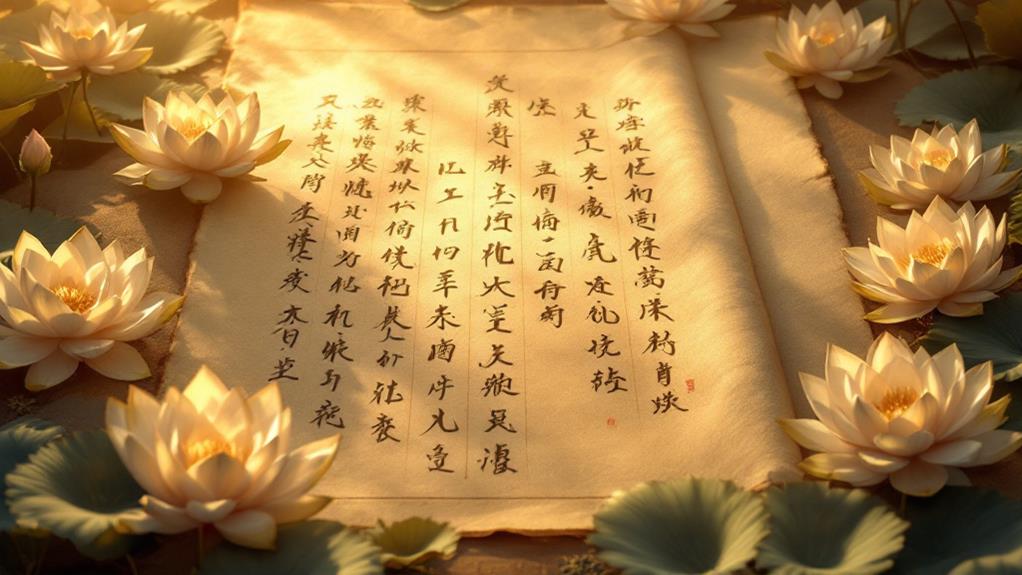
The printing innovations that transformed information dissemination in Asia also played a significant role in spreading Buddhist teachings, particularly those found in the Diamond Sutra. As the world's oldest dated printed book, the Diamond Sutra is a cornerstone of Buddhist literature, emphasizing the importance of mindfulness practices and the profound emptiness concept. When you engage with this text, you're invited to investigate how perceptions and attachments cloud your true understanding of reality.
In the Diamond Sutra, mindfulness practices are emphasized as fundamental tools for cultivating awareness and presence. As you practice mindfulness, you begin to see the transient nature of thoughts and experiences, helping you detach from the illusions of permanence. This mindfulness leads naturally to an understanding of the emptiness concept, a central theme in the sutra. The emptiness concept suggests that all phenomena lack inherent existence and are interconnected.
The Tale of Genji's Creation
A masterpiece of Japanese literature, "The Tale of Genji," offers a window into the Heian period's courtly life and artistic achievements. As you explore its creation, you'll uncover its author, Murasaki Shikibu, a lady-in-waiting at the imperial court. She crafted a text that stands as the world's initial novel. Her narrative structure is groundbreaking, weaving intricate plots that follow the life and loves of Hikaru Genji, the tale's central figure.
Character development in "The Tale of Genji" is profound. Murasaki Shikibu breathes life into each character, making them multi-dimensional and relatable. Genji himself evolves through experiences, reflecting the complexities of human emotions and relationships. This depth in character portrayal was pioneering for its time, influencing literary traditions across the globe.
Consider these key facets of its creation:
- Murasaki Shikibu's unique perspective: Her insights into the courtly world allow for a rich tapestry of life and politics.
- Complex narrative structure: The tale's episodic yet interconnected chapters form a cohesive whole.
- Emphasis on character development: Characters grow and change, mirroring real-life dynamics.
- Influence on future literature: Its techniques and themes resonate in later works worldwide.
Depiction of Heian Court Life
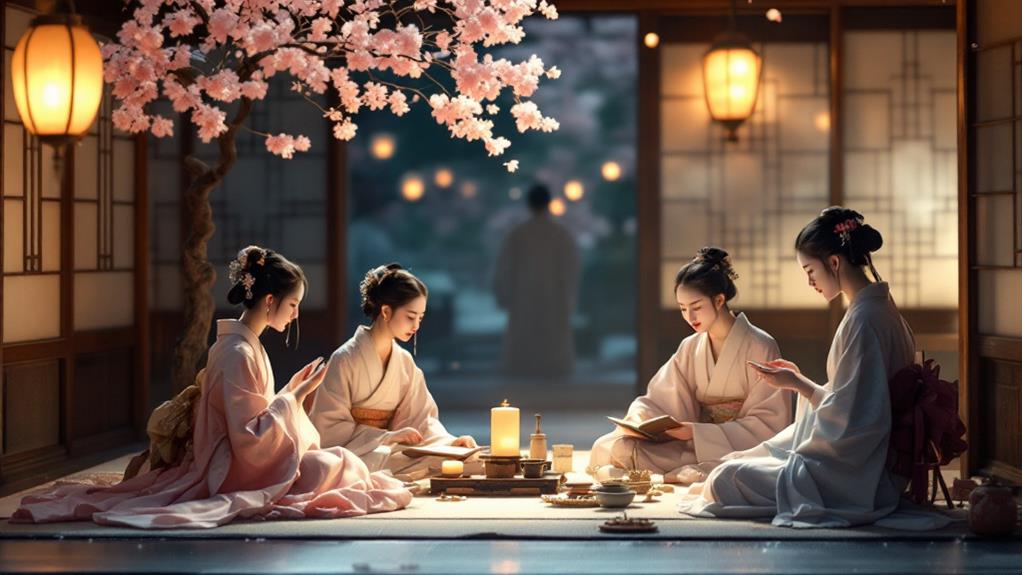
Peering into the Heian court life through "The Tale of Genji" reveals an intricate world of elegance, ceremony, and subtle power dynamics. You'll find that court etiquette is fundamental, dictating every interaction. Each gesture, word, and glance is carefully orchestrated within a rigid social hierarchy. As you navigate this world, you'll notice how aesthetic values are deeply embedded, influencing everything from clothing choices to the design of gardens and buildings.
Gender roles are clearly defined, with men and women engaging in distinct social functions. Men often maneuver through complex political dynamics, while women exert influence through artistic expression, excelling in poetry and music. Daily life at court is a series of ceremonial practices, where even the simplest of tasks are raised to an art form. Tea ceremonies, poetry contests, and seasonal festivals are not mere pastimes; they're crucial in maintaining social order and showcasing one's refinement.
The Heian court's daily life is a delicate balance of personal ambition and public duty, where every action is a performance before a discerning audience. You'll see how these elements together create a vivid tapestry that continues to captivate readers worldwide.
Literary Techniques in Genji
In exploring the literary techniques of "The Tale of Genji," you'll uncover how Murasaki Shikibu masterfully uses symbolism, imagery, and narrative structure to convey the intricacies of Heian society. The narrative structure of the tale weaves an intricate tapestry of character development, allowing you to witness the growth and complexities of Genji and those around him. Through the use of poetic imagery, Murasaki Shikibu paints vivid scenes that evoke emotional resonance, immersing you in a world where every detail holds significance.
The thematic depth of "The Tale of Genji" is augmented by its historical context, giving you insight into the societal norms and cultural symbolism of the Heian period. Stylistic elements such as the use of waka poetry not only enhance the narrative but also reflect the emotional states of characters, adding layers to their interactions and relationships.
- Symbolism and Imagery: Murasaki employs cultural symbols to add depth.
- Character Development: Characters evolve, revealing their multifaceted personalities.
- Narrative Structure: The story's flow highlights the interconnectedness of characters' lives.
- Poetic Imagery: Visual and emotional cues create a vivid reading experience.
These techniques blend seamlessly, creating a timeless masterpiece.
Cultural Influence in Asia
Investigate the cultural influence of Asian manuscripts and uncover how they have shaped art, literature, and philosophy across the continent. These texts, like the Diamond Sutra and the Tale of Genji, are more than just stories; they're vessels of religious symbolism and aesthetic values that have transcended their origins. In the Diamond Sutra, for instance, you'll find profound philosophical themes that have influenced Buddhist thought and practice. This manuscript's historical context highlights its role in spreading religious ideas and shaping spiritual discourse throughout Asia.
The Tale of Genji, with its intricate narrative structures, offers a window into the social hierarchy of Heian Japan. Its depiction of court life and artistic representations has profoundly impacted Japanese culture, influencing everything from noh theater to ukiyo-e art. The cultural exchanges facilitated by these manuscripts have allowed for a rich tapestry of ideas to flow across borders, enriching each culture it touches.
These texts have not only reflected but also shaped societal norms, artistic endeavors, and intellectual pursuits. By examining these manuscripts, you'll gain insight into how historical context and narrative structures have left a lasting imprint on Asian cultures.
Global Literary Impact
Asian manuscripts have not only shaped their native cultures but have also reached far beyond their borders, leaving a profound global literary impact. As you investigate these texts, you'll notice how they've influenced storytelling worldwide. The Diamond Sutra and Tale of Genji are prime examples of how narrative traditions transcend cultural boundaries. Their themes of spirituality and human emotion resonate universally, prompting writers from diverse backgrounds to incorporate these elements into their own works.
The cross-cultural exchange initiated by these manuscripts has paved the way for a richer global literary tapestry. When you immerse yourself in Western novels or poetry, you might uncover echoes of Asian influences, such as:
- Spiritual inquiry: Western writers often draw on themes found in the Diamond Sutra.
- Character depth: Inspired by Genji's complex figures, characters in global literature have become more nuanced.
- Narrative structure: Non-linear storytelling seen in Asian texts has influenced modern literary techniques.
- Emphasis on nature: Asian manuscripts often celebrate nature, inspiring similar motifs worldwide.
These enduring influences highlight the importance of understanding and appreciating the interconnectedness of global literary traditions, which continue to evolve through cross-cultural dialogue.
Modern Interpretations and Adaptations
Today, you can see the enduring legacy of Asian manuscripts in their modern interpretations and adaptations across different media. From the Diamond Sutra to the Tale of Genji, these works inspire contemporary retellings that resonate with today's audiences. Artistic adaptations breathe new life into ancient texts, offering digital interpretations that make these stories accessible to a global audience. Film adaptations of these manuscripts often examine their themes through cross-cultural influences, creating narratives that appeal to diverse viewers.
Theatrical performances also provide a platform for narrative experimentation, reimagining classic tales in inventive settings. These performances often blend traditional storytelling with modern techniques, creating a dynamic fusion that captivates audiences. Graphic novels have emerged as a popular medium for adapting these manuscripts, combining visual artistry with storytelling to capture the essence of the originals while appealing to new generations.
The influence of these manuscripts extends beyond traditional media, inspiring creators worldwide to investigate and reinterpret their themes and narratives. As you engage with these modern adaptations, you'll uncover how the timeless stories of Asian manuscripts continue to shape and enrich the cultural landscape, bridging past and present in exciting, meaningful ways.
Related posts