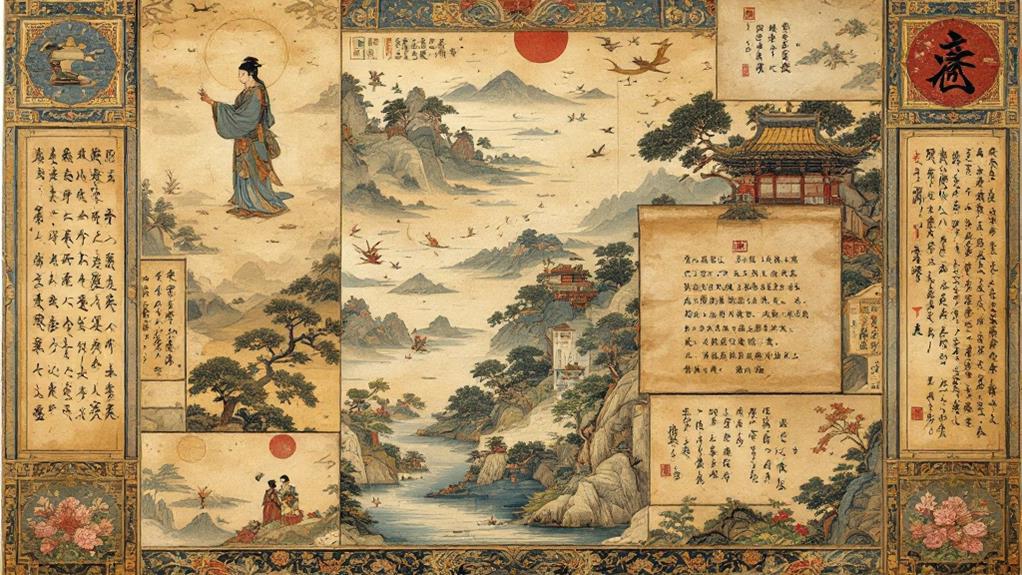
Ancient Asian Folios: The Diamond Sutra, Tale of Genji, and Other Literary Gems

You're about to encounter the rich tapestry of ancient Asian literature through fascinating works like "The Diamond Sutra" and "The Tale of Genji." "The Diamond Sutra," dating back to 868 AD in the Tang Dynasty, isn't just the oldest printed book; it's a cornerstone of Mahayana Buddhism and exemplifies early printing's role in idea dissemination. Meanwhile, "The Tale of Genji," from Japan's Heian period, weaves together romance and politics, providing insights into aristocratic life and inspiring Asian literature. These texts continue to shape stories today with timeless themes and complex characters. There's a wealth of insights waiting for you.
The Diamond Sutra's Legacy
The Diamond Sutra, one of the oldest known printed books, has left an indelible mark on both religious and literary landscapes. When you explore its historical context, you uncover that it was printed in 868 AD during China's Tang Dynasty. This period was marked by a flourishing of culture, trade, and technological advancements, including the development of woodblock printing. The Diamond Sutra stands as a representation of the period's creative spirit and its dedication to preserving spiritual teachings.
Its cultural significance can't be overstated. As a central text in Mahayana Buddhism, the Diamond Sutra has profoundly influenced Buddhist thought and practice. It emphasizes the concept of "emptiness" and the impermanent nature of reality, encouraging practitioners to cultivate wisdom and compassion. You might find it fascinating that its teachings have permeated beyond religious circles, impacting literature, art, and philosophy throughout Asia and the world. This sutra not only shaped spiritual discourse but also demonstrated how printing technology could disseminate complex ideas widely. By examining the Diamond Sutra's legacy, you gain insight into how ancient texts continue to resonate across cultures and centuries, bridging the past and present.
Origins of the Tale of Genji
Emerging from the cultural effervescence of Japan's Heian period, the "Tale of Genji" stands as a monumental achievement in world literature. You can see its origins deeply rooted in the historical context of the time, when art, poetry, and prose flourished. The narrative structure is intricate, weaving together a tapestry of romance, politics, and intrigue. It's not just a simple story; it's a complex investigation of character development that reveals the inner lives and emotions of its protagonists.
As you explore the "Tale of Genji," you'll notice its cultural significance, capturing the essence of the Heian period's aristocracy. The text reflects the societal norms and gender roles, providing insight into the lives of courtiers and the delicate balance of power and love. The poetic elements embedded within the story add layers of depth and beauty, enhancing the comprehensive experience.
The literary techniques employed by Murasaki Shikibu, the author, showcase her brilliance. She masterfully balances descriptive passages with dialogue, creating a vivid and engaging world. Through her work, you're offered a window into a past time, where the "Tale of Genji" shines as an enduring literary gem.
Influences on Asian Literature
Many literary works across Asia draw inspiration from the "Tale of Genji," highlighting its profound impact on the region's storytelling traditions. When you investigate Asian literature, you'll notice how cultural exchanges and historical context have shaped narratives beyond Japan's borders. The "Tale of Genji" stands as a proof of refined character development, intricate plots, and detailed settings, becoming a template for future works. As you probe into these stories, you can see how authors incorporate these elements, enriching their own cultural narratives.
Consider the historical context during which these texts emerged. The "Tale of Genji" flourished during Japan's Heian period, a time marked by lively cultural exchanges with China and Korea. This period inspired writers, who adapted themes and narrative techniques from neighboring cultures, creating a rich tapestry of stories. When you compare these adaptations, you'll find unique blends of local and borrowed elements.
Through reading, you'll uncover how the "Tale of Genji" and similar works facilitated a shared literary heritage. You'll appreciate how these influences continue to resonate, weaving through the fabric of modern Asian literature, echoing timeless stories and enriching contemporary narratives.
Philosophical Themes Explored
As you investigate the literary gems of Asia, philosophical themes reveal themselves as a cornerstone of storytelling, much like the cultural exchanges that influenced these narratives. In works like the "Diamond Sutra" and "Tale of Genji," you'll find a deep examination of Buddhist philosophy, which often shapes the narrative structure and aesthetic values. These texts explore existential themes, prompting you to reflect on life's transient nature and the moral dilemmas that arise from human actions.
Cultural context plays a significant role in how these stories address metaphysical inquiries. In the "Diamond Sutra," for instance, the focus on impermanence and enlightenment reflects Buddhist teachings that challenge your understanding of reality and human nature. Meanwhile, "Tale of Genji" offers a glimpse into Heian-era Japan, where courtly life and personal relationships are examined through the lens of aesthetic values and societal norms.
As you read these ancient folios, you'll encounter complex characters grappling with their desires and responsibilities, engaging with moral dilemmas that resonate even today. They invite you to ponder your place in the world and consider how philosophical insights from the past continue to shape human nature and experience.
Artistic Expressions in Manuscripts
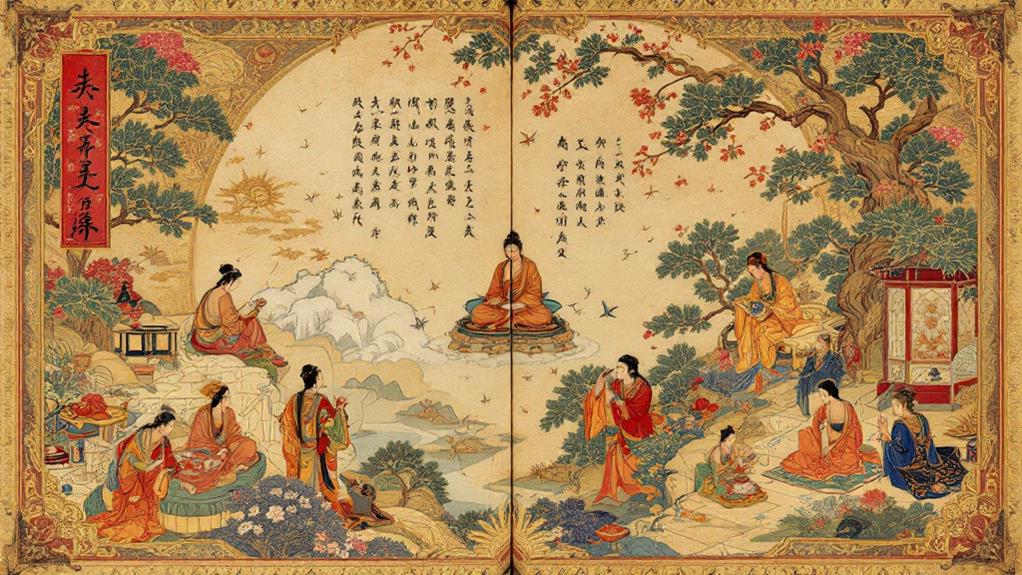
In the domain of literary gems, manuscripts serve as a canvas showcasing a lively tapestry of artistic expressions. When you investigate ancient Asian folios like "The Diamond Sutra" or "Tale of Genji," you're not just reading words; you're experiencing a rich blend of art and literature. Manuscript illustrations capture your imagination by bringing stories to life with intricate details and radiant colors. These illustrations serve a dual purpose: enhancing the narrative while displaying the artistic skill of the creator.
The calligraphic techniques in these manuscripts raise them to works of art. The precision and elegance of each stroke reflect not only the beauty of the text but also the cultural and spiritual significance imbued within.
Consider these key elements that make manuscript artistry so engaging:
- Visual storytelling: Illustrations that transform text into lively scenes.
- Elegant calligraphy: Mastery of strokes that convey both meaning and beauty.
- Cultural symbolism: Art that reflects societal values and traditions.
When you investigate these manuscripts, you're not just witnessing textual narratives; you're embracing a unique confluence of art and literature that transcends time and culture. Each manuscript offers a window into a world where art and words dance together in harmony.
Preservation of Ancient Texts
Preserving ancient texts is vital for maintaining the rich heritage of human thought and culture. You'll find that these texts provide invaluable insights into past societies, philosophies, and artistic expressions. To safeguard these valuables, you need to employ a variety of preservation techniques. Digital archiving has become a powerful tool, allowing you to store and access texts without risking damage to the original manuscripts. This way, you preserve their historical significance while making them widely accessible.
Manuscript conservation and restoration methods are key in preventing deterioration. You should use climate-controlled environments in ancient libraries to stabilize temperature and humidity, ensuring the physical longevity of these delicate materials. When you engage in textual analysis, you gain deeper understanding, highlighting their cultural heritage and context.
You can't overlook the role of modern technology in this process. Techniques like multispectral imaging can reveal hidden texts and details that were previously unreadable. By combining these groundbreaking methods with traditional conservation techniques, you're able to maintain the integrity of these works for future generations. Ultimately, preserving ancient texts isn't just about saving old books; it's about connecting with the past to enrich our present and future.
Comparative Literary Analysis
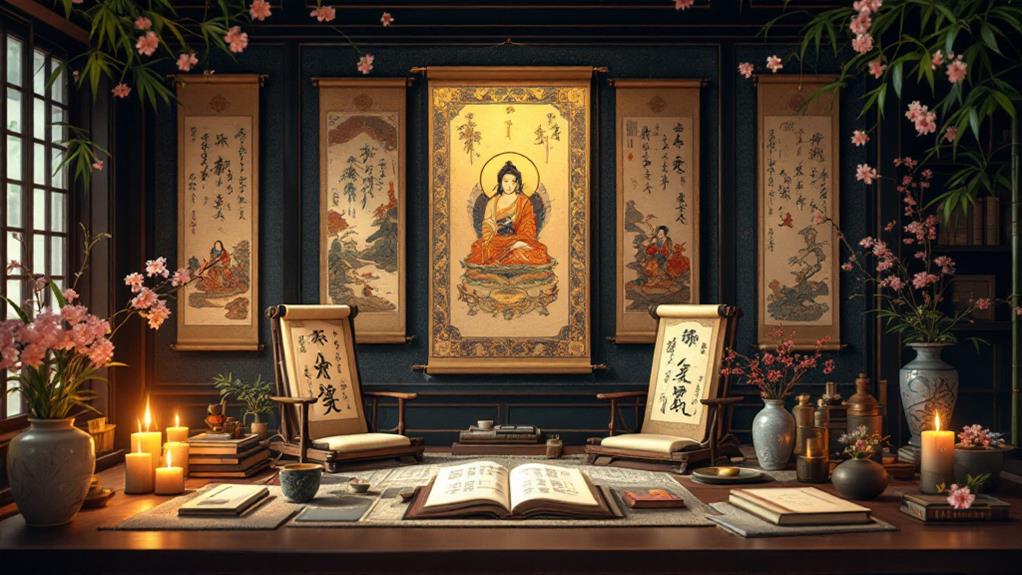
While preserving ancient texts guarantees their physical survival, the true essence of literature comes alive through comparative literary analysis. By exploring works like "The Diamond Sutra" and "The Tale of Genji," you can uncover the intricate narrative structures and rich cultural contexts that define them. Comparing these texts helps you appreciate their distinct storytelling techniques and the societal influences that shaped their creation.
When you investigate comparative literary analysis, you encounter:
- Narrative Structures: Examine how different authors build their stories. "The Diamond Sutra" uses a didactic approach, while "The Tale of Genji" employs an intricate, character-driven plot.
- Cultural Contexts: Consider the societal backdrop. "The Diamond Sutra" reflects Buddhist teachings, whereas "The Tale of Genji" offers a glimpse into Heian-era Japan's aristocracy.
- Thematic Exploration: Identify common themes across cultures, like the search for enlightenment or personal relationships, and see how they're distinctly expressed.
Impact on Modern Narratives
Although ancient texts like "The Diamond Sutra" and "The Tale of Genji" originate from vastly different cultural and historical contexts, their influence on modern narratives is undeniable. You can see this in the way contemporary stories often borrow narrative structures and themes that have stood the test of time. The Diamond Sutra's philosophical depth and examination of consciousness resonate with readers today who crave stories that challenge their worldview. This cultural resonance echoes in modern narratives that investigate existential themes and the quest for enlightenment.
In "The Tale of Genji," you find intricate character development and a focus on the subtleties of human relationships, which are hallmarks of modern literature. Authors today often draw from its narrative structures to build complex characters and interwoven storylines. Regardless of it being the investigation of inner thoughts or the depiction of societal norms, these ancient texts provide a blueprint for crafting compelling narratives that captivate audiences.
Future of Literary Discoveries

In the constantly changing landscape of literature, a few groundbreaking revelations await curious minds. By investigating the future of literary discoveries, you can tap into a domain where digital archives and manuscript digitization redefine how we interact with ancient texts. Emerging technologies pave the way for global collaborations, allowing scholars from diverse backgrounds to work together in preserving cultural heritage. These advancements also open doors for literary tourism, inviting enthusiasts to virtually investigate historical sites and collections they might not otherwise access.
To guarantee a bright future for literary discoveries, consider these key aspects:
- Interdisciplinary approaches: By integrating fields like history, linguistics, and technology, you can unveil new insights into ancient texts.
- Educational initiatives: Schools and universities can foster a love for literature by incorporating digitized manuscripts into their curricula, making learning more interactive and engaging.
- Cultural preservation: With the aid of digital technologies, preserving endangered manuscripts becomes more feasible, assuring that these cultural gems endure for future generations.
In this dynamic environment, you hold the power to investigate and contribute to literary history in ways unimaginable before. By engaging with these tools and initiatives, you're not just learning about the past; you're actively shaping the future of literature.
Related posts