A Deep Dive Into the Diamond Sutra: the Oldest Known Printed Book

You're about to unveil the rich history of the Diamond Sutra, the oldest known printed book, found in the Dunhuang Caves. This remarkable artifact emerged during the Tang Dynasty, a time of cultural exchange along the Silk Road. Investigate how its creation used revolutionary woodblock printing techniques, allowing for rapid dissemination of Buddhist teachings. The text's narrative format engages readers with profound philosophical themes like emptiness and impermanence, impacting Buddhist practices and art. Preservation efforts have safeguarded its wisdom till today, underscoring its significance in printing history. Uncover the fascinating expedition and influence of this ancient text.
Discovery in Dunhuang
In the early 20th century, a remarkable revelation in Dunhuang disclosed the Diamond Sutra, the world's oldest known printed book. As you investigate the Dunhuang caves, you'll find them brimming with ancient manuscripts and historical artifacts that highlight the site's archaeological significance. These caves served as a crossroads of cultural exchange, where traders and travelers left behind a rich tapestry of Buddhist art and literature.
When you probe into the finding of the Diamond Sutra, you uncover the incredible story of how this ancient text was found among thousands of other scrolls. The Sutra itself, a masterpiece of early printing, presents unique translation challenges due to its intricate language and historical context. Scholars continue to engage in extensive research to unravel its mysteries, shedding light on the evolution of printing and the spread of Buddhist teachings.
The Dunhuang caves reveal a wealth of knowledge that goes beyond the Diamond Sutra, offering a glimpse into a world where art, religion, and culture intersected. By examining these ancient manuscripts, you gain insight into the scholarly research required to preserve and understand these priceless historical artifacts, enriching your appreciation for this monumental finding.
Historical Context
The backdrop of the Diamond Sutra's creation is a fascinating tapestry of history and culture. During the Tang Dynasty, China was a lively hub for cultural exchange, largely thanks to the Silk Road. This trade route wasn't just for goods; it was a conduit for ideas, philosophies, and religious practices. Buddhist scriptures traveled along these paths, finding homes in monastic communities across Asia. The Diamond Sutra emerged within this rich context, a time when ancient texts were cherished and preserved with careful attention.
You'd find the manuscript tradition of the period deeply rooted in the act of translation. Scholars worked tirelessly to translate Buddhist texts from Sanskrit into Chinese, contributing greatly to translation history. This was no small feat, as it involved intricate understanding and adaptation of religious concepts.
Monks and scholars in these communities employed advanced preservation techniques to guarantee these texts endured. They understood the importance of safeguarding wisdom for future generations. Through this diligent work, the Diamond Sutra became more than just a religious text; it was a proof of cultural and intellectual collaboration. Its creation and survival illustrate a unique intersection of faith, knowledge, and the written word in ancient China.
Woodblock Printing Techniques

Emerging as a revolutionary method, woodblock printing transformed the way texts like the Diamond Sutra were replicated and disseminated. You'd find that this technique involved carving an entire page of text onto a wooden block. Once the block was ready, the careful process of ink application began. You'd apply ink evenly across the block's surface, ensuring no excess that could smudge the final print. This step required precision and consistency to achieve a clear, legible impression.
Selecting the right paper type was essential. During the Tang Dynasty, when the Diamond Sutra was printed, Chinese artisans favored materials like mulberry paper or hemp paper. These paper types were not only durable but also absorbed ink well, producing crisp, lasting prints. You'd lay the paper carefully over the inked block, pressing it down to transfer the text onto the page.
This method allowed for multiple copies of the text to be produced quickly compared to hand-copying. By mastering woodblock printing, you could replicate sacred texts, literature, and art with unparalleled efficiency, drastically altering the landscape of knowledge sharing in ancient China.
Structure of the Text
Understanding the structure of the Diamond Sutra reveals its profound influence and spiritual depth. When you explore the textual analysis, you'll notice that the narrative structure is both intricate and purposeful. The text unfolds as a dialogue between Buddha and his disciple, Subhuti. This dialogic approach not only serves to convey the teachings but also engages you directly, inviting reflection and deeper understanding.
In the Diamond Sutra, the narrative structure is framed as a series of questions and answers. This format is a powerful tool for guiding the reader through complex philosophical concepts. Each question posed by Subhuti is met with Buddha's illuminating responses, creating a rhythm that's both logical and meditative. This helps you, as a reader, to absorb the teachings in a structured yet accessible manner.
The text is divided into 32 sections, each serving as a building block for the overarching message. This segmentation allows you to focus on individual teachings while appreciating their interconnectedness. As you investigate the text, you'll find that this structured approach makes the Diamond Sutra a timeless guide, fostering spiritual insights and personal growth.
Core Philosophical Themes
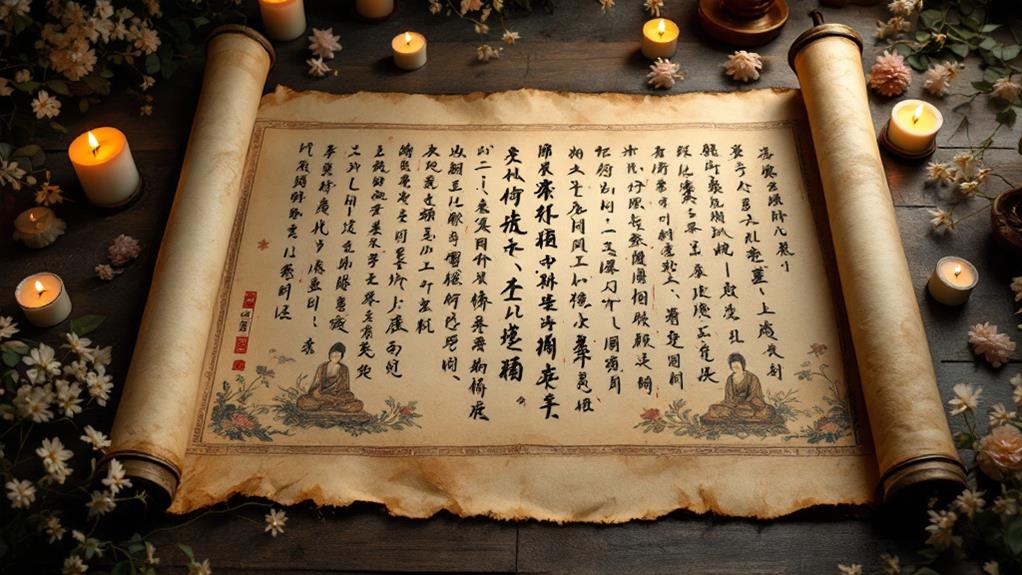
At the heart of the Diamond Sutra, you'll find profound philosophical themes that challenge conventional perceptions of reality and self. Central to its teachings is the emptiness concept, which posits that all phenomena lack inherent existence. This idea encourages you to see beyond surface appearances, cultivating wisdom by understanding that nothing is permanent or fixed.
The Sutra emphasizes non attachment teachings, urging you to let go of desires and ego-driven thoughts. By practicing non attachment, you can navigate life with a more balanced and peaceful mind, free from the burdens of clinging to transient things. This practice aligns with impermanence understanding, which reminds you that everything changes and nothing lasts forever.
Compassion practice is another core theme. The Sutra guides you to extend empathy and kindness to all beings, helping you along the enlightenment path. Through meditation techniques, you can deepen your awareness and welcome the duality perception, recognizing that opposites like self and other, or suffering and joy, are interconnected.
Ultimately, the Diamond Sutra invites you to cultivate wisdom, welcome compassion, and follow a path toward enlightenment, transforming your understanding of reality and self.
Impact on Buddhism
The Diamond Sutra has profoundly influenced Buddhism, shaping the way practitioners interpret and engage with its core teachings. It's not just an ancient text; it's a living, breathing guide that continues to impact diverse aspects of Buddhist life. Let's investigate how it's made its mark:
- Buddhist Practices: The Diamond Sutra's insights inform meditation methods, encouraging practitioners to examine the nature of reality beyond illusions.
- Textual Transmission: As the oldest known printed book, it transformed the way spiritual teachings were shared, leading to broader cultural exchange and access.
- Monastic Traditions: Within monasteries, the Sutra's ethical guidelines have guided monks in their daily lives, shaping communities that focus on mindfulness and compassion.
- Philosophical Debates: The Sutra's paradoxical ideas have fueled discussions on non-attachment and emptiness, challenging both laypeople and scholars to rethink conventional wisdom.
Preservation Through Time

Over centuries, the Diamond Sutra has been remarkably preserved, allowing us to glimpse into ancient wisdom. You might wonder how such an old manuscript has survived the test of time. It's all about careful manuscript conservation. Experts have dedicated countless hours to guaranteeing the text remains intact. They employ diverse techniques to stabilize and protect the fragile pages from further degradation. This process involves cleaning, repairing, and carefully storing the manuscript in controlled environments to prevent damage from light, humidity, and pests.
Besides physical preservation, digital archiving plays an essential role in safeguarding the Diamond Sutra for future generations. By creating digital copies, you can access the text without exposing the original to potential harm. Digital archiving not only preserves the content but also makes the Sutra more accessible to scholars and enthusiasts worldwide. This method guarantees the text's longevity by providing a backup that can be shared and studied without risking the original's integrity.
Through these efforts, the Diamond Sutra continues to captivate and educate, bridging the gap between the ancient world and our modern age. Without these preservation strategies, much of its wisdom could have been lost forever.
Cultural and Artistic Influence
Many might not realize the profound cultural and artistic influence the Diamond Sutra has had over the centuries. This ancient text is more than just a religious manuscript; it's a cornerstone of cultural symbolism and artistic representation. As you investigate its impact, you'll uncover how it has shaped diverse facets of art and culture.
- Artistic Representation: The Diamond Sutra has been a muse for countless artists. Its teachings inspire intricate paintings and sculptures that embody the essence of its messages.
- Cultural Symbolism: The text is imbued with symbols that convey deep philosophical meanings. You'll find these symbols echoed in traditional art forms across Asia, reflecting the Sutra's teachings.
- Literary Influence: The Sutra's poetic style and profound wisdom have influenced countless writers and poets, who weave its themes into their own works.
- Architectural Design: Temples and monuments often incorporate motifs from the Diamond Sutra, creating spaces that resonate with its spiritual teachings.
Modern Interpretations

While ancient texts often seem distant, the Diamond Sutra continues to find relevance in the present-day world through modern interpretations. You might be surprised to realize that scholars, spiritual seekers, and artists alike turn to this ancient Buddhist text for insights that speak to contemporary issues. Its teachings on impermanence and detachment resonate with the fast-paced, ever-changing world you navigate daily. However, interpreting the Diamond Sutra is not without its challenges.
One of the main interpretative challenges lies in translating its ancient wisdom into modern language and context. You might find that certain concepts, deeply rooted in Buddhist philosophy, require a shift in perspective to fully grasp. This text invites you to question your assumptions and see beyond the material world. By doing so, you reveal its contemporary relevance, offering guidance on mindfulness and inner peace.
Furthermore, artists and writers draw inspiration from the Sutra, incorporating its themes into their work, thereby keeping it alive and relevant. You, too, can investigate these interpretations, uncovering new ways the Diamond Sutra can enrich your life. Its teachings offer a timeless reflection on the human condition, reminding you of the power of simplicity and mindfulness.
Significance in Printing History
The Diamond Sutra holds a unique position in printing history as the oldest known printed book, transforming how knowledge was disseminated. Before its creation, information was shared orally or through handwritten manuscripts, which were time-consuming to produce. By utilizing woodblock printing technology, the Diamond Sutra paved the way for mass production of texts, making literary works more accessible and preserving their contents for future generations.
As you investigate its significance, consider these four key points:
- Revolutionary Printing Technology: The Diamond Sutra's use of woodblock printing marked the beginning of a new period in publishing, showcasing the potential of this technology to revolutionize information sharing.
- Cultural Transmission: By enabling the widespread distribution of Buddhist teachings, it played a crucial role in the dissemination of cultural and religious knowledge across Asia.
- Literary Importance: As a sacred text, the Diamond Sutra holds immense literary importance, influencing countless individuals and shaping philosophical thought.
- Historical Insight: Studying it provides valuable insights into the historical development of printing and the evolution of written communication.
Understanding the Diamond Sutra's impact on printing history highlights its enduring legacy and underscores the transformation it brought to the world of literature and beyond.
Related posts